
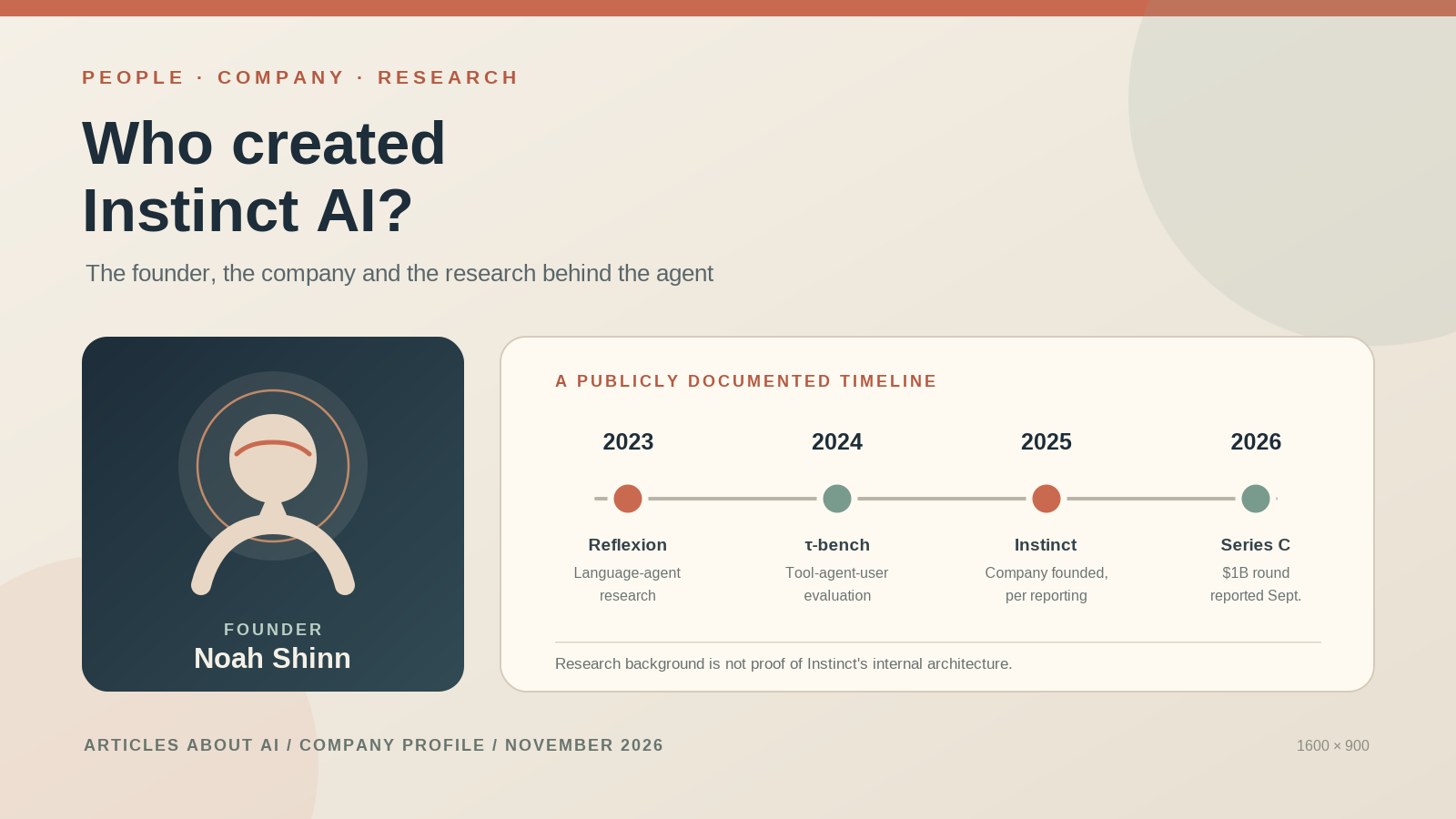
Instinct AI was founded by Noah Shinn and is operated by Spear Street Technology, Inc., a Delaware corporation headquartered in San Francisco. Shinn previously worked as an AI researcher at Sierra and co-authored research on language agents and tool-using systems. Those facts help explain the product’s research background—but they do not reveal the exact software architecture or the full team behind Instinct.
That distinction matters. A founder’s academic work is not automatically the blueprint for a commercial product, and a company’s funding announcements do not prove that its technology is reliable or widely available. This guide separates confirmed company information, Shinn’s documented research, and the parts of Instinct’s engineering that remain undisclosed.
For a product-level introduction, see What Is Instinct AI? How the Personal AI Agent Works. This article focuses on the people and company behind it.
Instinct AI: company and founder at a glance
| Question | What public sources establish |
|---|---|
| Who founded Instinct? | Noah Shinn is identified as the founder by Reuters and TechCrunch. |
| What company operates it? | Spear Street Technology, Inc. |
| Where is the company based? | San Francisco, California, according to its official Terms of Service. |
| When was Instinct founded? | Reuters and TechCrunch report that the startup was founded in 2025. |
| What did Shinn do before Instinct? | He worked as a research scientist at Sierra and previously conducted research at Northeastern and MIT. |
| What is known about its technology? | Instinct’s terms describe AI/ML functionality and the use of third-party large language models; its public site describes text and phone interaction and use of a phone and computer. |
| Is the full team public? | No complete team directory or detailed technical architecture was found in the public materials reviewed. |
The company’s own Terms of Service, last revised November 17, 2026, identify Spear Street Technology, Inc. as the provider of Instinct and describe it as a Delaware corporation headquartered in San Francisco. Reuters and TechCrunch independently identify Noah Shinn as the founder.
Who is Noah Shinn?
Noah Shinn is the founder associated with Instinct. Reuters described the startup as founded by Shinn in 2025, while TechCrunch’s August 26, 2026 report identified him as the founder leading the company.
Before Instinct, Shinn worked at Sierra, an AI company focused on customer-service agents. His own professional website describes him as a programmer and researcher and says he previously worked as a researcher at Sierra, where he joined as one of its first employees. The same biography says that, before Sierra, he worked on type prediction and code generation in Northeastern University’s Programming Language Group and on computational photochemistry research.
Sierra also has a Noah Shinn author profile, which identifies him as a research scientist and describes his earlier work at Northeastern and MIT. That profile is useful corroboration of his research background, although it should be read as a professional profile rather than a current company directory.
The relevant point is not his age or the attention around his fundraising. It is the sequence of work: academic research into language agents, applied agent evaluation at Sierra, and then a consumer product designed to take actions across everyday digital services.
What is Spear Street Technology?
Instinct is the product name. Spear Street Technology, Inc. is the legal company named in the service’s official terms.
The distinction is important when checking who provides the service, which entity is responsible for the terms, and where privacy or account questions should be directed. The current Terms of Service identify Spear Street Technology, Inc. as the provider of the website and AI-powered assistant. The Privacy Policy uses the same company name when explaining how user information is collected and processed.
The terms describe the corporation as a Delaware corporation with its headquarters in San Francisco, California. They do not describe Instinct as a Sierra product. Shinn’s previous employment at Sierra is part of his professional history; it is not evidence that Sierra owns, operates, or developed Instinct.
When was Instinct founded, and how did it grow?
Reuters and TechCrunch report that Instinct was founded in 2025. The service later became visible as an invite-only personal AI assistant, with TechCrunch reporting in August 2026 that it was still in private beta at that time.
The company’s fundraising attracted substantial attention:
- August 26, 2026: TechCrunch reported a $250 million Series B at a $2.5 billion valuation, co-led by Index Ventures and Benchmark, following earlier funding.
- September 28, 2026: Reuters and TechCrunch reported that Instinct raised a further $1 billion in a Series C round at a $10 billion valuation, with Sequoia Capital, Benchmark Capital, and Coatue participating.
These are reported financing figures, not measures of revenue, customer satisfaction, or task-completion accuracy. A high valuation can indicate investor confidence in the market opportunity; it cannot tell a user whether an agent will correctly book a ticket, protect an inbox, or complete a task without supervision.
For practical access and current cost information, see Is Instinct AI Free? Pricing, Availability, and Access Explained.
What is known about the Instinct team?
Public information about the people building Instinct is limited. TechCrunch described the startup as a small team led by former Sierra research scientist Noah Shinn. The company’s public website and legal documents identify the operating company, but they do not provide a complete list of executives, engineers, researchers, or co-founders.
That means it would be misleading to publish a speculative staff list or assign unverified titles. TechCrunch also reported that an Instinct bot had named another former Sierra employee as involved with the company, but the report explicitly said that involvement had not been confirmed. A chatbot response or social-media claim is not sufficient evidence to label someone a co-founder or executive.
The most defensible summary is therefore simple: Noah Shinn is the publicly identified founder; Spear Street Technology, Inc. is the legal operator; and a full, independently verifiable team roster has not been published in the sources reviewed.
What technology powers Instinct AI?
Instinct’s public materials describe what the product can do more clearly than how its internal software is built.
The official homepage presents Instinct as a personal assistant that users can text or call. It says the assistant can use a phone and computer in a way similar to a person. The official terms add a more technical description: Instinct uses artificial intelligence and machine-learning tools to generate responses and take actions, and third-party large language models may be incorporated into the service.
The terms also describe interaction with connected services and third-party websites, applications, and platforms. In practical terms, the product can be understood as a system that combines several layers:
- A language interface: The user describes a goal through a message or call.
- AI models: Models interpret the request and generate responses or instructions. The terms acknowledge the use of third-party large language models, but do not publish a complete provider list.
- Context and connected information: The service may use information the user supplies or makes available through connected accounts and conversations.
- Tools and external services: The agent can interact with websites, applications, and other services to attempt the requested task.
- Action and oversight: The service may take actions on the user’s behalf, while its terms place responsibility on the user to maintain meaningful oversight and review consequential actions.
This is a product-level explanation based on public documentation, not a reverse-engineered architecture diagram. Instinct has not publicly specified every model, orchestration layer, planning algorithm, browser-control component, evaluation system, or internal safety mechanism. It would be inaccurate to name a particular foundation model or claim that a specific research framework is running inside the product without a direct company disclosure.
For a closer look at the user-facing capabilities, read Instinct AI Features Explained: What Can the AI Agent Actually Do?. For a general explanation of the action cycle, see How Instinct AI Works: Understanding Personal AI Agents.
How Shinn’s research connects to personal AI agents
Shinn’s research background is relevant because it addresses two difficult problems for AI agents: learning from unsuccessful attempts and evaluating whether agents can use tools reliably over multi-step interactions.
Reflexion: learning from feedback
Shinn was the first-listed author of Reflexion: Language Agents with Verbal Reinforcement Learning, published as a NeurIPS 2023 paper. The research describes a method in which an agent turns feedback about a previous attempt into a written reflection, stores that reflection in an episodic memory buffer, and uses it to guide later attempts.
The paper’s idea is notable because it explores improvement through language feedback and memory rather than requiring the model’s weights to be updated after every failure. It is one contribution to the wider research field of language agents.
However, the Reflexion paper does not establish that Instinct uses the Reflexion framework. A founder’s earlier research can inform how they think about agent design, but a commercial product may use different models, techniques, or proprietary systems.
τ-bench: testing agents in realistic workflows
Shinn also co-authored τ-bench: A Benchmark for Tool-Agent-User Interaction in Real-World Domains, with Shunyu Yao, Pedram Razavi, and Karthik Narasimhan. The paper studies whether agents can interact with users, call tools, and follow domain-specific policies across multi-turn tasks.
One important contribution is the pass^k reliability measure, which looks at whether an agent can succeed consistently over repeated attempts rather than succeeding once by chance. The paper’s experiments highlight how difficult it is for agents to perform tool-based tasks reliably.
That problem is directly relevant to personal assistants. A system that can interact with a browser or a phone must do more than produce a plausible answer: it must select the correct action, respect constraints, handle exceptions, and verify the resulting state.
Again, τ-bench is evidence of Shinn’s research experience, not proof that Instinct uses the benchmark internally or has achieved a particular score on it.
Is Instinct a Sierra product?
No public source reviewed identifies Instinct as a Sierra product. The documented connection is that Shinn previously worked at Sierra as a research scientist. Instinct is operated by Spear Street Technology, Inc., according to Instinct’s own terms.
The distinction matters because people sometimes infer company ownership from a founder’s previous employer. A shared employment history does not establish shared ownership, product development, or corporate control.
What is confirmed—and what remains unknown?
| Topic | Publicly documented | Not established by the sources reviewed |
|---|---|---|
| Founder | Noah Shinn | A complete list of co-founders |
| Legal operator | Spear Street Technology, Inc. | A broader corporate ownership chart |
| Location | San Francisco headquarters in the official terms | A complete list of offices |
| Research background | Shinn’s Sierra work, Reflexion, and τ-bench | Whether those exact methods are used in Instinct |
| AI technology | AI/ML tools and third-party LLMs are referenced in the terms | Exact model providers, routing, and proprietary architecture |
| Team | A small team led by Shinn was described in reporting | A verified staff directory and complete leadership roster |
| Funding | Reported Series B and Series C rounds | Revenue, profitability, or independently audited usage metrics |
This is the most useful way to assess a fast-growing AI startup: distinguish official disclosures, independent reporting, academic research, and assumptions. The available evidence tells us who founded Instinct, which legal entity operates it, and some of the research background behind its founder. It does not reveal the complete internal engineering design.
Frequently asked questions
Who is the founder of Instinct AI?
Noah Shinn is identified as the founder by Reuters and TechCrunch. He previously worked as a research scientist at Sierra.
What company operates Instinct AI?
Instinct’s official Terms of Service identify Spear Street Technology, Inc., a Delaware corporation headquartered in San Francisco, as the provider of the service.
Was Instinct created by former Sierra employees?
The founder, Noah Shinn, previously worked at Sierra. Public reporting describes a small team led by Shinn, but the available official materials do not provide a complete, verified employee or co-founder list.
What AI model does Instinct use?
Instinct’s terms refer to AI and machine-learning tools and say third-party large language models may be incorporated. The company has not published a complete list of model providers or a detailed model architecture in the public documents reviewed.
Does Instinct use the Reflexion research framework?
There is no public confirmation that Instinct implements Reflexion. Noah Shinn co-authored the Reflexion paper, but that research connection should not be treated as a product architecture disclosure.
Is Instinct part of Sierra?
The sources reviewed identify Sierra as Shinn’s former employer and Spear Street Technology, Inc. as the company operating Instinct. They do not identify Instinct as a Sierra product.
Sources and further reading
- Instinct — Official Website
- Instinct — Terms of Service, revised November 17, 2026
- Instinct — Privacy Policy
- Noah Shinn — Professional Website
- Sierra — Noah Shinn Author Profile
- Reflexion: Language Agents with Verbal Reinforcement Learning — arXiv
- τ-bench: A Benchmark for Tool-Agent-User Interaction — arXiv
- TechCrunch — Instinct’s $350M Series B, August 26, 2026
- Reuters — Instinct’s $1B Series C, September 28, 2026
- TechCrunch — Instinct’s $1B Series C, September 28, 2026
- TechCrunch — Instinct’s early team and privacy reporting, August 24, 2026