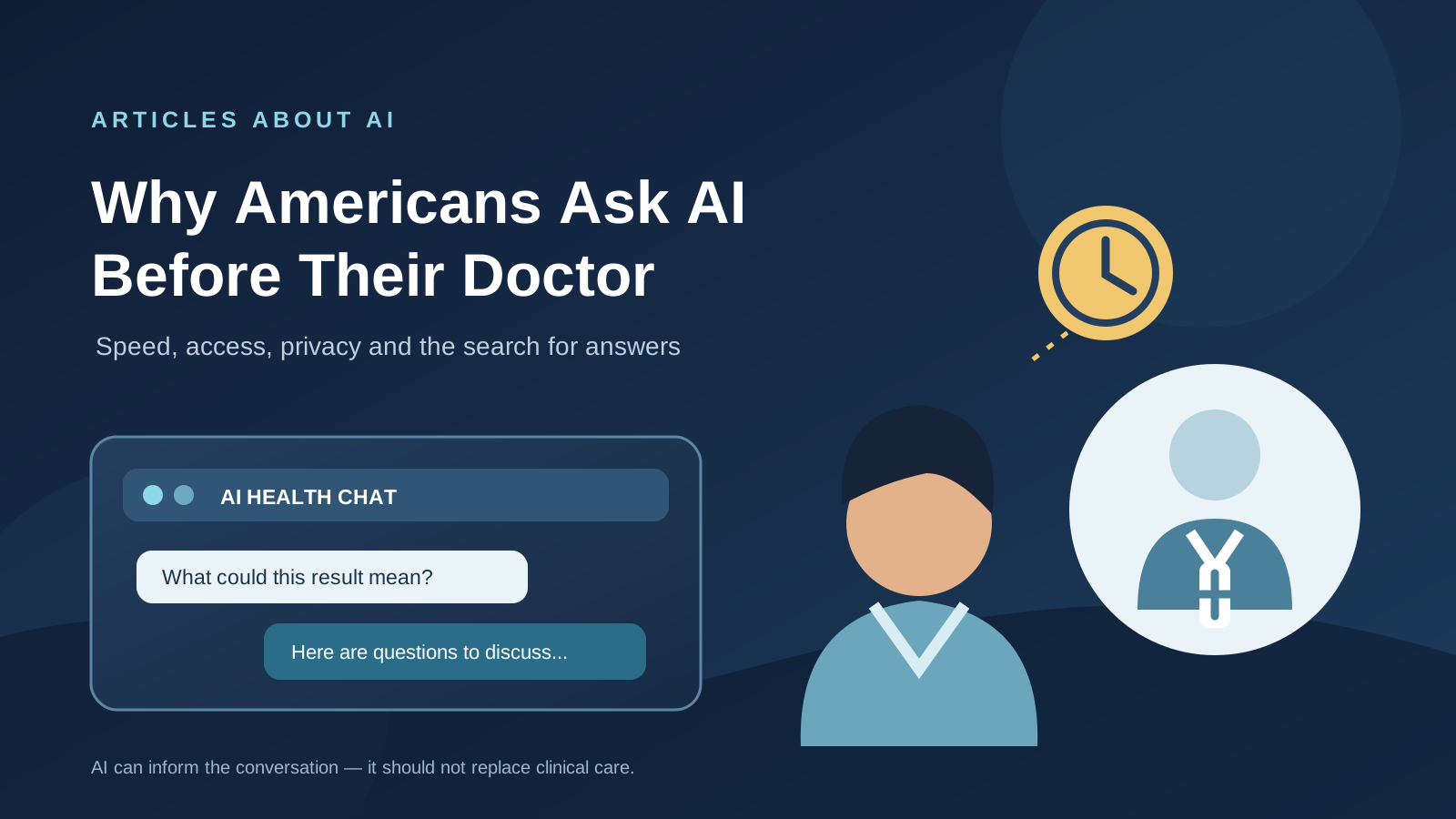
A growing number of Americans are turning to an AI chatbot when a health question comes up—sometimes before they call a doctor’s office, book an appointment, or speak with a clinician. They may want to understand a new symptom, make sense of a laboratory result, check what a diagnosis means, or simply get an answer outside normal office hours.
The appeal is easy to understand. An AI assistant is available on demand, responds in conversational language, and can feel less intimidating than discussing a sensitive concern with another person. For some people, it is also a way to look for information when healthcare is expensive or an appointment is difficult to obtain.
Recent U.S. surveys show that this behavior is no longer marginal. But the evidence also points to an important distinction: many people use AI to prepare for or supplement healthcare—not necessarily because they believe a chatbot can replace a doctor.
How many Americans use AI for health information?
Several surveys published in 2026 provide a picture of how quickly AI has become another source of health information. Their estimates differ because they ask different questions, use different survey periods, and define AI use in different ways.
A March 2026 KFF Tracking Poll found that 32% of U.S. adults had used AI chatbots for health information or advice in the previous year. That included 29% who had sought information about physical health and 16% who had used AI for mental health information; respondents could fall into both groups.
A separate Pew Research Center survey, conducted June 22–28, 2026, found that 34% of U.S. adults had used AI chatbots for at least one of eight specified health or medical reasons. Those reasons included getting quick information, exploring possible causes of symptoms, learning about treatments, and understanding test results.
The figures should not be treated as a direct trend comparison: the surveys used different question wording and measurement periods. Taken together, however, they show that AI chatbots have become a familiar part of how many Americans look for health information.
Sources: KFF’s 2026 poll on AI and health information and Pew Research Center’s study of why Americans use AI chatbots for health.
1. People want quick answers when a health question arises
Speed is one of the clearest reasons people turn to AI. A symptom or medical question can arise at night, during a weekend, or while someone is waiting for a call back. A chatbot can respond immediately, without requiring an appointment or a search through multiple websites.
In KFF’s March 2026 survey, 65% of people who had used AI for health information said that getting quick or immediate information or support was a major reason for doing so. This was the most frequently cited major reason in the poll.
Pew’s August 2026 research also found that getting health information quickly was a common motivation: 28% of U.S. adults said they had used AI chatbots for that reason.
An AI response can be useful as an initial explanation. It may define an unfamiliar term, summarize general information, or help someone identify questions to ask a clinician. But speed is not the same as accuracy. A fast answer can still be incomplete, outdated, or unsuitable for an individual’s medical circumstances.
The safest use of that convenience is to treat the chatbot as a starting point—not as a reason to postpone care when symptoms are concerning.
2. Healthcare can be expensive or difficult to access
AI use is not driven by curiosity alone. Some Americans turn to chatbots because seeing a healthcare professional may involve financial, practical, or scheduling barriers.
KFF found that 19% of people who had used AI for health information cited the cost of seeing a health professional as a major reason. Another 18% said not having a regular doctor or being unable to get an appointment was a major reason.
These barriers were more pronounced among younger adults in the survey. Among AI health users under 30, 29% cited the cost of care as a major reason, while 38% cited not having a regular provider or being unable to get an appointment. The results describe the experiences of survey respondents; they do not mean that AI can fill the role of a clinician.
Pew’s survey offers another view of the cost factor: 22% of U.S. adults said they had used AI chatbots to get health information at little or no cost.
This helps explain why a free or low-cost chatbot can seem attractive when a person is unsure whether a concern warrants an appointment. But an AI service cannot remove the underlying need for examination, testing, treatment, or follow-up. Nor can it guarantee that a person has correctly assessed the urgency of a symptom.
AI may make general information easier to access. It does not solve shortages of healthcare professionals, insurance gaps, high treatment costs, or delays in clinical care.
3. People use AI to understand what a doctor has already told them
Asking AI about health does not always happen before a medical appointment. Many people use chatbots after speaking with a healthcare professional because they want more time to understand unfamiliar terminology or remember what was discussed.
Pew’s August 2026 survey found that 22% of U.S. adults had used AI chatbots to learn more about a diagnosis from a doctor, while 20% had used them to help understand laboratory results. Another 22% said they had used chatbots to get information about treatments.
This points to a practical role for AI: translating complex language into a simpler explanation. For example, someone might ask what a medical abbreviation generally means, what a test measures, or what questions to raise at a follow-up appointment.
However, interpreting a test result is not just a matter of defining a number. Its significance can depend on the laboratory’s reference range, the reason the test was ordered, symptoms, medical history, medicines, and other results. A chatbot may explain general concepts, but it cannot reliably interpret every result in its full clinical context.
If an AI explanation appears to conflict with what a clinician said, take the question back to the clinician rather than asking the chatbot to decide who is right.
For a practical framework, see our guide to using AI to understand health answers and verify their reliability.
4. A chatbot can feel easier for sensitive or embarrassing questions
Some people find it easier to type a question into a private chat than to say it aloud. They may be worried about embarrassment, judgment, stigma, or not knowing how to describe a concern.
KFF’s March 2026 poll found that 36% of AI health users said feeling more comfortable looking up health topics privately was a major reason for using AI. Pew’s August survey found that 18% of U.S. adults had used chatbots to get health information about something they felt uncomfortable discussing.
This does not necessarily mean that users distrust doctors. It may mean they want to organize their thoughts before a conversation, understand basic terminology, or find the words to describe a sensitive issue.
A chatbot can help someone prepare questions, but it is not a confidential substitute for a healthcare professional. Privacy protections vary by product, account settings, and jurisdiction. Users should review the provider’s data policy before entering symptoms, diagnoses, medical records, or other sensitive details.
Avoid sharing unnecessary identifiers or uploading documents that contain personal information unless you understand how the service handles that data. For more on the limitations of AI health responses, read what AI can and cannot tell you about your symptoms.
5. People want to decide whether they need an appointment
A common question behind an AI health search is straightforward: “Should I see a doctor about this?”
KFF found that 41% of people who had used AI for health information said looking up information before deciding whether to see a provider was a major reason for doing so. Pew’s survey found that 15% of U.S. adults had used chatbots to help decide whether to go to a doctor.
This is an understandable use case, but it is also one of the riskiest. A general-purpose chatbot cannot reliably rule out serious conditions or determine that a symptom is safe to ignore. It may not ask the right follow-up questions, recognize the importance of a particular combination of symptoms, or know the person’s complete medical history.
AI can help someone write down what they are experiencing or prepare questions for a medical appointment. It should not be used as a gatekeeper that decides whether professional assessment is necessary.
If symptoms are severe, sudden, rapidly worsening, or potentially life-threatening, seek emergency medical care rather than waiting for a chatbot response. For non-emergency concerns that are persistent, worsening, or worrying, contact an appropriate healthcare professional.
6. Many people use AI alongside doctors, not instead of them
The phrase “asking AI before asking a doctor” can suggest that people are abandoning medical care. Survey findings show a more complicated picture.
A 2026 survey from the West Health-Gallup Center on Healthcare in America reported that 25% of U.S. adults had used an AI tool or chatbot for health information or advice. Among people who had recently used AI for health information, 59% said they used it to research on their own before visiting a doctor, and 56% said they used it to research after a visit.
The same Gallup report found that people also cited barriers and negative experiences: some recent users said they had used AI because they could not afford a doctor visit, could not access a provider, or had felt dismissed or ignored by a provider.
These results suggest that AI is often being fitted around existing healthcare experiences. People may use it to prepare for an appointment, understand a diagnosis afterward, or formulate a follow-up question.
That can be constructive when it improves a patient’s understanding and communication. It becomes more concerning when an AI response replaces needed evaluation, encourages someone to disregard professional advice, or creates false reassurance.
Read the West Health-Gallup report on Americans using AI to supplement healthcare visits.
7. The convenience comes with accuracy and privacy concerns
The reasons for using AI are practical, but convenience does not remove the risks.
A chatbot may produce a confident explanation that contains a factual error, omit an important warning, or provide a source that does not support its claim. The answer may also fail to account for age, pregnancy, existing conditions, allergies, current medicines, or other information that can change the appropriate medical advice.
Privacy is another concern. KFF reported that 77% of U.S. adults were concerned about the privacy of personal medical information provided to AI tools. Among people who had used AI for health information, 41% said they had uploaded personal medical information—such as test results or doctors’ notes—to an AI tool or chatbot.
Before sharing health information, check the service’s privacy policy and data controls. Do not assume that a consumer chatbot has the same confidentiality protections as a doctor’s office or an approved patient portal.
For a broader checklist, see five questions to ask before trusting an AI health answer. It covers evidence, source verification, relevance, uncertainty, and personal data.
What this means for patients and healthcare professionals
The rise of AI health questions reflects a demand for accessible explanations, timely information, and support navigating complex healthcare systems. It also shows that people want more opportunities to understand their own health.
For patients, a sensible approach is to use AI for general education and appointment preparation, then verify important claims with reliable medical sources or a qualified professional. Keep a record of questions and uncertainties rather than treating a chatbot’s answer as a diagnosis.
For healthcare professionals, AI use can be an opportunity to ask patients what tools they have consulted and what they understood from them. A non-judgmental conversation can help identify misinformation, clarify test results, and address concerns that might otherwise remain unspoken.
For technology providers, the findings underline the importance of transparent limitations, reliable source handling, privacy safeguards, and clear guidance about when users should seek professional care.
Frequently asked questions
Why do Americans ask AI about health before seeing a doctor?
Common reasons include getting quick answers, understanding symptoms or test results, looking up information before deciding whether to make an appointment, privacy, and the cost or availability of healthcare. Surveys from KFF and Pew in 2026 identify these as recurring motivations.
How many Americans use AI for health advice?
KFF’s March 2026 poll found that 32% of U.S. adults had used AI chatbots for health information or advice in the previous year. Pew’s August 2026 survey found that 34% had used chatbots for at least one of eight specified health or medical reasons. These are different measures and should not be treated as identical estimates.
Do people use AI instead of going to the doctor?
Some people may not follow up with a clinician after using AI, but survey evidence also shows substantial use around medical visits. West Health-Gallup reported that 59% of recent AI health-information users researched before a doctor visit and 56% researched after one. AI use does not, by itself, show that a person has replaced professional care.
Can AI interpret medical test results?
AI can explain general medical terms and what a test is commonly used to measure. It may not correctly interpret an individual result because clinical meaning depends on the person’s health, symptoms, medical history, laboratory reference ranges, and other findings. Ask the clinician who ordered the test to explain what the result means for you.
Is it safe to share medical information with AI chatbots?
It depends on the product and its data practices. Review the provider’s privacy policy, retention settings, and data-use controls before sharing sensitive details. Avoid uploading identifiable medical records unless you have confirmed that the service is appropriate for that information.
Can an AI chatbot tell me whether I need a doctor?
A general-purpose chatbot cannot reliably rule out an emergency or determine that professional care is unnecessary. Use it, at most, to prepare questions or understand general information. Seek urgent or emergency care for severe, sudden, rapidly worsening, or potentially life-threatening symptoms.
The bottom line
Americans ask AI about health because it is fast, accessible, conversational, and sometimes less expensive or less intimidating than navigating the healthcare system. They also use it to understand diagnoses, laboratory results, and treatment information—often around, rather than wholly instead of, a doctor’s visit.
The important question is not whether people will use AI for health information. They already do. It is whether they can use it without mistaking a fluent chatbot response for a clinical assessment. AI can help people become better prepared and better informed, but diagnosis, treatment decisions, and urgent medical assessment still require appropriate healthcare professionals.
Sources and further reading
- KFF — Poll: 1 in 3 Adults Are Turning to AI Chatbots for Health Information (March 25, 2026). National survey on use, motivations, healthcare access, and privacy concerns.
- Pew Research Center — From Diagnoses to Treatments, Why Americans Use AI Chatbots for Health (August 25, 2026). Survey of 3,488 U.S. adults conducted June 22–28, 2026.
- West Health-Gallup Center on Healthcare in America — Americans Turning to AI to Supplement Healthcare Visits (April 14, 2026). Nationally representative survey of more than 5,500 U.S. adults, conducted October 27–December 22, 2025.
- World Health Organization — Ethics and governance of artificial intelligence for health. Guidance on governance and risks associated with AI in health contexts.
- U.S. National Library of Medicine — MedlinePlus: Evaluating Health Information. Practical guidance for checking the reliability of online health information.
This article is for general educational purposes only. It is not medical advice and does not replace evaluation, diagnosis, or treatment by a qualified healthcare professional.