
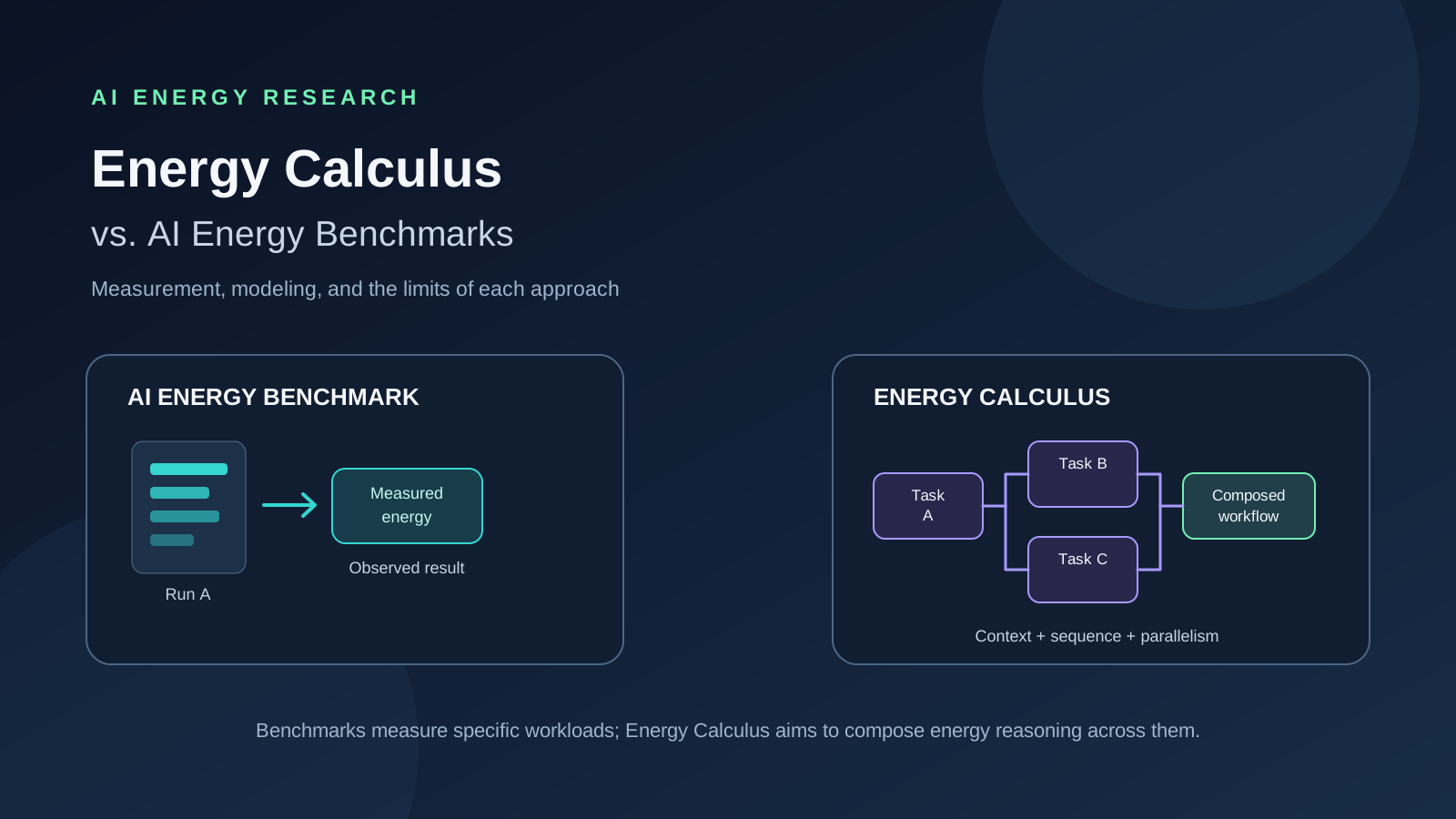
Energy Calculus and AI energy benchmarks address a shared problem—understanding the electricity consumed by computing—but they answer different questions. An energy benchmark measures a defined workload under stated conditions. Energy Calculus is a proposed mathematical framework for composing energy measurements across the stages and dependencies of a larger computational workflow.
That distinction matters when developers compare AI models, estimate the energy cost of a production service, or decide whether an optimization will remain effective after a workload changes. A benchmark can provide valuable empirical evidence, while Energy Calculus aims to help reason about how measurements from individual computational elements fit together.
The research paper Energy Calculus: A Compositional Algebra of Energy in Computational Systems was submitted to arXiv on July 13, 2026, by Mosharaf Chowdhury, Jae-Won Chung, Jeff J. Ma, Nishil Talati, and Ruofan Wu. It is a preprint, so its claims should be read as research proposals rather than as a universally validated production standard. On October 27, 2026, the University of Michigan also announced the DARPA-funded E-CALC project, which aims to develop tools for energy measurement and optimization across the machine-learning lifecycle.
This guide compares Energy Calculus with AI energy benchmarking, explains how they can complement one another, and gives developers a practical checklist for evaluating energy-efficiency claims.
Energy Calculus vs. an AI energy benchmark: the core difference
An AI energy benchmark is an empirical measurement process. Researchers or engineers run a specified model or task on particular hardware, with defined software and operating settings, and record energy use or related metrics. A benchmark can help compare runs, provided that the methodology and conditions are sufficiently consistent.
Energy Calculus approaches the problem from a different direction. It represents measurable computational elements with energy signatures, then uses composition operators to reason about sequential tasks, parallel tasks on the same device, and parallel tasks across devices. The goal is to model a workflow according to its execution structure rather than treat energy as one isolated number collected after the run.
In short, benchmarks measure specific executions; Energy Calculus aims to compose energy reasoning across executions and components. The framework does not make measurement unnecessary. Reliable measurements are an important input.
What AI energy benchmarks measure
AI energy benchmarks can answer practical questions when their methodology is transparent:
- How much energy did a particular model use during a defined inference workload?
- How did two models compare on the same hardware and task?
- What happened to energy consumption when batch size, sequence length, precision, or power limits changed?
- How much energy did a training run consume under a specified configuration?
- Did a software or hardware change improve energy per request, token, sample, or completed task?
The results are only meaningful when the units and boundaries are clear. Power is a rate, commonly expressed in watts; energy is accumulated over time, commonly expressed in joules or kilowatt-hours. A report that provides only peak power does not, by itself, establish total energy consumed.
A good AI energy benchmark should document the model version, workload, input and output sizes, accelerator and host hardware, software stack, power measurement method, warm-up procedure, run duration, and repeated-run variability. It should also explain whether the measurement includes the host CPU, memory, networking, cooling, idle baseline, or only the accelerator.
These details matter because AI energy consumption changes with workload shape and system conditions. A result from one GPU, model, batch size, or sequence length should not automatically be generalized to another.
What Energy Calculus adds
Energy Calculus is designed to describe energy as a compositional property of computation. Each energy element has an energy signature that can include execution time, static and dynamic energy, hardware operating point, execution context, and measurement uncertainty.
That context is important. Two operations that appear similar in source code may consume different amounts of energy when they run at different clock frequencies, memory states, thermal conditions, or levels of resource contention. Energy Calculus explicitly treats context-dependent interactions as part of the reasoning problem.
The paper describes three main ways to compose elements:
- Sequential composition: models tasks that execute one after another.
- Same-device parallel composition: models concurrent work sharing a device.
- Cross-device parallel composition: models work running in parallel across different devices.
These operators are intended to follow the structure of a computation, including workflows represented as directed acyclic graphs (DAGs). The framework also propagates measurement uncertainty and extends its reasoning to time–energy trade-offs, including Pareto frontiers.
The important qualification is that Energy Calculus is not simply a new leaderboard or a single score for ranking AI models. It is a proposed algebra for combining measurements and reasoning about their interactions. Its usefulness depends on the quality of the input measurements and on how well the modeled context captures the behavior of real hardware.
A practical example: measuring an AI inference service
Imagine an AI application that receives a request, preprocesses the input, runs model inference, and post-processes the output. A benchmark might measure the energy used by the entire request under a fixed configuration. That is useful for establishing a baseline.
Now imagine the team wants to change only the preprocessing stage, move one operation to another device, or run some work concurrently. The overall energy result may not equal a simple sum of separately measured components. Concurrent tasks can contend for compute, memory bandwidth, or power; hardware operating states can change; and the execution time of one stage can affect the behavior of another.
Energy Calculus is intended to help reason about these combinations by representing each measured element and its context, then composing the elements according to the workflow. It may help identify what must be measured again when a change alters the context enough to invalidate an earlier estimate.
This is a modeling approach, not a guarantee that a developer can accurately predict every production request from a few measurements. Real-world use still requires validation against end-to-end measurements and careful attention to uncertainty.
Side-by-side comparison
| Question | AI energy benchmark | Energy Calculus |
|---|---|---|
| Primary purpose | Measure a defined workload | Compose energy reasoning across computational elements |
| Main input | Executed workloads and measured energy | Energy signatures, context, execution structure, and uncertainty |
| Typical output | Energy and performance metrics for stated conditions | A composed model or estimate, including uncertainty and trade-offs |
| Handles workflow dependencies | Depends on benchmark design; end-to-end runs can measure a whole workflow | Explicitly models sequential and parallel composition |
| Compares models directly | Yes, when conditions and methodology are comparable | Not primarily a model leaderboard |
| Eliminates hardware measurements | No | No; reliable measurements are foundational |
| Evidence status | Depends on the benchmark’s published methodology and data | The cited Energy Calculus paper is a preprint proposing a framework |
| Main caution | Results may not generalize beyond the tested setup | Model assumptions and context must be validated against real executions |
The approaches are complementary. Benchmarks can provide the empirical measurements needed to characterize energy elements. Energy Calculus can then offer a way to reason about how those elements may combine in a more complex workflow. A sound evaluation should use both measurement and modeling rather than treat either as a substitute for the other.
How Energy Calculus relates to ML.ENERGY and Zeus
The University of Michigan team has described earlier work that targets related but distinct problems. ML.ENERGY is a benchmark initiative for measuring and comparing energy consumption across open-weight AI models and software frameworks. Zeus focuses on energy optimization for machine-learning training workloads, including tuning settings such as batch size and power limits.
Energy Calculus is aimed at a broader compositional question: how can energy behavior be represented and combined across computational elements and different parts of a workflow? These efforts should not be treated as interchangeable products. A benchmark provides measurements under its methodology; an optimizer searches for better operating settings; Energy Calculus proposes a mathematical structure for composing energy signatures and reasoning about context.
The October 2026 E-CALC project announcement describes a two-year, $1.83 million DARPA-funded effort involving the University of Michigan, the University of Illinois Urbana-Champaign, and BAE Systems. The project aims to build high-precision measurement tools combining physical sensors with software analysis and to release documentation and software openly. The announced ambition to reduce AI energy needs by up to half is a project goal—not proof that Energy Calculus has already cut energy consumption by 50% across AI workloads.
What Energy Calculus does not prove on its own
A mathematical framework can make assumptions explicit and improve how measurements are combined, but it does not automatically establish a real-world energy saving. Readers and engineering teams should keep several limits in mind.
It is not a measured energy saving by itself. A model or algebra is not evidence that a specific AI service uses less electricity. Claims about savings require experiments, baseline definitions, repeatable measurements, and workload-relevant comparisons.
It is not a universal ranking of AI models. Energy use depends on the task, input and output lengths, throughput target, hardware, software, and measurement boundary. A model that is efficient for one workload may not be best for another.
It does not remove measurement uncertainty. The paper makes uncertainty part of the energy signature and composition process. That is useful only if the underlying measurements and uncertainty estimates are credible.
It does not make context irrelevant. Hardware state and interactions between tasks can affect the result. If a proposed optimization changes those conditions, the team may need new measurements or a richer model.
It is not yet a substitute for independent validation. Because the cited paper is an arXiv preprint, engineering teams should watch for later peer-reviewed work, reproducible implementations, public datasets, and tests across diverse workloads before relying on the framework for high-stakes energy forecasts.
A developer checklist for evaluating AI energy claims
Whether you are reading a benchmark report or evaluating Energy Calculus, ask these questions before trusting a headline result:
- What exactly was measured? Identify whether the figure covers the accelerator, the whole server, the full workflow, or a larger facility boundary.
- Which energy unit is reported? Do not confuse watts with joules or kilowatt-hours.
- What workload was used? Record model version, task, input length, output length, batch size, throughput, and latency target.
- What hardware and software were involved? Note accelerator type, host, drivers, runtime, framework, precision, and power settings.
- Was the result repeated? Look for variability, confidence intervals, error bars, or another clear account of measurement uncertainty.
- Is the comparison fair? Models should be evaluated on comparable tasks and quality requirements, not just on raw speed or energy totals.
- Does the result generalize? A training benchmark, a short inference prompt, and a long-context production workload are different operating conditions.
- Was the modeled result validated end to end? For Energy Calculus, compare composed estimates with actual measurements of the complete workflow.
- Are savings measured or projected? Distinguish observed results from a project’s stated target or expected impact.
- Can another team reproduce the method? Prefer published protocols, accessible code, transparent hardware details, and clearly stated limitations.
This checklist is useful because energy efficiency is multidimensional. A lower-energy run may take longer, deliver fewer tokens per second, or produce different quality. Teams should select metrics that reflect their actual service goals, such as joules per request at a specified latency and quality target.
Why Energy Calculus could matter for AI sustainability
As AI systems expand from isolated experiments to production services, the energy cost of a complete workflow becomes more important. Data preparation, training, evaluation, deployment, and inference may use different hardware and execute under different constraints. Optimizing a single stage does not necessarily minimize the energy of the whole system.
Energy Calculus offers a way to formalize this systems-level problem. By representing energy measurements alongside execution context and uncertainty, it aims to make it easier to reason about interactions that are lost when energy is reduced to a single number. It could be useful for researchers comparing optimization strategies, infrastructure teams planning workloads, and developers assessing time–energy trade-offs.
But the practical impact will depend on evidence: reliable measurement tools, clear definitions, implementations that other researchers can inspect, and evaluations showing where composition improves estimates over simpler approaches. For now, Energy Calculus is best understood as a promising research framework whose real-world reach remains to be established—not as a completed solution to AI’s energy demands.
The bottom line
AI energy benchmarks and Energy Calculus answer different, complementary questions. Benchmarks show what a defined workload consumed under measured conditions. Energy Calculus proposes how those measurements can be combined to reason about larger workflows, parallel execution, context dependence, uncertainty, and time–energy trade-offs.
For developers, the most defensible approach is to measure the workload that matters, document the conditions, quantify uncertainty, and validate any composed estimate against end-to-end behavior. Energy Calculus may make that reasoning more systematic, but trustworthy energy claims still require reproducible measurements.
Sources and further reading
- Primary research paper: Energy Calculus: A Compositional Algebra of Energy in Computational Systems — arXiv. The paper describes the proposed algebra, energy signatures, composition operators, uncertainty propagation, and time–energy Pareto frontiers. It is a preprint.
- University of Michigan Engineering: Optimizing AI energy consumption throughout its entire lifecycle. Project details for E-CALC, its funding, collaborators, measurement-tool plans, and stated aims.
- University of Michigan Engineering: AI energy use: new tools show which model consumes the most power and why. Background on measuring AI energy consumption and the ML.ENERGY effort.
- University of Michigan Engineering: AI training energy reduced up to 50% with U-M software. Related work on training optimization; this is separate from the Energy Calculus framework and should not be conflated with E-CALC’s stated target.
Related guides on Articles About AI
- University of Michigan and DARPA’s Energy Calculus project: what it could mean for AI energy efficiency
- What Is Energy Calculus? How the Mathematical Framework Models AI Energy Use
- AI Data Centers and Electricity Bills: Why AI Power Demand Matters
- The Biggest AI Challenges in 2026: Risks and Solutions