
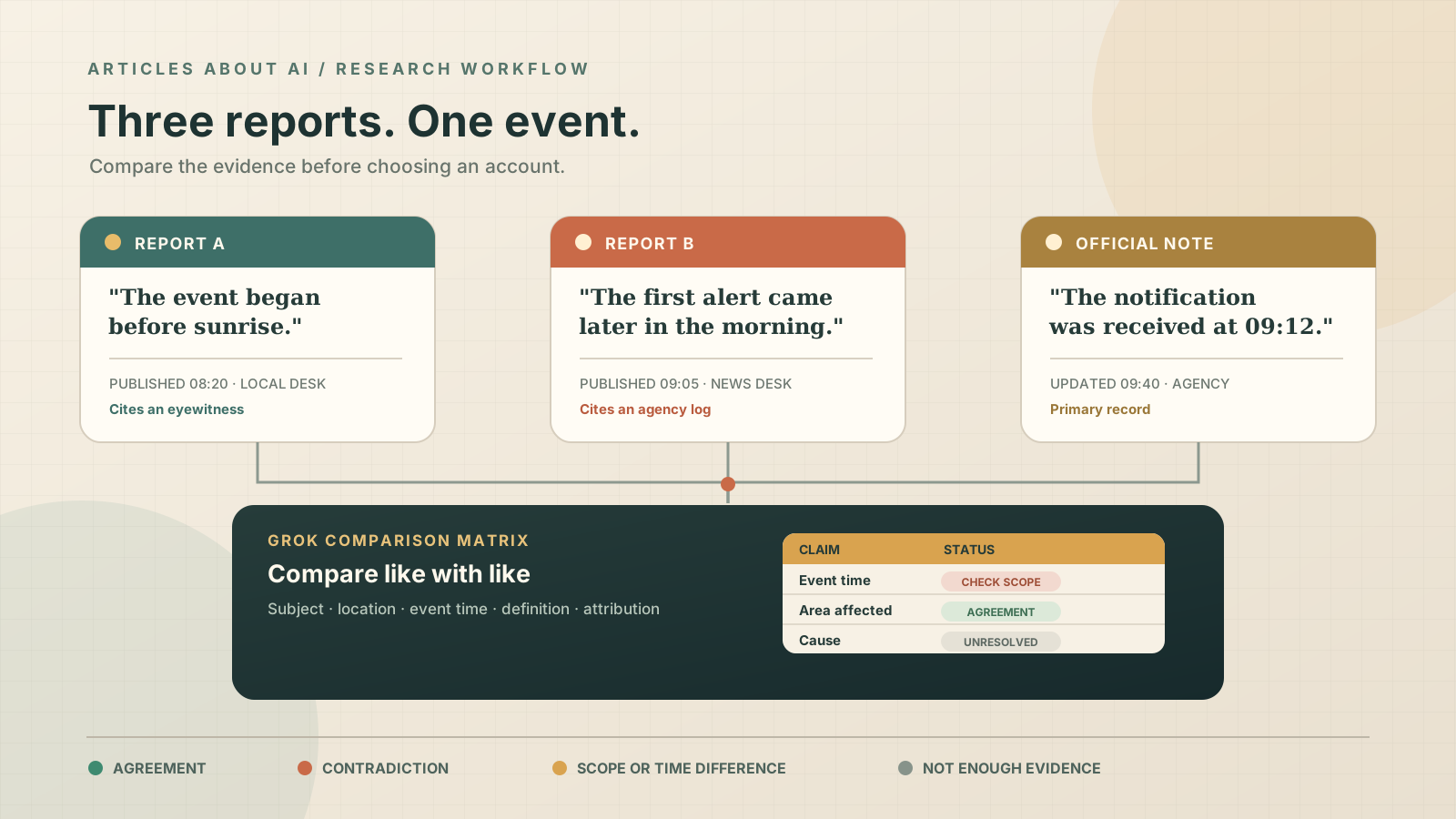
When a major event unfolds, different news organizations can publish accounts that appear to contradict one another. One report may describe an incident as having happened before dawn; another may give a later time. An official statement may report one number, while a newsroom cites a different figure from a witness or local authority. A headline may describe a decision as final even though the article says it is still under review.
Some differences are genuine contradictions. Others arise because the reports were published at different moments, use different definitions, cover different locations, or rely on sources with different access to the event. Reading the headlines side by side is rarely enough to tell which is happening.
Grok can help compare conflicting reports by collecting relevant coverage, extracting the claims each report makes, arranging those claims by topic and time, and identifying where the underlying evidence agrees or diverges. The useful result is not a verdict chosen by an AI model. It is a structured comparison that shows what each report actually says, which sources it relies on, and what remains unresolved.
This guide focuses on comparing multiple reports about the same event. It is different from checking whether one viral post is true or tracing a claim back to its earliest appearance. For those tasks, see our guides to using Grok to verify a breaking news claim and tracing a viral claim to its original source. Here, the goal is to make several accounts comparable without flattening their differences.
What Grok can contribute to a report comparison
Grok is available through X, and X’s Help Center says it can decide whether to search public X posts and conduct a real-time web search when responding. That can be useful when an event is being discussed by newsrooms, public agencies, companies, witnesses, and people close to the story.
The current xAI developer documentation describes two distinct search tools:
- Web Search lets an application using Grok search and browse web pages. The API documentation describes domain filters that can restrict searches to selected websites.
- X Search can search public X content by keyword or meaning, find users, and retrieve a post together with its thread.
These are documented API capabilities. They should not be treated as a promise that every filter, control, or search option appears in every consumer version of Grok. In the Grok app, the exact search behavior and interface can vary. You can still ask for a comparison and request direct links, but you should inspect the results yourself.
Start with the official documentation: X Help Center: About Grok, xAI Web Search, and xAI X Search.
For this task, Grok is most useful as a research organizer. It can help you find reports that address the same event, extract claims from each report, separate a source’s own observations from its attributions, build a chronology, identify shared sources, and create a comparison matrix. It cannot establish that a report is accurate simply because it found the page, summarized it fluently, or attached a citation.
X itself warns that Grok may provide factually incorrect information, summarize material incorrectly, or miss context, and recommends independent verification. Treat that warning as part of the workflow, not as a footnote.
Step 1: Define the event and the comparison question
Before searching, define exactly which event you want to compare. A broad prompt such as “Compare reports about the crisis” can mix different incidents, locations, dates, and phases of a developing story.
Write a short event brief with the event or incident, its location, the date or time window, the people or organizations involved, and the specific questions on which reports appear to differ.
For example, you might compare reports about the time a transport service was suspended, the number of locations affected by a power outage, the status of a court ruling, or the sequence of events during a public announcement. These are illustrative research questions, not claims about a particular current event.
Separate the questions instead of asking Grok to compare everything at once. A report may agree with another on the location but disagree on the start time. It may confirm that an agency issued a statement while interpreting the consequences differently. Those are separate comparison dimensions.
Prompt for Grok:
I want to compare news reports about this event:

Event: [brief description]
Location: [place]
Date or time window: [date or range]
People or organizations involved: [names]

First, restate the event boundary in one paragraph. Then list the specific factual questions that can be compared across reports. Do not decide which account is correct yet. Flag any ambiguity that could cause reports about different events or time periods to be mixed together.
If the event brief contains an uncertain date or location, keep that uncertainty visible. Do not let the model silently turn an approximate description into a precise one.
Step 2: Gather a balanced set of reports
Ask Grok to search for coverage from several relevant types of sources. A useful comparison set may include local reporting, national or international news organizations, official statements, specialist publications, and direct documents. The right mix depends on the event.
Prompt:
Find reports about [event] from different news organizations and relevant primary sources. Include local reporting where available, established national or international outlets, and statements or documents from the organizations directly involved.

For every result, provide:
- Direct URL and publisher
- Headline
- Displayed publication date and time, if available
- Displayed update date and time, if available
- Named sources or documents cited
- Whether the report appears to contain original reporting or mainly repeats another source

Do not rank reports by popularity. Do not treat search-result order as proof of reliability. Exclude results about a different event and explain why.
When using X, search for more than one phrase. Try the event name, location, agency name, a distinctive phrase from a report, and the names of people directly involved. X’s search guidance describes keyword and hashtag searches and provides filters such as Top, Latest, People, Photos, Videos, News, and Broadcasts. Its advanced search can narrow results by words, accounts, places, and dates.
Use the Latest view when you need to understand the sequence of posts, but do not assume that the earliest result you can see is the first post ever made. Search visibility is not a complete archive. Use Top only to discover prominent discussion, not as an evidence ranking.
For API users, xAI’s X Search documentation describes keyword search, semantic search, user search, and thread retrieval. It also documents date and account restrictions for search calls. Those controls are part of the developer API, not necessarily the consumer Grok interface.
Step 3: Preserve each report as a separate source
Do not ask Grok to merge the articles into one narrative immediately. First create a source register. This prevents a summary from blending details from one report into another.
| ID | Publisher | Report | Published | Updated | Main source types |
|---|---|---|---|---|---|
| R-01 | Outlet A | Report title | Time shown | Time shown or unknown | Named official, document |
| R-02 | Outlet B | Report title | Time shown | Time shown or unknown | Reporter on scene, witness |
| R-03 | Agency C | Official statement | Time shown | Time shown or unknown | Agency statement |
| R-04 | Outlet D | Follow-up report | Time shown | Time shown or unknown | New interview, earlier report |
The labels above are placeholders. Replace them with real publisher names, URLs, and dates. Keep the original URL for every source, and save a copy or note the access date if the story is likely to change.
Ask Grok to extract the main claims from each report independently:
Review each source separately. For every report, extract the factual claims it makes about the event. Record the exact wording or a short faithful paraphrase, the paragraph or section where it appears, the person or organization to whom the claim is attributed, and any qualification in the same report.

Keep each report separate. Do not combine details from different publishers. If a report does not address a question, mark it "not stated" rather than filling the gap from another source.
This stage should produce a claim inventory, not a verdict. If a report says that officials confirmed a service had resumed, record who the officials were and what exactly they confirmed. Do not rewrite it as “the service resumed everywhere” unless the source says that.
Step 4: Normalize the claims before comparing them
Two reports can use different language while describing the same fact. They can also use similar words while referring to different facts. Before asking Grok to identify contradictions, make sure the claims are being compared on the same terms.
For each claim, identify:
- Subject: who or what the statement concerns.
- Action or condition: what is said to have happened.
- Location: the exact place or area covered.
- Time: when the event occurred, not merely when it was reported.
- Quantity: the number, unit, and population being counted.
- Status: confirmed, planned, estimated, alleged, or still under review.
- Attribution: who is making the statement and how the report obtained it.
Consider two hypothetical reports. One says that services were suspended in the central district. Another says that the entire network remained operational. They may look contradictory, but the second may refer to the network outside the central district. The subject and geographic scope are different.
Likewise, a report published at 09:00 may describe a situation that changed by 11:00. The later report is not necessarily correcting the earlier one; it may be describing a later state of the event.
Prompt:
Normalize these claims without changing their meaning. For each one, identify the subject, action, location, event time, quantity and unit, status, and attributed source. Flag terms that are undefined or used differently across reports. Do not label any claims contradictory until their scope and time frame are comparable.
If a key term is ambiguous, preserve the original wording and add a note. Do not force two claims into the same category just to make a table easier to read.
Step 5: Build a side-by-side comparison matrix
Once the claims have been normalized, ask Grok to compare the same question across the source register. The matrix should show both agreement and disagreement.
| Comparison question | Report R-01 | Report R-02 | Report R-03 | Initial assessment |
|---|---|---|---|---|
| When did the event begin? | Time stated by source | Different time stated | Not stated | Needs timeline check |
| Which area was affected? | Area A | Areas A and B | Area A only | Scope differs |
| How many people were affected? | Figure and attribution | Different figure and attribution | No figure | Definitions may differ |
| What caused the event? | Cause attributed to source | Cause described as unknown | No cause stated | Not established |
| What is the current status? | Status at publication | Later status | Official status update | Compare update times |
The entries are illustrative. A real matrix must be populated from the linked reports, not from invented example findings.
Prompt:
Compare the normalized claims in source register R-01 through R-[N].

Create a matrix with one row for each factual question and one column for each report. For every cell, quote or accurately paraphrase only what that report states and include its source ID. Use "not stated" where the report is silent.

In a separate assessment column, classify the relationship as:
- Agreement
- Direct contradiction
- Difference in scope or definition
- Difference in time or update stage
- Different attribution
- Unresolved or insufficient information

Explain the reason for each classification. Do not select a winning report at this stage.
The matrix is the central working document. Keep the source IDs and links attached to the cells so a reviewer can return to the exact passage. A comparison table without traceable references can make a mistaken paraphrase look authoritative.
Step 6: Distinguish a real contradiction from a reporting difference
A contradiction exists only when two claims address the same question, subject, place, time frame, and definition but assert incompatible facts.
Different publication times
A first report may describe what was known at 08:30. A follow-up at 10:45 may include a new official statement. Record both publication times and any update times. The later report may supersede an earlier figure without proving that the earlier report was unreasonable when it was published.
Different event times
A report may give the time a witness first noticed an incident; another may give the time an agency received a call. Both can be accurate because they describe different milestones. Ask what each timestamp represents.
Different geographic scope
“Several neighborhoods” and “the whole city” are not interchangeable. Check whether a report covers one district, the municipality, a wider region, or the full service area.
Different definitions or units
A figure for people evacuated is not the same as a figure for people affected. A count of confirmed cases is not the same as an estimate of suspected cases. A total that includes temporary closures may differ from one that counts permanent closures.
Different levels of certainty
“Officials are investigating a possible cause” does not contradict “the cause has not been established.” One describes an investigative lead; the other describes the current evidentiary status.
Different attribution
“Police said the road was closed” and “a witness said the road was open” are claims about what two sources reported. They are not automatically proof that one of the underlying statements is false. The time and location of each observation matter.
Different editorial emphasis
A headline may emphasize the most dramatic detail while the body contains important qualifications. Compare the article text and its cited evidence, not just the headline.
Prompt:
Review every pair marked as a possible contradiction. Test whether the statements refer to the same subject, location, event time, quantity, definition, and status. Explain whether the conflict is genuine or can be reconciled by a difference in scope, timing, terminology, or attribution. If the available reports do not resolve it, retain the label "unresolved."
Do not let Grok remove a contradiction merely because a plausible explanation can be imagined. A reconciliation needs evidence. If no source establishes why the reports differ, record the possible explanation as a hypothesis, not as a finding.
Step 7: Map which reports rely on the same underlying source
A comparison becomes misleading when repeated coverage is mistaken for independent confirmation. Five outlets may publish the same number because all five cite one government statement. They are five publications, but not five independent sources for that number.
Ask Grok to trace the source relationships:
For every important claim, map the evidence chain behind each report. Identify whether the report relies on:
- Its own reporter's observation or interview
- A named eyewitness
- An official statement or document
- A press release or briefing
- A wire-service report
- Another news organization
- An anonymous source
- An unverified social post

Identify reports that share the same underlying source. Do not count copied or syndicated coverage as independent corroboration. If the origin of a claim is unclear, mark it unknown.
A source-dependency table can make the relationships visible:
| Report | Immediate source cited | Underlying source | Independent evidence? |
|---|---|---|---|
| R-01 | Agency statement | Agency C | No separate corroboration shown |
| R-02 | Reporter interview | Named witness | Potentially independent |
| R-03 | Wire report | Same agency statement as R-01 | No |
| R-04 | Original document | Published record | Direct documentary source |
These are example rows, not findings. In a real comparison, inspect the cited links and the wording of each article.
A primary source is not automatically neutral or complete. An agency statement is primary evidence of what the agency announced. It may not independently prove every detail about the event. A company statement is direct evidence of the company’s position, not necessarily independent confirmation of its performance claims. Attribute each statement to the organization that made it.
The Associated Press’s published standards are useful here. AP says that information from the internet must be vetted and attributed to the original source, and that anything reasonably open to dispute should be attributed. Its guidance also emphasizes explaining the credibility of sources and the provenance of documents. See AP’s Telling the Story standards.
Step 8: Check the strongest evidence behind each disputed detail
After the comparison matrix reveals where reports differ, investigate only the disputed details that matter. Do not ask Grok to decide which outlet is more trustworthy in general. Ask what evidence supports the specific statement.
For each disagreement, look for the most direct available record: an official statement, filing, order, or public notice; a transcript, recording, or complete video; a dataset or published measurement; a direct interview or eyewitness account with clear attribution; a correction or update issued by the original publisher; or a separate report based on independent reporting.
Ask Grok:
For the disputed point [describe it], locate the most direct primary source available. Give the original URL, issuing organization or creator, publication date, and the exact passage or section relevant to the point. Explain what the source establishes and what it does not establish. Distinguish an original document from a news report that merely quotes or summarizes it. If no direct source can be located, say so.
Open the source yourself. Check that the link leads to the cited document and that the relevant passage actually supports the description. A source can be real but irrelevant, outdated, or narrower than the claim made about it.
If the disagreement depends on a technical term, consult the organization responsible for that term or the underlying dataset. If it depends on a legal decision, locate the decision or official docket. If it depends on a scientific measurement, check the study, data release, or institution that produced it. A general search summary is not a substitute for the record.
Step 9: Produce a careful comparison brief
The final output should not be a single blended story that hides uncertainty. It should tell the reader which details are consistently reported, which are disputed, and why the differences remain.
Prompt:
Prepare a concise comparison brief based only on the source register and verified evidence in this conversation.

Use these sections:
1. Event scope and time window
2. Points of agreement across the reports
3. Genuine contradictions, with the conflicting statements and source IDs
4. Differences explained by timing, scope, definitions, or attribution
5. Shared or dependent sources that should not be counted as independent
6. Primary evidence located and what it establishes
7. Important facts that remain unknown
8. Corrections or updates that changed the reporting

Attribute disputed claims to the publisher or named source. Do not write a definitive conclusion where the evidence is incomplete. End with the date and time at which the comparison was last checked.
Review the brief against the original reports. Make sure that a statement attributed to one outlet is not accidentally assigned to another. Confirm every number, date, name, and quotation. If a report has been updated since the comparison began, revise the register and rerun the affected rows.
A reusable Grok prompt for comparing conflicting reports
For a complete first pass, replace the bracketed fields in this prompt:
Act as a careful research assistant. Compare reports about the same event without assuming that one publisher is correct.

EVENT: [event]
LOCATION: [location]
TIME WINDOW: [date or range]
REPORTS: [paste URLs]

First, confirm that every report concerns the same event. Create a source register with publisher, headline, publication time, update time, and cited sources. Extract each report's factual claims separately. Normalize claims by subject, location, event time, quantity, definition, status, and attribution.

Then create a side-by-side comparison matrix. Classify each difference as agreement, direct contradiction, scope or definition difference, timing or update difference, attribution difference, or unresolved. Map shared sources so repeated coverage is not mistaken for independent confirmation.

For each material disagreement, search for the most direct primary source and provide its original URL and relevant passage. Explain what it proves and what it does not prove.

Do not invent sources, quotations, dates, or evidence. Do not infer that a claim is true because several reports repeat it. If a source is inaccessible, a date is missing, or a point cannot be resolved, state that limitation. Keep facts, source claims, and your interpretation in separate columns. Provide a last-checked timestamp.
For a long event with many updates, do not try to compare every article in one enormous prompt. Work in batches, preserve the source IDs, and ask Grok to merge only the verified comparison records. This makes it easier to spot missing links and correct a mistaken extraction.
How to judge the result without treating Grok as the editor
A useful comparison should leave you with a better map of the evidence, not simply a confident-sounding winner. Apply these checks before relying on the output:
- Traceability: Can every important statement be followed to a specific report, document, or source?
- Comparability: Are the statements about the same time, place, quantity, and definition?
- Independence: Do the reports add separate evidence, or repeat one underlying source?
- Attribution: Is it clear who made each disputed claim?
- Completeness: Have you checked corrections, updates, and relevant qualifications?
- Uncertainty: Does the comparison preserve unanswered questions instead of filling them with guesses?
Avoid asking Grok to assign an overall credibility score to each publisher. Reliability is claim-specific. A publication may have direct reporting on one aspect of an event and rely on a secondhand statement for another. Evaluate the evidence behind the claim, not only the brand name.
Also avoid treating a source count as a vote. Three reports that repeat one press release do not outweigh one original court document. Equally, an official statement may be the best record of what an agency announced while still leaving a factual question unanswered. The evidence type must match the question.
Important limitations and privacy considerations
Search coverage is incomplete. Public X posts may be missing, filtered, deleted, protected, or difficult to locate. Search results can surface reposts and commentary before original reporting. A report may be updated without every downstream copy being corrected. Grok can misread a date, merge details from separate stories, or generate a plausible but unsupported explanation for a discrepancy.
The X Help Center explicitly recommends independent verification of Grok’s answers. Treat its summaries as leads. Open the source, inspect the relevant passage, and record any limitation.
Be careful with sensitive information. A public event may involve victims, private individuals, medical details, or unverified allegations. Do not paste confidential documents, private contact information, or sensitive personal data into an AI conversation. Use only information you are authorized to process, and avoid reproducing unnecessary personal details in a comparison brief.
For a more detailed claim-by-claim verification process, continue with How to Use Grok to Verify a Breaking News Claim. If the main difficulty is identifying where a viral statement originated, use How to Use Grok to Trace a Viral Claim Back to Its Original Source. If you need to extract evidence from a large collection of source documents rather than news articles, see How to Use Claude to Extract Evidence from a Collection of Documents.
Frequently asked questions
Can Grok compare two news articles directly?
Yes. You can provide both article URLs and ask Grok to extract their claims, compare the same factual details, and show where the accounts agree or differ. For a reliable result, ask it to keep the reports separate, provide source links, record publication and update times, and distinguish direct contradictions from differences in scope or timing. Check the cited passages yourself.
Does Grok search both X and the web?
X says Grok can decide whether to search public X posts and conduct real-time web searches when responding. xAI also documents separate X Search and Web Search tools for API developers. The controls available in the consumer app can differ from those documented for the API.
How can I tell whether two reports are independent?
Inspect the sources each report cites. If both repeat the same agency statement, wire story, anonymous source, or social post, they may not provide independent confirmation of the underlying fact. Look for separate interviews, original documents, direct observation, or independently gathered data.
What if two reports give different numbers?
First check what each number measures, the unit, the geographic scope, the time of the estimate, and who supplied it. One figure may be preliminary while another is a later update. If the definitions and time frames match but the numbers remain incompatible, keep the discrepancy unresolved until stronger evidence is available.
Should I trust the report with the most citations?
No. Citation quantity is not the same as evidence quality. A report with many links may repeat the same underlying source. Examine whether each source is relevant, direct, independent, current, and accurately represented.
Can Grok decide which news organization is telling the truth?
It can help organize evidence and identify inconsistencies, but it should not be treated as the final editor or arbiter. The answer depends on the original records, source independence, accurate attribution, and the context of each report. If the evidence is incomplete, the responsible conclusion is that the issue remains unresolved.
The goal is a clearer record, not a forced verdict
Comparing conflicting reports with Grok works best when the task is broken into stages: define the event, preserve each report, extract claims separately, normalize the details, build a comparison matrix, map shared sources, and inspect the strongest evidence behind each disagreement.
That process can reveal whether two accounts genuinely conflict or merely describe different moments, places, definitions, or sources. It can also show where several reports depend on the same original statement and where important questions remain unanswered.
Use Grok to organize the research and expose the gaps. Keep the original reports and documents as the evidence. A careful comparison is valuable precisely because it can say what is known, what is disputed, and what cannot yet be established.