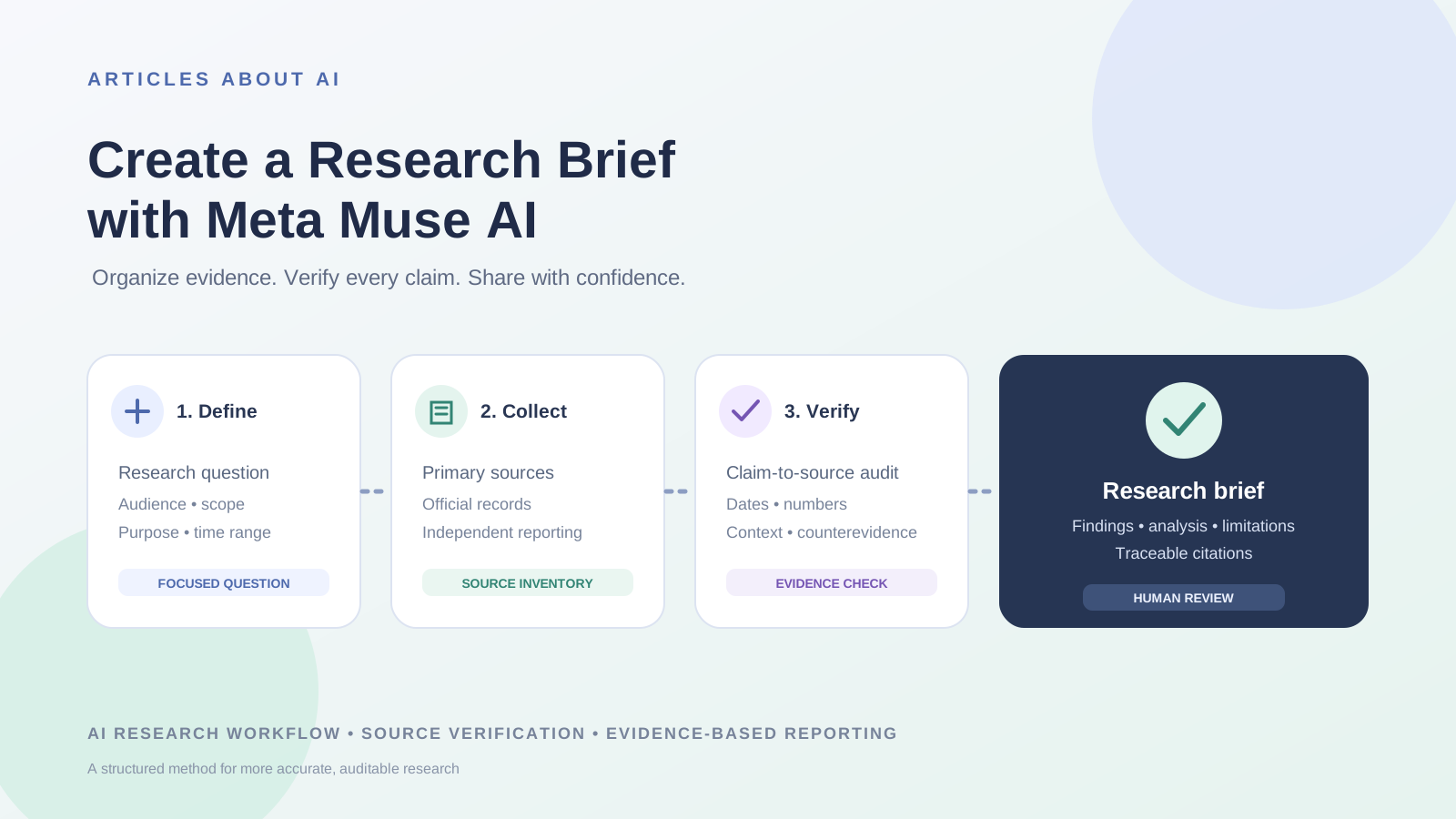
A useful research brief is more than a polished summary. It gives readers a clear answer to a defined question, shows where the evidence came from, distinguishes established facts from interpretation, and makes important gaps visible. Meta Muse AI can help organize a multi-step research task and draft a structured document, but you must verify the sources and claims before relying on the brief.
Meta describes Muse as a personal AI agent that can browse the web, work across multiple steps, create documents, and continue working on tasks in the background. Those published capabilities make it a possible assistant for preparing a research brief. They do not guarantee that every source it finds is relevant, every citation is accurate, or every conclusion is sound. This article presents a repeatable workflow; it is not a report of a live accuracy test of Muse.
What is a research brief?
A research brief is a concise, evidence-led document that answers a specific question for a particular reader or decision. Unlike an open-ended essay, it has a defined scope and makes the supporting evidence easy to inspect.
A practical research brief usually contains:
- Research question: the exact issue the brief is intended to answer
- Executive summary: the main findings in a few concise points
- Scope and method: what was examined, which period or market was covered, and what was excluded
- Key findings: factual statements supported by traceable evidence
- Analysis: what the findings may mean, clearly separated from the facts
- Limitations and open questions: missing data, conflicting sources, and unresolved uncertainty
- Sources: titles, publishers, dates, URLs, and the claims each source supports
If you are starting with a broad topic, first read our guide to researching a topic with Meta Muse AI and verifying every source. This article focuses on turning research into a concise brief and auditing its accuracy.
Step 1: Define the question, reader, and decision
The quality of the brief depends on the question it is designed to answer. Avoid prompts such as “Research artificial intelligence” or “Tell me about the market.” They invite broad summaries without a clear standard for deciding what belongs in the final document.
Define five things before asking Muse to begin:
- Question: What specific issue must the research answer?
- Audience: Is the brief for a manager, researcher, customer, student, or general reader?
- Purpose: Is it intended to explain a topic, compare options, assess a claim, or support a decision?
- Scope: Which geography, industry, organizations, and time period matter?
- Output: How long should the brief be, and should it include a timeline, table, recommendations, or appendices?
For example, replace “Research AI adoption” with: “Prepare a two-page brief on how publicly documented AI agents are being adopted in customer support by large retailers, using sources published from January 2025 through October 2026. Separate announced deployments from independently measured outcomes.”
A scoped question makes it easier to detect missing evidence and irrelevant sources.
Step 2: Ask Muse to build an evidence plan first
Do not ask for the finished brief in the first prompt. Ask for a research plan and source inventory before drafting. This creates an opportunity to correct the scope and reject weak sources early.
Copy-and-use prompt: research plan
I need a research brief about [specific topic] for [intended audience and purpose].
The research question is: [write one precise question].
Scope: [geography, organizations, subject boundaries, and date range].
Before writing the brief, create a research plan. Break the question into smaller answerable subquestions. For each subquestion, identify the kinds of evidence needed and search for relevant primary sources first, such as official documentation, original research, regulatory records, datasets, company filings, or direct statements.
Then identify reputable independent sources that can provide context or challenge important claims. Return a source inventory with the exact title, publisher, URL, publication date, source type, relevant passage or section, and the specific question or claim the source may support.
Do not draft conclusions yet. Flag inaccessible links, missing evidence, duplicate coverage, and questions that cannot currently be answered. Do not invent sources, quotations, dates, or statistics.
Review the plan before moving on. Remove sources that do not address the question, request alternatives for weak evidence, and add missing subquestions.
Step 3: Collect primary and independent sources
A reliable research brief needs more than a long bibliography. It needs sources that are appropriate to the claims being made.
Primary sources are closest to the underlying event or data. Depending on the subject, they may include:
- Original academic papers and research datasets
- Official product documentation and release notes
- Government reports, legislation, regulatory filings, and public records
- Company annual reports, investor presentations, and official announcements
- Full transcripts, speeches, interviews, and original survey results
Independent sources can provide analysis, scrutiny, and context. Look for reputable reporting, specialist publications, independent research organizations, and subject-matter experts. Check whether multiple articles rely on the same press release or study; repetition is not independent corroboration.
Ask Muse to label the source type and explain the relevance of each item. A company announcement can confirm what a company announced, but it may not independently establish that a product performs as advertised.
For a company-focused assignment, our guide to researching a company with Meta Muse AI using official sources explains how to work with investor-relations pages, filings, and corporate announcements.
Step 4: Build a claim-to-evidence matrix
Before writing prose, turn the source list into a claim-to-evidence matrix. This is one of the most useful checks against unsupported statements.
| Draft claim | Evidence required | Source to inspect | Verification result |
|---|---|---|---|
| A product was launched on a specific date | Dated launch announcement or release notes | Official announcement | Confirm the date and exact scope |
| A study found a measurable effect | Original paper, methods, and results | Research publication | Check sample, measure, and limitations |
| A market is growing at a stated rate | Comparable data across defined periods | Original dataset or report | Check geography, period, and definition |
| An organization adopted a tool | Direct confirmation or documented deployment | Official case study plus independent evidence | Distinguish a pilot from broad deployment |
For each important statement, ask:
- Does the source actually support the exact wording?
- Is the evidence direct, or is the source repeating someone else?
- Does the source refer to the same product, organization, geography, and time period?
- Is the statement a fact, estimate, forecast, allegation, or opinion?
- Is there credible evidence that contradicts or qualifies it?
If the source does not support the claim, revise or remove the claim. Do not preserve a sentence merely because it makes the brief sound complete.
Step 5: Verify every citation and important source
A citation is useful only if it leads to the right material and supports the statement beside it. Open each important link instead of relying on a generated bibliography.
Check the following:
- Link validity: Does the URL open the intended page or document?
- Identity: Is the publisher or author the organization you think it is?
- Date: When was it published, updated, or issued?
- Context: Does the cited passage support the claim without omitting a qualification?
- Evidence quality: Is it original evidence, a secondary summary, commentary, or promotional material?
- Relevance: Does it answer the research question and match the defined scope?
- Independence: Does another source provide separate evidence, or does it repeat the same underlying statement?
Copy-and-use prompt: citation audit
Audit the draft research brief below. Do not rewrite it yet.
For each factual claim, locate the citation attached to it and check whether the source supports the exact statement. Return a table with: claim, cited source, relevant passage or section, publication date, whether the source is primary or secondary, support status (supported, partly supported, unsupported, or unverifiable), and the reason.
Identify broken or inaccessible links, citations that point to the wrong page, outdated evidence, unsupported numbers, missing context, and claims that need an independent source. Do not infer that a citation is valid from its title alone. If you cannot open or inspect a source, label it unverifiable rather than marking it as confirmed.
Muse can help structure this audit, but the researcher should open and inspect the sources directly. For a claim-by-claim news verification method, see how to fact-check a news story with Meta Muse AI.
Step 6: Check dates, numbers, quotations, and comparisons
Some errors are easy to miss because the sentence sounds plausible. Give special attention to high-impact details:
- Dates: distinguish publication dates, event dates, and update dates.
- Numbers: verify units, currencies, sample sizes, denominators, and rounding.
- Percentages: check the baseline and whether the figure is a percentage change or percentage-point change.
- Quotes: compare wording with the original transcript, document, or recording.
- Comparisons: make sure the sources use comparable definitions, periods, and methods.
- Product capabilities: distinguish announced features, available features, beta features, and planned features.
- Research findings: inspect the study design, sample, limitations, and whether the conclusion is stronger than the data justify.
For quantitative claims, return to the original dataset or report whenever possible. If a number cannot be reproduced or traced, label it as unverified or leave it out.
Step 7: Test the brief for omissions and opposing evidence
A brief can contain only true statements and still mislead if it leaves out important context. Ask Muse to challenge the draft rather than simply polish it.
Copy-and-use prompt: red-team review
Review this research brief as a skeptical editor. Try to find reasons its conclusions may be incomplete or overstated.
Identify:
- Important counterevidence or credible alternative explanations
- Relevant sources or perspectives missing from the source list
- Claims that confuse correlation with causation
- Conclusions that go beyond the evidence
- Conflicts between sources or changes over time
- Ambiguous terms, hidden assumptions, and scope limitations
For every criticism, explain which claim is affected and what evidence would resolve the issue. Do not invent counterevidence or present speculation as fact. If no reliable evidence is available, state that clearly.
Then decide which criticisms require a change. Include material limitations in the final brief rather than hiding them in an internal note.
Step 8: Draft the research brief with traceable findings
Only after the evidence review should you ask Muse to draft the document.
Copy-and-use prompt: final research brief
Using only the sources and claims that passed the evidence review, draft a research brief answering: [research question].
Audience: [reader]. Purpose: [purpose]. Length: [target length].
Use this structure:
- Title and research cutoff date
- Executive summary with three to five key findings
- Research question, scope, and method
- Key findings, with citations placed next to the claims they support
- Analysis, clearly separated from reported facts
- Conflicting evidence, limitations, and unanswered questions
- Conclusion or decision implications, only where supported
- Source register with title, publisher, date, URL, and source type
Do not add facts that are not in the verified evidence set. Preserve qualifications and uncertainty. Do not turn estimates into confirmed figures or company statements into independent findings. If the evidence does not answer a question, say so.
The final document should be concise enough for its audience but detailed enough to audit. Keep citations close to factual claims, not only in a list at the end.
Step 9: Run a final quality-control checklist
Before sharing or using the brief, check each item:
- The research question and intended audience are explicit.
- The scope and research cutoff date are stated.
- Every key factual claim has a relevant source.
- Important links have been opened and inspected.
- Numbers, dates, quotations, and comparisons have been checked.
- Primary evidence is distinguished from commentary and company claims.
- Conflicting evidence and material limitations are disclosed.
- Recommendations do not go beyond the evidence.
- The executive summary matches the detailed findings.
- The source register is complete and readable.
If a key claim fails verification, correct it before sharing the brief. If it cannot be verified, remove it or label it clearly as unresolved.
Common mistakes when creating AI research briefs
Asking for the finished report too early
A polished first draft can conceal weak sourcing. Build and review the evidence inventory before asking for a final document.
Treating citations as proof
A source title or URL does not prove that the linked material supports a sentence. Inspect the actual passage and its context.
Mixing facts with interpretation
Use explicit wording such as “the report states,” “the company announced,” “the available evidence suggests,” and “this remains uncertain.” This helps readers distinguish source statements from analysis.
Ignoring publication dates
Old sources may be useful for historical context but unsuitable for describing current products, policies, or market conditions. Record dates and check whether newer information changes the conclusion.
Overloading the brief with keywords or irrelevant details
A research brief is not a source dump. Keep material that answers the question, and move useful background or technical detail into an appendix.
Assuming Muse’s review is independent verification
Asking the same agent to draft and check its own work does not create independent confirmation. Human review and direct inspection of source material remain necessary.
Can Meta Muse AI create a research brief automatically?
Meta’s published product information says Muse can browse the web, complete multi-step tasks, and create documents. Those capabilities may help with source gathering, organizing findings, and preparing a draft. The quality of the result still depends on the research question, accessible sources, and verification process.
Muse should be treated as a research assistant, not as an independent auditor. For consequential business, legal, medical, or financial decisions, use authoritative records and appropriate expert review rather than relying on an AI-generated brief alone.
Frequently asked questions
What should a research brief include?
A useful brief includes a focused question, audience and scope, executive summary, key findings, method, analysis, limitations, and a source register. The format should be adapted to the decision or reader it serves.
How do I check whether Meta Muse AI’s sources are accurate?
Open each important link, confirm the publisher and date, inspect the relevant passage, and check whether it supports the exact claim. Compare important findings with original documents and independent sources.
Can Meta Muse AI write an executive summary?
You can ask Muse to draft an executive summary from a verified evidence set. Check that every point reflects the detailed findings and does not remove important qualifications.
How many sources should a research brief use?
There is no universal number. Use enough relevant, credible sources to answer the question and substantiate its key claims. A small set of strong primary sources may be more useful than a long list of repetitive summaries.
Is an AI-generated research brief reliable enough for business decisions?
Not on its own. Verify material facts against authoritative records, disclose uncertainty, and obtain professional review when the decision has legal, financial, safety, or other significant consequences.
Sources and further reading
- Meta Muse: Official product overview — Meta’s description of Muse’s browsing, multi-step task, and document capabilities.
- Introducing Muse: Meta’s launch announcement — Meta’s description of the agent, user controls, and approval for certain actions.
- How We Built Safety Into Muse — Meta’s technical explanation of browser-agent safeguards and security design.
- How to Research a Topic with Meta Muse AI and Verify Every Source — related source-first research workflow.
- How to Research a Company with Meta Muse AI Using Official Sources — related guide to company and filing research.
- How to Fact-Check a News Story with Meta Muse AI — related claim verification workflow.
Editorial note: Meta’s product pages describe the company’s own stated capabilities. This guide does not claim that a live test of Muse was conducted or that its generated research is guaranteed to be accurate. The verification workflow is designed to make evidence, limitations, and uncertainty visible to the human reviewer.