
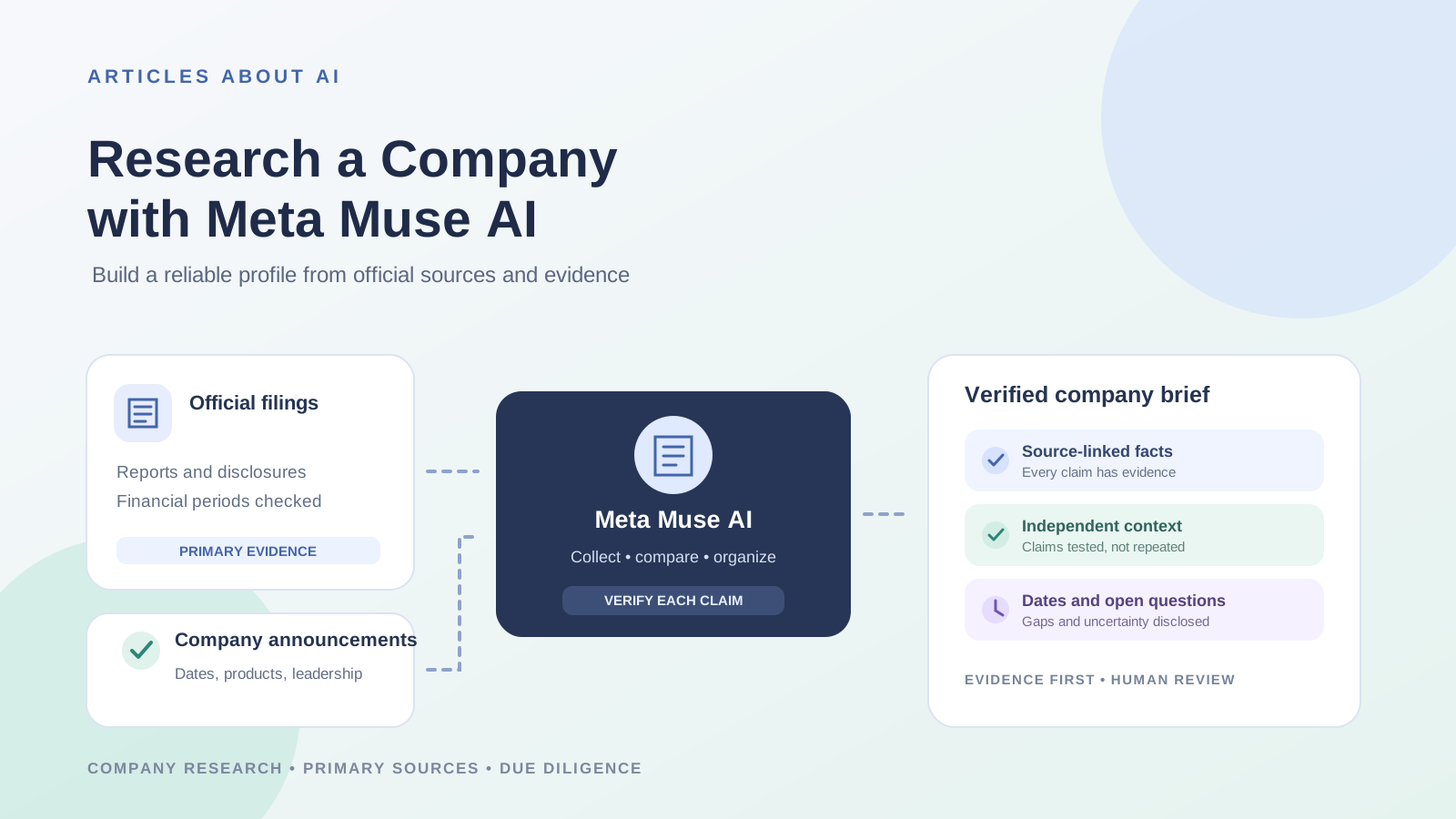
Researching a company well takes more than collecting facts from its homepage. You may need to understand what the business sells, who runs it, how it reports financial performance, what it has announced recently, and which claims are independently supported. Meta Muse AI can help organize this research, but important findings should be checked against the original documents.
Meta describes Muse as a personal AI agent that can browse the web and work through multi-step tasks. Its usefulness for a particular company-research assignment depends on access to sources, available features, and the quality of the results. This guide is a practical workflow, not a claim that we conducted a live benchmark of Muse or verified its output in a real session.
What can Meta Muse AI help you research about a company?
Depending on the company and available public records, you can ask Muse to help organize information about:
- The company’s products, services, business model, and target customers
- Leadership, ownership disclosures, subsidiaries, and corporate structure
- Recent official announcements, product launches, and strategic changes
- Financial results and statements published by the company or regulators
- Competitors and how their public offerings differ
- Risks, unresolved questions, and claims that need further evidence
Start with our guide to what Meta Muse AI is, its features, and how it works if you need an overview of the agent. For a source-first workflow, see how to research a topic with Meta Muse AI and verify every source. If your research includes a news claim about the company, use our guide on how to fact-check a news story with Meta Muse AI.
Step 1: Define the company research question
Avoid a vague request such as “Tell me everything about Company X.” Set a clear scope before collecting information. Specify:
- Company identity: full legal name, official website, and ticker symbol if applicable
- Purpose: background research, competitor analysis, supplier screening, investment research, or product evaluation
- Time period: current position, the last financial year, or a defined historical period
- Geography: the relevant country or market
- Evidence standard: official records first, followed by independent reporting
- Deliverable: a one-page brief, timeline, comparison table, or list of verified claims
This matters because companies can share similar names, change names, operate through subsidiaries, or have different legal entities in different countries.
A reusable Meta Muse prompt
Research [full legal company name] for [specific purpose]. First confirm the company’s identity using its official website and, where relevant, a regulator or corporate registry. Build a source list before drafting a summary.
Prioritize primary sources: investor-relations pages, annual reports, audited financial statements, regulatory filings, official product documentation, leadership pages, and dated company announcements. Then find reputable independent reporting to add context or challenge material claims.
For every important claim, provide the exact source title, publisher, URL, publication date, relevant passage or section, and what the source actually supports. Separate company statements from independently established facts, estimates, analysis, and allegations. Flag missing, conflicting, or outdated evidence. Do not invent figures, quotations, sources, or financial conclusions. If a source cannot be opened, say so.
Finish with a concise company profile, a dated timeline, a list of unresolved questions, and a table linking each key claim to its evidence. Do not make purchases, contact anyone, submit forms, or take external actions.
Review the output as a draft research aid. A prompt can guide the work, but it cannot guarantee complete coverage or correct interpretation.
Step 2: Confirm you have the right company
Before researching performance or reputation, verify that every source refers to the same organization. Check the legal name, official domain, headquarters where disclosed, registration details, and stock ticker where relevant.
For a public company, its investor-relations website and regulatory filings can help establish identity. In the United States, the SEC’s EDGAR company filings database lets readers search filings by company, person, or filing details. For companies in other jurisdictions, identify the relevant official securities regulator or corporate registry.
Ask Muse to list any possible name collisions or subsidiaries rather than silently combining information from different businesses. Open the cited sources yourself and confirm the legal entity and reporting period.
Step 3: Collect primary sources before summaries
Build the evidence base before asking for a polished company profile. Useful primary sources include:
- Official company website: products, services, locations, leadership, and published contact information.
- Investor relations: earnings releases, shareholder letters, presentations, and financial reports for public companies.
- Regulatory filings: annual and quarterly reports, material-event filings, and other disclosures required by the relevant regulator.
- Official documentation: product specifications, service terms, release notes, security documentation, and pricing pages.
- Company announcements: dated releases about launches, acquisitions, partnerships, or changes in leadership.
- Public records: court documents, government notices, procurement records, or registry entries when relevant to the research question.
Company sources are authoritative for what the company announced or reported. They are not automatically independent proof that every marketing claim is true. Label the difference clearly.
For example, “The company announced a new service on 12 October” can be verified against its announcement. “The service is the market leader” requires a defensible definition of market leadership and evidence beyond the company’s own promotional statement.
Step 4: Ask for a claim-to-source table
Do not accept a list of links without knowing what each one proves. Ask Muse to organize the evidence in a table with these columns:
| Claim | Source and date | Source type | Evidence found | Confidence or gap |
|---|---|---|---|---|
| The company launched a product | Official release | Primary | Announcement states launch date and scope | Confirms announcement, not product performance |
| Revenue changed year over year | Filed financial report | Primary | Reported figures for specified periods | Check currency, period, and accounting basis |
| A product has a particular capability | Official documentation | Primary | Feature description or specification | Confirm availability and plan limitations |
| A business risk is material | Filing plus independent reporting | Mixed | Risk disclosure and external context | Distinguish disclosed risk from a proven outcome |
Treat the table as a working document, not a verdict. Click each link, verify the relevant passage, and record the date you checked it. If a source does not support the claim, remove the claim or find better evidence.
Step 5: Check financial and performance claims carefully
If the company publishes financial information, use the original report rather than relying only on a news summary or a generated answer. Check:
- The reporting period and whether figures are quarterly or annual
- Currency, units, and whether numbers are rounded
- Whether a figure is revenue, gross profit, operating income, net income, bookings, or another measure
- Whether a metric is audited, unaudited, adjusted, estimated, or non-GAAP
- Whether a comparison uses consistent periods and accounting definitions
- Whether management’s forward-looking statements are forecasts rather than completed results
Do not ask Muse to infer financial health from a single metric. A revenue increase alone does not establish profitability, cash strength, or a sound investment. If you are considering an investment, treat this workflow as preliminary research—not personalized financial advice—and consult the original filings and a qualified professional where appropriate.
Step 6: Add independent reporting and test company claims
After gathering primary sources, search for reliable independent reporting that provides context, identifies disputes, or examines whether a claim is supported. Two articles are not necessarily independent if both repeat the same company statement or rely on the same unnamed source.
Ask Muse to identify the original basis for each reported fact and to flag when coverage merely repeats a press release. For material controversies, seek multiple credible sources and, where available, the underlying records or responses from the parties involved.
Our guide to fact-checking news with Meta Muse AI explains how to trace a claim, compare independent accounts, and avoid treating repetition as confirmation.
Step 7: Check dates, changes, and contradictions
Company information becomes outdated quickly. A leadership page may change, a product may be discontinued, and a financial figure may refer to a prior fiscal year. For each key source, record the publication date and, if relevant, the date the information was accessed.
Ask Muse to produce a timeline of significant announcements and identify contradictions between current pages and older releases. Then inspect the source documents directly. If two sources disagree, do not average them or choose the newer one automatically: determine whether they refer to different periods, entities, definitions, or circumstances.
Use cautious labels such as “the company reported,” “the filing states,” “independent reporting found,” and “not independently confirmed.” These phrases preserve the distinction between evidence and interpretation.
Step 8: Produce a concise company research brief
Once the evidence has been checked, ask Muse to draft a brief with a consistent structure:
- Company identity: legal name, official domain, business description
- Products and customers: what the company says it provides and to whom
- Business model: how it says it earns revenue, where supported by sources
- Leadership and structure: confirmed roles and disclosed subsidiaries
- Recent developments: dated events linked to original announcements
- Financial snapshot: only comparable, sourced figures where relevant
- Competitive context: clearly defined competitors and sourced comparisons
- Risks and open questions: disclosed risks, conflicting evidence, and unknowns
- Source register: title, publisher, date, URL, and claim supported
Add a short note stating the research cutoff date and any limits in the evidence. Keep source links close to the claims they support so another reader can audit the brief.
Common mistakes to avoid
- Using the homepage as the only source: it may explain the company’s positioning but rarely answers every research question.
- Treating company marketing as independent verification: attribute promotional claims to the company unless corroborated.
- Mixing different legal entities: verify subsidiaries, similarly named businesses, and reporting boundaries.
- Comparing incompatible financial metrics: align periods, currencies, definitions, and accounting bases first.
- Accepting plausible-looking citations: open every important source and check that it supports the exact claim.
- Ignoring negative or contradictory evidence: include material caveats and the company’s response where available.
- Assuming AI coverage is exhaustive: report gaps instead of implying that every relevant source was found.
Is Meta Muse AI enough for company due diligence?
No single research assistant should be treated as a complete due-diligence process. Muse may help gather public information and structure a multi-step task, but source availability, interpretation, and coverage can vary. Legal, financial, supplier, and investment decisions may require official records, expert review, and additional checks that an AI agent cannot replace.
Use appropriate privacy controls when researching non-public business information. Do not paste confidential documents, credentials, customer records, or trade secrets into a service unless you are authorized to share them and understand the applicable data-handling terms. Review permissions before connecting business accounts, and approve any consequential action yourself.
Frequently asked questions
Can Meta Muse AI create a company profile?
You can ask it to draft a profile from public sources and organize the results into sections. Verify the company identity, important statements, dates, and citations before relying on the profile.
Which sources are best for researching a company?
Start with official company documentation, investor-relations materials, regulatory filings, public records, and dated announcements. Use reputable independent reporting to add context and test material claims.
Can I use Meta Muse AI for competitor research?
Yes, as a way to organize public information about products, pricing, positioning, and announcements. Define comparison criteria consistently and verify each company’s information against its own current documentation. Do not present unsupported market-share estimates as facts.
Does this guide verify Muse’s accuracy?
No. It describes a repeatable research method based on documented product capabilities and general source-verification practices. It does not claim that a live test of Muse was performed or that the agent will always return accurate, complete results.
Sources and further reading
- Meta Muse: official product overview — Meta’s description of Muse and its browser-based, multi-step agent capabilities.
- Introducing Muse: Meta’s official launch announcement — launch details and the company’s description of user controls.
- U.S. SEC EDGAR search — primary source for filings from companies that report to the SEC.
- How We Built Safety Into Muse — Meta’s technical explanation of browser and agent safeguards.
- How to research a topic with Meta Muse AI and verify every source — related guide on source checking.
- How to fact-check a news story with Meta Muse AI — related guide on verifying individual claims.
The key principle is simple: let AI help organize the research, but let verifiable evidence determine what you publish or decide.