
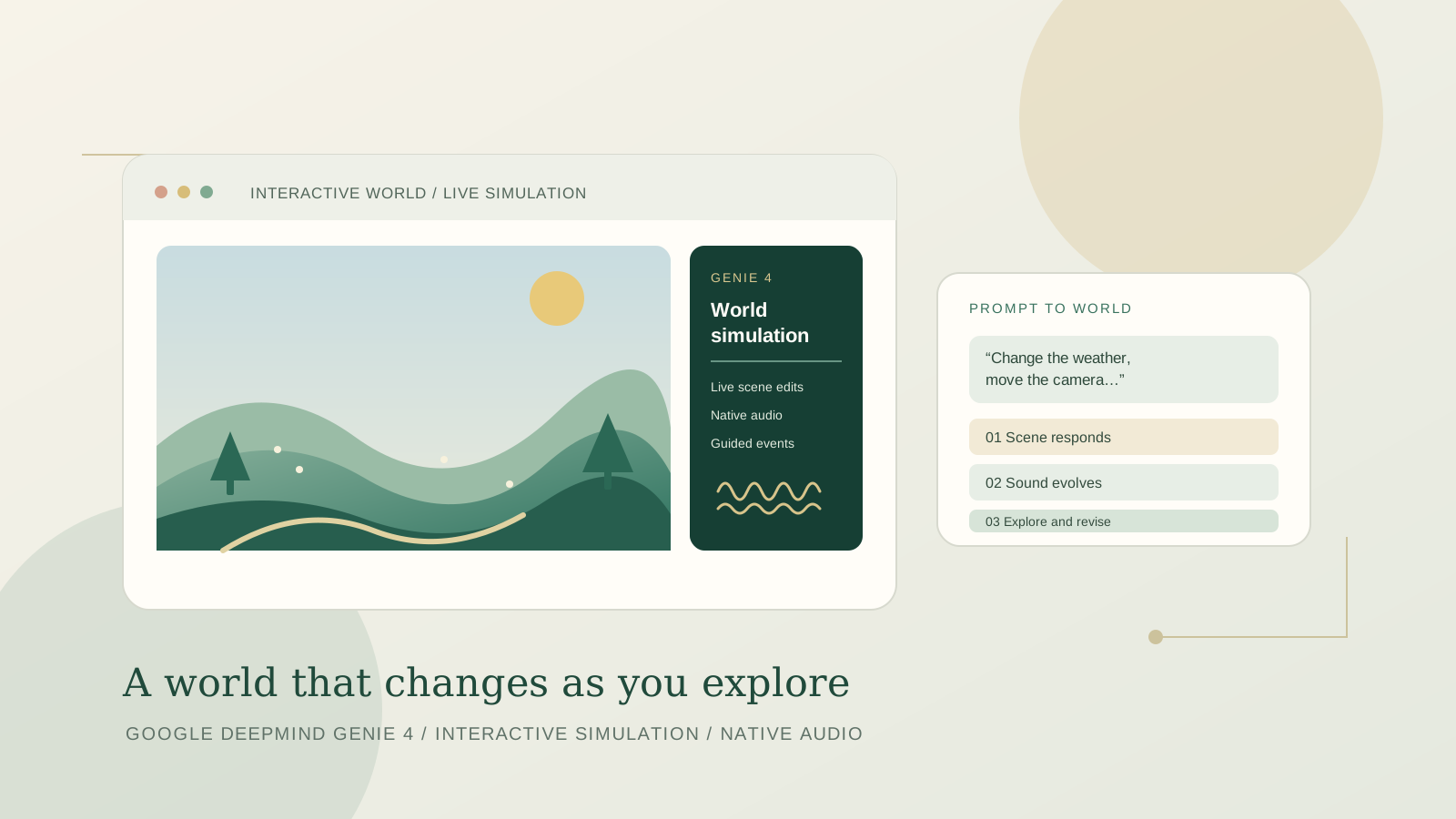
Google DeepMind announced Genie 4 on October 27, 2026, describing it as a real-time world model that generates explorable environments with native audio. Instead of producing only a finished image or video clip, Genie 4 is designed to create a simulated scene that users can navigate and modify while it continues to evolve. Prompts can change elements such as weather, camera position, objects, and characters, while the model generates the sights and sounds of the environment.
The announcement is important for game prototyping, creative previsualization, robotics research, and AI-agent training. But Genie 4 remains an early research preview. Access is limited to trusted testers, and Google has not published a general release date or pricing. This guide separates confirmed features from open questions and explains how to prepare for access without assuming the model is already available to everyone.
What is Google Genie 4?
Genie 4 is a generative world model from Google DeepMind. A world model attempts to represent how an environment changes in response to events and actions. In Genie 4, that means generating a dynamic scene that can be explored, rather than simply rendering a static picture or a fixed video.
Google says Genie 4 builds on the Gemini family. Gemini Omni helps ground appearance and behavior in real-world patterns, while other Gemini models contribute reasoning intended to help keep the simulation coherent. Google also describes Gemini 3.8 Flash as a guiding agent in the loop: it observes the evolving scene, breaks goals into steps, reviews frames to check progress, and adapts when the user changes the plan.
That architecture is a research direction, not a guarantee that every generated world will remain physically correct. Google explicitly notes that visual details and object permanence can drift over longer sessions or after complex edits. Long-term consistency, spatial accuracy, and complex physical interactions remain active research challenges.
Official overview: Google DeepMind — Genie 4.
The main Genie 4 features
1. Real-time world editing with text prompts
Users can steer a running simulation through natural-language instructions. Google’s examples include changing the weather, moving the camera, and adding a person or object. The model then adapts the scene to the instruction rather than requiring the user to start a new generation for every change.
This makes Genie 4 different from a conventional text-to-video tool. A fixed video is a sequence to watch; an interactive world is an environment that responds as the user navigates it. However, “real time” does not mean unlimited duration or perfect control. The experience is still experimental, and scene consistency can weaken as a session becomes more complex.
2. Native audio and interactive dialogue
Google calls Genie 4 its first real-time world model to generate audio natively. The simulated environment can include ambient sounds, such as wind or waves, and interactive character speech. The company says the audio accompanying its official demonstration videos was produced directly by Genie 4.
Native audio matters because sound can help a generated environment feel more coherent. It also creates a harder technical problem: sound, dialogue, visible actions, and changes in the scene need to agree. Google has not published a complete technical specification for how the audio system works or independent benchmark results for its accuracy. Treat the announcement as a description of demonstrated capabilities, not evidence that all sound or dialogue will be perfectly synchronized.
3. More realistic motion and physical interactions
Google highlights more realistic appearance, fluid movement, collisions, aerodynamics, and character behavior. Characters are intended to move naturally, react to surroundings, and respond to user steering. Such behavior could make virtual scenes more useful for early design and simulation.
The limits are important. A visually plausible simulation is not the same as a validated physics engine, and a convincing interaction does not prove that the simulated result matches real-world dynamics. For engineering or robotics work, simulation results should be checked against domain-specific tools and real measurements.
4. Multi-step goals and agent-guided simulation
Google describes combining Genie 4 with Gemini models to simulate multi-step events. In the company’s example, a reasoning model breaks a goal into steps, sends captions or instructions into the evolving world, and adapts the plan based on the simulation’s progress.
This may be useful for generating many possible scenarios for an AI agent to encounter. Still, users should not assume that Genie 4 is a generally available autonomous agent platform or a drop-in replacement for existing game engines, robot simulators, or testing infrastructure.
How to get access to Genie 4
As of Google’s October 27 announcement, Genie 4 is available as a research preview to trusted testers selected by Google. Google says it plans to expand access to Google AI Ultra subscribers through Project Genie and to early-access partners using the Gemini API and Google AI Studio. The announcement does not provide a firm date for that expansion.
To follow the official access path:
- Visit the Google DeepMind Genie 4 page.
- Use the official Project Genie waitlist link provided on that page if you want to be notified about consumer access.
- If you are a developer or researcher, monitor Google’s announcements about Gemini API and Google AI Studio early access.
- Do not assume that a standard Gemini subscription, API key, or Google AI Studio account automatically enables Genie 4.
- Check the current terms, supported regions, plan requirements, and usage limits before planning a production project.
Is Genie 4 available to everyone?
No. Google describes a limited research preview for trusted testers, with broader access planned. An announcement that access is “coming soon” is not a public launch date. Until Google publishes more details, availability should be considered restricted.
How much does Genie 4 cost?
Google has not announced public pricing for Genie 4 in the October 27 announcement. Do not infer its price from a Google AI Ultra subscription or from pricing for other Gemini models. Wait for the relevant product or API documentation to specify what is included, what is metered, and which access tiers are supported.
How developers and creators can prepare
Because broad access has not yet opened, the most useful preparation is to define a concrete experiment and the criteria that would make it successful.
For game developers
Use cases include exploring level concepts, generating environments for early prototyping, testing camera paths, and experimenting with interactive characters. A world model may help a team compare ideas before building a detailed level in a conventional game engine.
Prepare a small evaluation set: a few environment descriptions, camera movements, character interactions, and scene changes. Score whether the world follows instructions, preserves important objects, and remains visually coherent after repeated edits. Compare the results with your existing tools rather than assuming that a generative model will replace them.
For filmmakers and creative teams
Google describes trusted testers exploring Genie 4 for previsualization, lighting and camera experimentation, dialogue, and alternate scene takes. These workflows could help teams test concepts quickly before investing in a full production.
A useful evaluation is whether the generated scene preserves the intended composition and continuity after a prompt change. Also review how much manual correction is needed and whether generated speech, ambient sound, and visible action match. Do not treat a generated preview as a finished, rights-cleared production asset without reviewing the applicable terms and content requirements.
For robotics and AI-agent research
Synthetic environments can help researchers test plans and generate varied scenarios without immediately exposing a physical robot to every condition. Genie 4 could eventually contribute to this area, and Google explicitly mentions training environments for robots and agents as a potential application.
But generated environments must not be confused with validated robot simulators. Before using any world model for training or evaluation, compare its physical behavior and state transitions against trusted simulation tools and real-world data. For related practical guidance, see our existing article on Gemini 4 Argon for robotics and our guide to evaluating AI agent reliability.
For educators and journalists
Interactive simulations may help explain historical environments, environmental events, or complex systems. Google says trusted testers are exploring creative, educational, journalistic, gaming, and engineering uses.
These applications need careful labeling. A generated simulation is not documentary evidence, and realistic visuals can make invented details appear authentic. When using generated scenes to explain real events, distinguish verified source material from model-generated reconstruction and retain provenance information.
Genie 4 vs. Genie 3: what is confirmed?
Google presents Genie 4 as a step forward in realism, interactive control, and audio. The clearest announced difference is native audio, including environmental sound and interactive dialogue. The company also highlights more natural movement and the ability to steer a scene while it evolves.
However, Google has not supplied a comprehensive public benchmark table comparing Genie 4 with Genie 3 in its announcement. Claims about exact session duration, universal consistency, or specific percentage improvements should not be repeated as established facts unless Google publishes supporting documentation. For now, the fairest comparison is feature-based: the announced Genie 4 experience adds native audio and further real-time steering capabilities, while its long-session consistency remains an open research area.
Safety, provenance, and limitations
Interactive world generation raises questions about misleading realism, unsafe scenarios, and whether synthetic footage can be distinguished from real recordings. Google says Genie 4 is being introduced gradually with safety guardrails and that generated video and audio will include SynthID, its imperceptible watermarking technology intended to help identify AI-generated media.
Watermarking is a useful provenance measure, but it should not be treated as a substitute for editorial verification or a guarantee that every copy will always retain detectable provenance. If a generated scene is used in journalism, education, or public communication, label it clearly and preserve the original context.
The current preview also has limitations in visual consistency, object permanence, spatial accuracy, and complex physical interactions. These are particularly relevant when a simulation is used to inform decisions outside a creative sandbox. Evaluate failure cases as carefully as successful demos.
For more on evaluating multi-step systems, read our guides to AI agent production observability and AI agent reliability testing.
Frequently asked questions
Can I use Genie 4 right now?
Only if you are among the trusted testers selected for the research preview. Google has said broader access is planned through Project Genie for Google AI Ultra subscribers and early-access partners for the Gemini API and Google AI Studio, but it has not announced a firm date.
Does Genie 4 generate sound as well as visuals?
Yes, native audio is one of the central announced features. Google says its demos include audio generated directly by Genie 4, including ambient sound and interactive dialogue. Independent performance measurements have not yet been published in the announcement.
Can I use Genie 4 to build a complete game?
The model may help explore concepts and create interactive prototypes, but Google has not presented it as a complete game-development platform. A production game still needs engine integration, asset management, gameplay logic, testing, performance optimization, and licensing review.
Can Genie 4 train robots?
Google identifies robot and agent training environments as a potential use case. Researchers should validate simulation fidelity and avoid treating generated scenes as a substitute for established robotics simulators or safety testing.
Is there a public API and pricing page?
Google says early access for developers through Gemini API and Google AI Studio is planned. Public pricing and broad availability were not specified in the announcement. Check official documentation before committing to a development plan.
Conclusion
Genie 4 points toward interactive generative environments that combine real-time scene editing, simulated motion, native sound, and agent-guided multi-step behavior. The most immediate opportunities are creative exploration, early game and film prototyping, and research into synthetic environments. The main limitation is access: this remains a restricted research preview with no public price or general release date announced.
For now, developers should monitor the official Genie 4 page, define testable use cases, and assess scene consistency and audio alignment when access becomes available. Avoid basing a business plan on an unannounced launch date or treating realistic simulations as verified evidence of the physical world.