
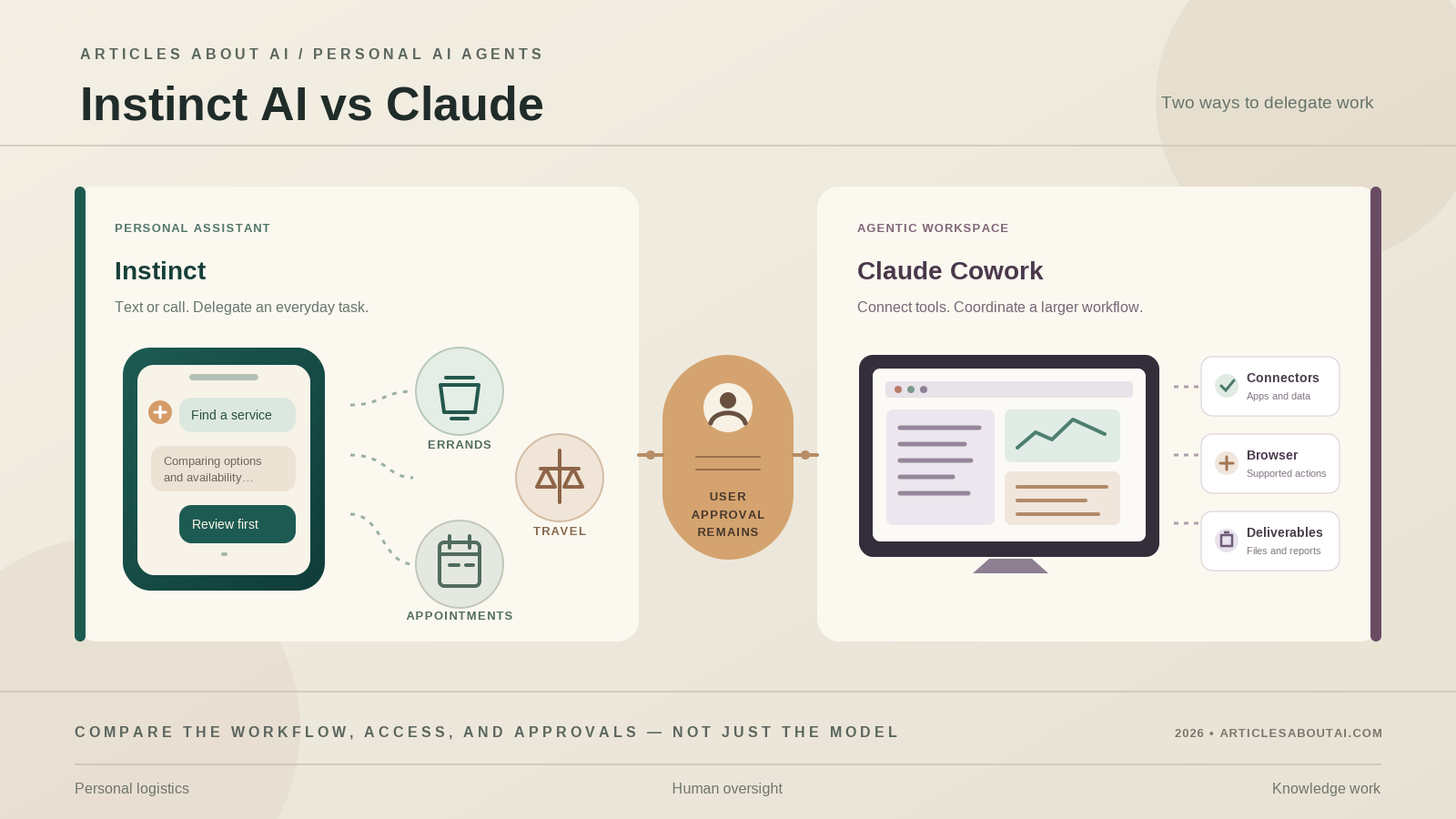
Instinct AI and Claude are both moving beyond the traditional chatbot model, but they approach personal assistance from different directions. Instinct presents itself as an assistant you can text or call to handle practical tasks across websites and services. Claude is a general-purpose AI assistant whose newer Cowork experience can coordinate connected tools, files, browser work, and scheduled tasks. The overlap is real; the product emphasis is not the same.
A fair comparison also needs to distinguish Claude’s ordinary chat from Claude Cowork. Claude chat is available on a free plan, while Cowork is a paid-plan capability. Cowork adds a more agentic workspace for longer tasks, and computer use adds another layer of desktop interaction with its own availability and safety limits.
The short answer: Instinct is the more purpose-built personal operator for errands and consumer logistics; Claude Cowork is the broader work environment for research, connected-app workflows, files, and recurring knowledge tasks. Which is better depends on the task, the services you need to connect, the level of autonomy you are comfortable granting, and the price you are willing to pay.
Instinct AI vs Claude: quick comparison
| Area | Instinct AI | Claude and Claude Cowork |
|---|---|---|
| Product emphasis | Communication-first personal assistant for practical life tasks | General AI assistant with a dedicated agentic workspace for multi-step work |
| Main interaction | Text or phone call; the service can use a phone and computer | Chat across web, desktop, and mobile; Cowork sessions can continue across supported surfaces |
| Everyday examples | Groceries, travel, flowers, reservations, appointments, subscriptions | Research, email and calendar work, files, reports, recurring tasks, and supported computer workflows |
| Connected services | Connected services plus browser interaction with some third-party sites not separately connected | A directory of connectors, including Google Workspace; custom connectors and MCP services are also supported |
| Browser and computer actions | Official materials describe phone and computer use, but do not publish a complete feature-by-feature access matrix | Cowork can use connectors, a browser, and computer use; computer use has separate plan, device, and permission requirements |
| Scheduled work | Public materials describe task planning and personal assistance; a complete public schedule-feature matrix is not available | Scheduled Cowork tasks are documented for paid plans and can run in the cloud |
| Pricing | Terms currently say access is without charge; fees may be introduced with notice | Claude has a free plan; Cowork is on paid plans, with individual Pro, Max, and Ultra prices published |
| Best fit | Personal errands and consumer-facing tasks through a simple assistant interaction | Research, connected-app work, file-based projects, reports, and recurring knowledge workflows |
This table describes documented product positioning, not a guarantee that every capability is enabled for every account. Availability, connected-service permissions, operating-system support, and staged rollouts can change what a user can actually do.
1. Different starting points: a personal operator versus a general AI workspace
Instinct’s official homepage describes the product as a personal assistant that understands what a user is working on and what matters to them. Its stated interaction model is deliberately simple: users can text or call it. The homepage gives examples such as ordering groceries or recipe ingredients, booking a train, sending flowers, and finding a sports court.
That positioning makes Instinct easy to understand as a personal task layer. Instead of treating every request as a separate research conversation, the product is designed around delegating a practical outcome: arrange something, contact a service, find an option, or complete a task through a third-party service.
Claude begins from a broader assistant model. Standard Claude can answer questions, search the web, work with files, create artifacts, and connect to supported apps. Claude Cowork adds a task-oriented environment for longer work: Claude can plan a task, use connected tools and files, run code in an isolated cloud environment, and return a finished output. Depending on the setup, it can also reach local folders, a browser, or desktop applications through Claude Desktop.
The distinction is not that one product can act and the other can only talk. Both can work with services and take actions when the right capability and permission are available. The difference is the default workflow: Instinct is framed around personal delegation; Cowork is framed around completing a broader piece of work.
2. Everyday errands and personal logistics
Instinct has a clear advantage in product identity when the job is an everyday errand. Its public examples are consumer-oriented: groceries, travel, flowers, restaurant reservations, and finding a local activity. Its Privacy Policy, revised November 17, 2026, also names scheduling appointments, researching and booking travel, and managing subscriptions as examples of tasks the service is intended to support.
A request to find a train, arrange a reservation, or contact a business fits naturally into that model. Instinct’s Terms also describe its ability to interact with connected third-party services and with other third-party platforms through its browser functionality. The exact action still depends on the website, account access, and available safeguards.
Claude can handle some of the same practical work, particularly when it can use a relevant connector or supported browser workflow. For example, its Google Workspace connectors can search and send email, manage calendar events, and work with Drive files. Cowork can also run scheduled tasks that compile briefings, review messages, or prepare reports.
However, Claude’s official documentation positions Cowork as a general work environment rather than a consumer-errand service. A personal task may be entirely possible, but the user should check whether the relevant connector or browser action is available and whether the final step needs approval.
Practical verdict: If the main goal is to delegate personal logistics through a text- or call-based assistant, Instinct is the more direct fit. If the errand involves substantial research, documents, email, or a repeatable workflow, Claude Cowork may be the more flexible environment.
For examples of Instinct’s personal-task approach, see How to Use Instinct AI to Manage Everyday Tasks and How to Use Instinct AI to Handle Personal Errands.
3. Connected apps: what each assistant can reach
Connected services are often more important than the model name. An assistant cannot manage a calendar it cannot access, and a browser agent cannot complete a transaction on a site that blocks the action or requires a step it cannot perform.
Instinct’s Privacy Policy says the service may access and exchange information with platforms that a user connects or uses to sign in. It also says its browser functionality may interact with other third-party websites and applications that have not been separately connected. That is a meaningful distinction: Instinct’s documented approach includes both connected services and browser-based interaction with other sites.
The same policy explains that linking Google Workspace can give Instinct access to products such as Gmail and Google Calendar, along with related message metadata, event details, and other content shared through Google Workspace APIs. It says this information is used to provide the service and personalize the experience. The policy makes a specific commitment that information received directly from Google Workspace APIs is not used to evaluate, fine-tune, train, or improve AI models, and is not used for advertising.
Claude uses a connector-based approach. Anthropic’s connector documentation says connectors let Claude access apps and services, retrieve data, and take actions within connected services. Users can browse a directory, connect supported services, and add custom connectors or services that support MCP. Claude inherits the user’s permissions from the connected service.
The Google Workspace connector guide documents specific Gmail, Calendar, and Drive actions. These include searching and reading email, drafting and sending messages, creating and updating calendar events, finding mutual availability, and working with Drive files. By default, Claude asks for approval before actions such as sending email or changing files, except where the user or organization has configured a different approval mode.
The practical difference is that Instinct’s public policy emphasizes a personal assistant that can interact with connected services and other websites, while Claude exposes a broader connector ecosystem with more explicit documentation for individual app actions and permissions.
4. Browser and computer use: similar ambition, different controls
Both products aim to move beyond text generation, but their public documentation describes computer interaction differently.
Instinct’s homepage says it can use a phone and computer in the same way a person does. Its Terms describe actions on connected services and other third-party platforms, including exchanging data and taking actions on the user’s behalf. The public materials do not provide a complete matrix showing exactly which browser, operating system, or computer-control feature is available to every account. It is therefore better to treat the homepage examples as product positioning, not as a promise that every website or device action will work.
Claude Cowork documents a more explicit sequence. When possible, Claude uses a connector first. If no suitable connector exists, it may use a browser. If that still does not solve the task and computer use is enabled, Claude can interact with the screen by clicking, typing, and navigating desktop applications.
Anthropic says computer use is available in Cowork and Claude Code through the Claude Desktop application on macOS and Windows. On Team and Enterprise plans, it is in beta and must be enabled by an organization owner in the new Claude experience. Each app requires permission before Claude can interact with it. Some applications are restricted, and users can stop the task or block apps.
There are important limits. Computer use requires the desktop to be awake and Claude Desktop to be running. Screen interaction is slower than using a direct connector, and complex tasks may need another attempt. Anthropic also warns that computer use has no sandbox between Claude and the applications on the screen. Claude takes screenshots to understand the interface, so information visible in an approved app may be exposed to the task.
Practical verdict: Claude provides more detailed public documentation about the sequence of connectors, browser use, and desktop interaction. Instinct’s phone-and-computer model is central to its identity, but users should check their own account and current service documentation for the precise actions enabled.
5. Email, calendars, and recurring work
Claude’s Google Workspace documentation is unusually specific. It lists Gmail search, reading, drafting, sending, replying, forwarding, and label or thread organization. For Google Calendar, it lists viewing calendars, creating and updating events, finding shared availability, managing attendees, and setting recurring meetings. These are documented connector capabilities, not merely examples in a marketing description.
Claude Cowork also supports scheduled tasks on paid plans. Anthropic says these can run recurring research, create daily briefings, compile weekly reports, and organize files. Scheduled tasks run remotely on a chosen cadence, so they can continue even when the computer is asleep or the desktop application is closed, subject to the connectors and files available to the task.
Instinct’s Privacy Policy confirms that Google Workspace connections can provide access to email and calendar information and allow actions on the user’s behalf. It also identifies appointments, travel, and subscriptions as everyday task categories. Its public documentation is less explicit than Anthropic’s connector guides about a complete list of individual calendar and email actions or a universal scheduled-task feature.
For task-specific guidance, see How to Use Instinct AI to Manage Emails and Follow-Ups and How to Use Instinct AI to Organize Your Calendar and Appointments.
6. Privacy and model training: read the policies, not the slogans
Neither product should be judged by a general claim that an assistant is private. The relevant questions are which information it can access, how that information is used, whether it can be used for model improvement, how long it is retained, and what happens when a user disconnects a service.
Instinct’s Privacy Policy makes a specific distinction for Google Workspace API data: it says that data received directly from those APIs is not used to evaluate, fine-tune, train, or improve AI models, and is not used for advertising. For other information, the policy says some materials may be used to develop and improve the service, including model training, subject to an opt-out in settings. Materials added to Instinct’s Vault are treated separately and are not used to train AI models. The policy also describes exceptions for information flagged for safety review.
Anthropic’s policy distinguishes consumer Claude accounts from commercial products. For consumer plans such as Free, Pro, and Max, Anthropic says chats and coding sessions may be used to improve models if the user chooses to allow it, if a conversation is flagged for safety review, or if the user otherwise explicitly opts in. Anthropic says Incognito chats are not used to improve its models. It also says raw content from connectors is not included in this model-improvement use unless the content is copied directly into the conversation.
For Claude for Work and the Anthropic API, Anthropic says it does not use chats or coding sessions to train models unless the customer participates in the Development Partner Program or explicitly provides material for training.
These are not identical policies, and the account type matters. Read the current policy for the exact product and plan you use. For Instinct, also distinguish Google Workspace API data from content shared through other channels. For Claude, distinguish consumer accounts from commercial workspaces and understand the effect of feedback, safety review, and privacy settings.
7. Safety and human oversight
Instinct’s Terms, revised November 17, 2026, say users remain responsible for actions taken on third-party services. The Terms require meaningful human oversight, prompt review of actions, and appropriate approval workflows—especially where an action creates a financial obligation, affects another person, discloses sensitive information, or is difficult to reverse. They also warn that Instinct can produce incorrect information or make errors when carrying out actions.
Anthropic’s Cowork safety guidance makes a similar point from the perspective of its tools. Cowork separates read actions from write actions, recommends stronger oversight for high-stakes work, and warns about prompt injection in emails, documents, and websites. Its computer-use guidance adds a specific caution: screen interaction can expose visible information and is not sandboxed from the applications the user approves.
For both assistants, a sensible operating rule is to delegate research and preparation freely only within an appropriate access boundary, but keep approval for sending messages, making purchases, changing accounts, deleting files, or committing to a booking. Verify the result in the original service rather than relying only on the assistant’s summary.
8. Pricing and access: Instinct’s current terms versus Claude’s published plans
Instinct’s Terms of Service, last revised November 17, 2026, state that the service is currently available without charge. The same section reserves the right to introduce fees for access or particular features and says users will receive notice before applicable fees become payable. The company does not publish a detailed tiered price table in the cited Terms, so users should not assume that today’s no-charge status is permanent.
Claude has a published individual pricing structure. At the time of this review, Anthropic lists:
| Claude plan | Published individual price | Relevant access notes |
|---|---|---|
| Free | $0 | Claude chat and connectors; Cowork is not included |
| Pro | $17 per month with annual billing ($200 billed upfront), or $20 monthly | Cowork, hand-off and scheduled tasks, subject to usage limits |
| Max | From $100 per month | Higher usage and access to advanced features |
| Ultra | $200 per month | Higher usage allowance for longer workloads |
Prices are in U.S. dollars, exclude applicable tax, and may change. Team and Enterprise pricing is separate. Anthropic’s pricing page and Cowork availability documentation should be checked before subscribing, because feature access can vary by plan, organization settings, and rollout.
The key distinction is simple: Claude has a free chat tier, but Cowork is a paid-plan capability. Instinct’s current Terms say the service is available without charge, while allowing fees to be introduced later with notice. Compare the feature you actually need, not just the entry-level price.
Which assistant should you choose?
Choose Instinct AI if you want a communication-first personal assistant for errands, bookings, travel, shopping, appointments, and follow-ups. Its product identity is built around delegating practical tasks through text or calls. Its current Terms say the service is available without charge, although future fees are possible.
Choose Claude if you want a broad AI assistant for writing, research, files, and connected apps. Choose Claude Cowork when the task needs multiple stages, scheduled work, or a combination of connectors, browser activity, and desktop access. Cowork is a paid feature, and computer use has additional device and permission requirements.
Choose based on the workflow, not a universal ranking. If your main goal is to arrange a personal errand, Instinct’s design may be more direct. If you need to analyze files, search connected work tools, produce a report, or run recurring research, Claude Cowork is more explicitly designed for that kind of work.
Final verdict
Instinct is the more focused personal assistant; Claude Cowork is the more documented general-purpose work agent. Instinct’s appeal is the simple instruction-to-errand model. Claude’s advantage is the breadth of its connector ecosystem, detailed app actions, file workflows, scheduled tasks, and computer-use controls.
Neither is guaranteed to complete every action. A website can block automation, an integration may not have write access, a feature may not be available to a particular account, and an agent can misunderstand a request. Keep a human approval step for consequential actions and verify completion with the service provider.
Frequently asked questions
Is Instinct AI better than Claude?
Neither is universally better. Instinct is positioned around practical personal tasks and a text-or-call interaction model. Claude is broader, with chat, connectors, file work, and Cowork for multi-step tasks. The better choice depends on the workflow and the features available to your account.
Can Claude do the same things as Instinct?
There is overlap. Claude can work with connected email and calendar services, use browser and computer tools where available, and run scheduled tasks in Cowork. Instinct’s public examples focus more directly on consumer errands such as groceries, travel, reservations, and sending flowers. Neither product guarantees every third-party action.
Is Claude Cowork free?
No. Claude has a free chat plan, but Anthropic lists Cowork and scheduled task hand-off among paid-plan capabilities. Check the current pricing and availability pages because plans and rollouts can change.
Is Instinct AI free?
Instinct’s Terms of Service, revised November 17, 2026, say the service is currently available without charge. The same Terms allow the company to introduce fees with notice, so users should check the latest terms before relying on that status.
Which assistant is safer for private information?
There is no universal answer. Instinct makes a specific no-training commitment for data received directly through Google Workspace APIs, while other materials are subject to its broader opt-out and Vault rules. Anthropic distinguishes consumer and commercial accounts, and its computer-use feature can see screenshots of approved apps. Review the exact policy, connected permissions, and approval controls for the plan you use.
Sources and further reading
- Instinct — Official website
- Instinct — Terms of Service, revised November 17, 2026
- Instinct — Privacy Policy, revised November 17, 2026
- Anthropic — Claude plans and pricing
- Anthropic — Use Claude Cowork on web, desktop, and mobile
- Anthropic — Use connectors to extend Claude’s capabilities
- Anthropic — Google Workspace connectors
- Anthropic — Let Claude use your computer in Cowork
- Anthropic — Use Claude Cowork safely
- Anthropic Privacy Center — Consumer model training
- Anthropic Privacy Center — Commercial model training