
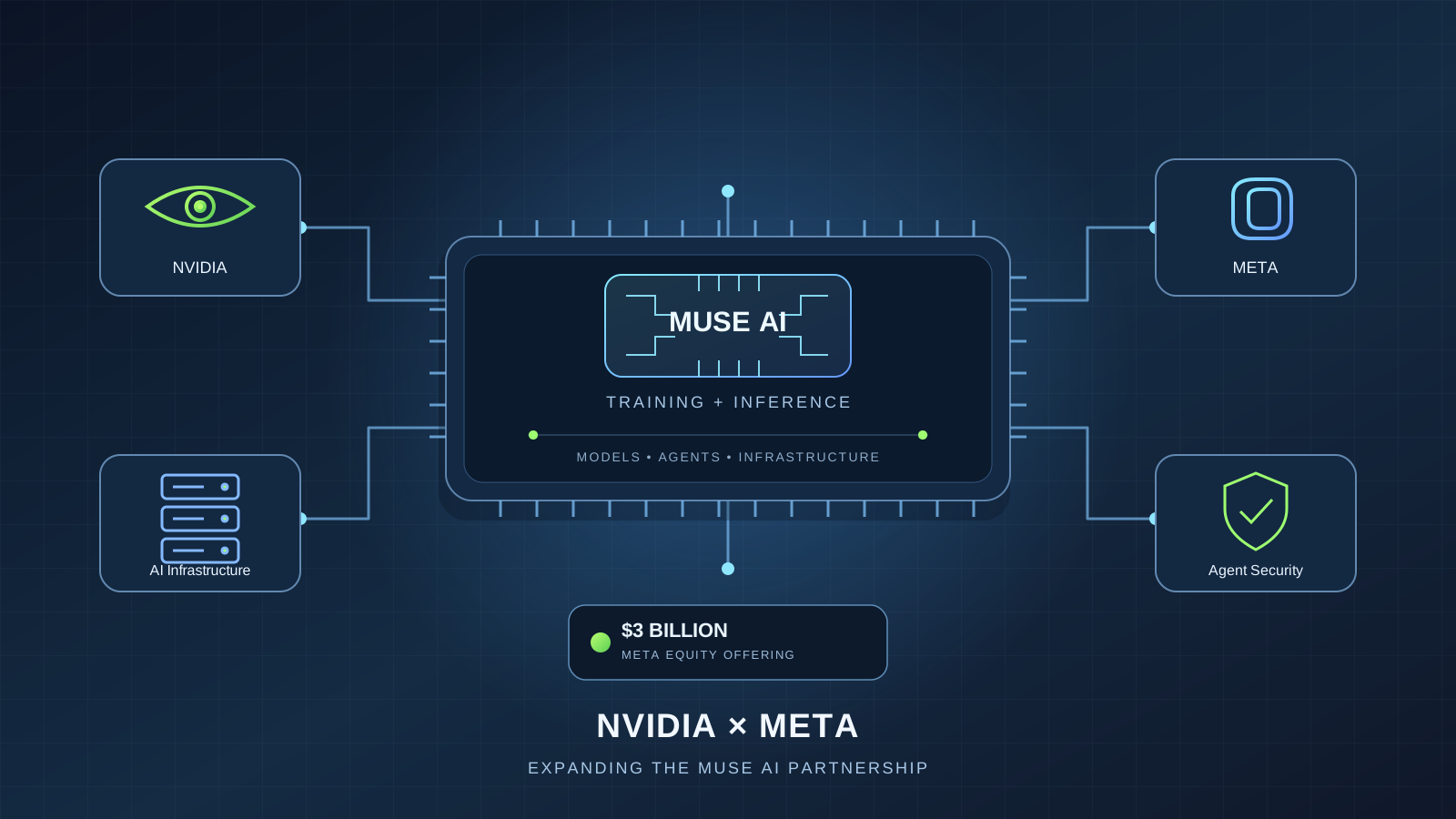
NVIDIA and Meta announced an expanded partnership on October 27, 2026, focused on Meta’s Muse AI assistant and the Muse family of models. NVIDIA said it will invest $3 billion in Meta’s equity offering while the companies work together to improve Muse training and inference performance. The announcement also describes plans for Meta to expand its use of NVIDIA infrastructure, including Vera Rubin systems, Vera CPUs, Spectrum-X Ethernet networking, and BlueField-4.
The news combines a technical collaboration with a significant financial investment. It is also important to separate what the companies confirmed from what remains under consideration: the expanded Muse work and infrastructure plans were announced, while possible additional collaboration involving NVIDIA OpenShell and NVIDIA Sentry was described as an area the companies will consider—not as a finished product integration.
This report uses NVIDIA’s official announcement and independent reporting from Reuters. The original NVIDIA release is dated October 27, 2026; Reuters also reported the news that day. The announcement does not provide a complete implementation timeline, a public benchmark methodology, or all financial terms.
What did NVIDIA and Meta announce?
The companies said they will expand their work on Muse and the Muse family of models to improve training and inference performance. NVIDIA’s statement connects the effort to demand for useful AI agents and says the companies intend to optimize workflows to improve performance and total cost of ownership.
Three elements matter most:
- Model optimization: NVIDIA and Meta will work more closely on Muse model training and inference. The statement does not publish a quantified improvement or a benchmark protocol that independently proves a specific performance gain.
- Infrastructure expansion: Meta intends to expand deployment of NVIDIA infrastructure for next-generation AI agents, including Vera Rubin and Vera CPUs, along with Spectrum-X Ethernet networking and BlueField-4.
- Financial investment: NVIDIA says it will invest $3 billion in Meta’s equity offering. That figure is confirmed by the companies’ announcement, but it does not by itself reveal NVIDIA’s eventual ownership percentage or the exact shares purchased.
The companies also said they would consider further collaboration around the NVIDIA OpenShell Reference Architecture, NVIDIA OpenShell for safe deployment, and NVIDIA Sentry for monitoring agent behavior. The word “consider” matters: the announcement does not give a committed launch date, full product specification, or confirmation that a new joint security product is already generally available.
Why Muse is central to the partnership
Muse is Meta’s AI assistant and model family. Meta’s consumer-facing agent is part of a broader effort to move from single-turn chat toward systems that can plan, use supported tools, and carry out multi-step tasks. For background on the product itself, see our guide to what Meta Muse AI is, its features, and availability.
Agentic systems can generate more infrastructure work than a single answer in a chat interface. They may make multiple model calls, use tools, wait for external results, and repeat parts of a task. That makes inference efficiency, memory movement, CPU orchestration, and networking important alongside accelerator performance. NVIDIA and Meta’s emphasis on end-to-end optimization reflects that broader workload.
The announcement says Muse models and agents have delivered “frontier-level” benchmark performance and strong consumer download growth, but those descriptions are the companies’ characterization. The release does not provide enough benchmark details to independently verify a universal performance ranking. Nor does popularity alone establish quality, reliability, or user retention. Our separate coverage of Meta Muse’s reported US download milestone discusses adoption claims and the importance of distinguishing third-party estimates from vendor statements.
What the expanded model collaboration could change
Training and inference are related but different workloads. Training updates model parameters using data and compute; inference runs a trained model to generate outputs or decide the next step in a task. Improvements in one do not automatically imply equal gains in the other.
NVIDIA and Meta say they will collaborate on optimizations across workflows to improve performance and total cost of ownership. That could involve model architecture, kernels, software libraries, batching, memory use, communication between accelerators, or how agents select and call models. However, the public announcement does not specify which of those engineering techniques will be applied or quantify their individual contributions. They are possible routes to optimization, not confirmed details of this agreement.
A rigorous evaluation would need to identify the model version, task mix, output-quality criteria, hardware, software stack, latency target, and cost boundary. For agent workflows, it should also measure tool-call success, task completion, retries, and human intervention. Without those details, it would be premature to assign a percentage improvement to the partnership.
For readers comparing model ecosystems, our guide to open-weight vs. closed AI models in 2026 explains why access, licensing, deployment options, and independent evaluation all matter. A hardware partnership may improve a model’s efficiency, but it does not automatically change whether the model weights are open, what license applies, or which services can access it.
The infrastructure named in the announcement
Meta intends to expand deployment of several NVIDIA technologies. The release names the following components:
| Technology | Role in the announcement | What has not been disclosed |
|---|---|---|
| NVIDIA Vera Rubin | Infrastructure Meta intends to expand for next-generation AI agents | Unit counts, delivery schedule, and site-by-site deployment |
| NVIDIA Vera CPUs | Additional CPU deployment for agent-related workloads | Exact configuration, volume, and pricing |
| NVIDIA Spectrum-X Ethernet | Networking intended to support efficiency and throughput | Network topology, cluster size, and performance measurements for this deal |
| NVIDIA BlueField-4 | Part of the infrastructure expansion | Quantity, deployment schedule, and the specific workloads assigned to it |
This list shows that the partnership is not described as a GPU-only agreement. Agent systems depend on the wider data-center stack, including compute, networking, data movement, and software. Still, the companies have not published a complete bill of materials, procurement schedule, or a contract specifying exact quantities. Meta’s stated intent to expand deployment should not be rewritten as a disclosed order for a particular number of chips.
Infrastructure efficiency also needs a consistent metric. “Performance per watt,” throughput, latency, and cost per completed task are different measures. A system may improve one without improving all the others. A useful benchmark would report the workload and quality threshold alongside power, latency, and cost.
NVIDIA OpenShell and Sentry: what is confirmed about agent security?
The companies said they will consider additional collaboration opportunities involving the NVIDIA OpenShell Reference Architecture, OpenShell, and Sentry. NVIDIA describes OpenShell in connection with safe deployment and Sentry in connection with monitoring agent behavior.
The announcement is relevant because agents may access tools, data, and connected applications rather than only produce text. Stronger deployment controls and behavioral monitoring can be important in environments where agents perform consequential actions. But the release does not establish that every Muse workflow will use these technologies, that the proposed collaboration has been completed, or that the tools eliminate all agent-security risks.
Organizations evaluating agent systems should continue to apply normal security practices: least-privilege access, clear user approvals for consequential actions, logging, isolation, monitoring, and a way to revoke access. Security claims should be tested against the organization’s actual tools and threat model. Our coverage of AI agent security and the Codex-discovered Brotli vulnerability offers a separate example of why AI-related workflows still depend on ordinary software security controls.
What does the $3 billion investment mean?
NVIDIA said it will invest $3 billion in Meta’s equity offering. That is a confirmed announced investment, but it should not be confused with a disclosed percentage of Meta’s ownership or a completed transaction. The companies’ announcement does not state a final share count, purchase price per share, ownership percentage, or closing date.
The financial move arrives as Meta raises capital for its broader AI infrastructure ambitions. Reuters reported the $3 billion investment alongside the expanded Muse collaboration. It is reasonable to say the investment strengthens the strategic relationship, but it would be speculative to claim that it guarantees a specific future amount of NVIDIA hardware revenue or that the investment is contractually tied to particular chip purchases unless the companies disclose such terms.
The distinction between a supplier relationship and an equity investment is important. NVIDIA supplies technology used in AI infrastructure, while investing in a customer’s equity offering creates a separate financial exposure. The announcement does not provide enough detail to calculate NVIDIA’s resulting ownership stake or to determine all conditions attached to the investment.
Readers following the wider economics of AI infrastructure should watch for regulatory filings, final offering terms, and any later disclosures about procurement volumes. Until those details are published, articles should avoid inventing ownership percentages, guaranteed hardware orders, or financial returns.
NVIDIA and Meta Muse partnership: confirmed facts vs. open questions
Confirmed by the announcement
- NVIDIA and Meta will expand their work on Muse and the Muse family of models.
- The stated aim is to improve training and inference performance and optimize workflows for performance and total cost of ownership.
- Meta intends to expand deployment of NVIDIA infrastructure, including Vera Rubin, Vera CPUs, Spectrum-X Ethernet, and BlueField-4.
- NVIDIA says it will invest $3 billion in Meta’s equity offering.
- The companies will consider further collaboration involving OpenShell and Sentry.
Not established in the public announcement
- A quantified percentage improvement in inference speed, training time, or cost.
- A reproducible independent benchmark proving Muse outperforms all competing models.
- Exact hardware quantities, delivery dates, and deployment locations.
- A final ownership percentage or all terms of the $3 billion investment.
- A committed release date or general availability date for a joint OpenShell/Sentry integration.
- A guarantee that the investment results in a particular volume of future NVIDIA sales.
This distinction is important for readers and for search quality. The strongest report is specific about the announcement while avoiding claims that are not supported by the available sources.
How this affects AI developers and businesses
For developers, the near-term story is not that a new Muse model or security product has necessarily become available today. It is that Meta and NVIDIA intend to deepen optimization across models and infrastructure. Developers should watch for future model releases, technical documentation, reproducible inference benchmarks, and changes to access or deployment requirements.
For enterprise buyers, the announcement reinforces the importance of evaluating total system cost rather than only model API prices or accelerator specifications. A useful cost model includes inference volume, hardware utilization, network overhead, retries, tool execution, monitoring, and human review. For agents, the relevant unit may be cost per successfully completed task at an agreed quality threshold—not simply cost per generated token.
For AI infrastructure teams, the planned deployment of Vera Rubin, Vera CPUs, Spectrum-X, and BlueField-4 is a signal to follow the full stack. However, the announcement alone is not a purchase order with published quantities or delivery dates. Capacity planning should rely on vendor documentation and contractual information when it becomes available.
Frequently asked questions
What did NVIDIA and Meta announce on October 27, 2026?
They announced an expanded collaboration on Muse and the Muse family of models to improve training and inference performance. NVIDIA also said it will invest $3 billion in Meta’s equity offering.
Is the $3 billion investment confirmed?
Yes. NVIDIA’s official announcement states that it will invest $3 billion in Meta’s equity offering. The announcement does not disclose the final ownership percentage, share count, or all transaction terms.
Which NVIDIA technologies will Meta expand?
The announcement names Vera Rubin, Vera CPUs, Spectrum-X Ethernet networking, and BlueField-4. It does not disclose exact quantities or a complete rollout timetable.
Is NVIDIA OpenShell already integrated into every Muse agent?
The announcement does not say that. It says the companies will consider additional collaboration involving the OpenShell Reference Architecture, OpenShell, and Sentry. A completed universal integration has not been established by this release.
Did the companies publish benchmark improvements?
The announcement describes the goal of improving performance and total cost of ownership, and it characterizes Muse as having delivered frontier-level benchmark performance. It does not publish a reproducible new benchmark proving a specific percentage improvement from this expanded partnership.
Does this announcement mean a new Muse model is available now?
Not by itself. The release announces expanded collaboration and infrastructure plans; it does not identify a newly released Muse model with a public download or API availability date.
Verdict
The NVIDIA–Meta announcement is significant because it joins three areas of the AI ecosystem: model optimization for Muse, expanded data-center infrastructure, and a $3 billion equity investment. It also points to possible future work on agent deployment and monitoring through OpenShell and Sentry.
The facts should be kept narrow. The partnership expansion and investment are confirmed; specific performance gains, hardware quantities, final financial terms, and the timeline for any additional security integration are not disclosed in the announcement. The most useful follow-up will be independent performance data, technical documentation, and formal disclosures that show how the collaboration translates into measurable improvements.