
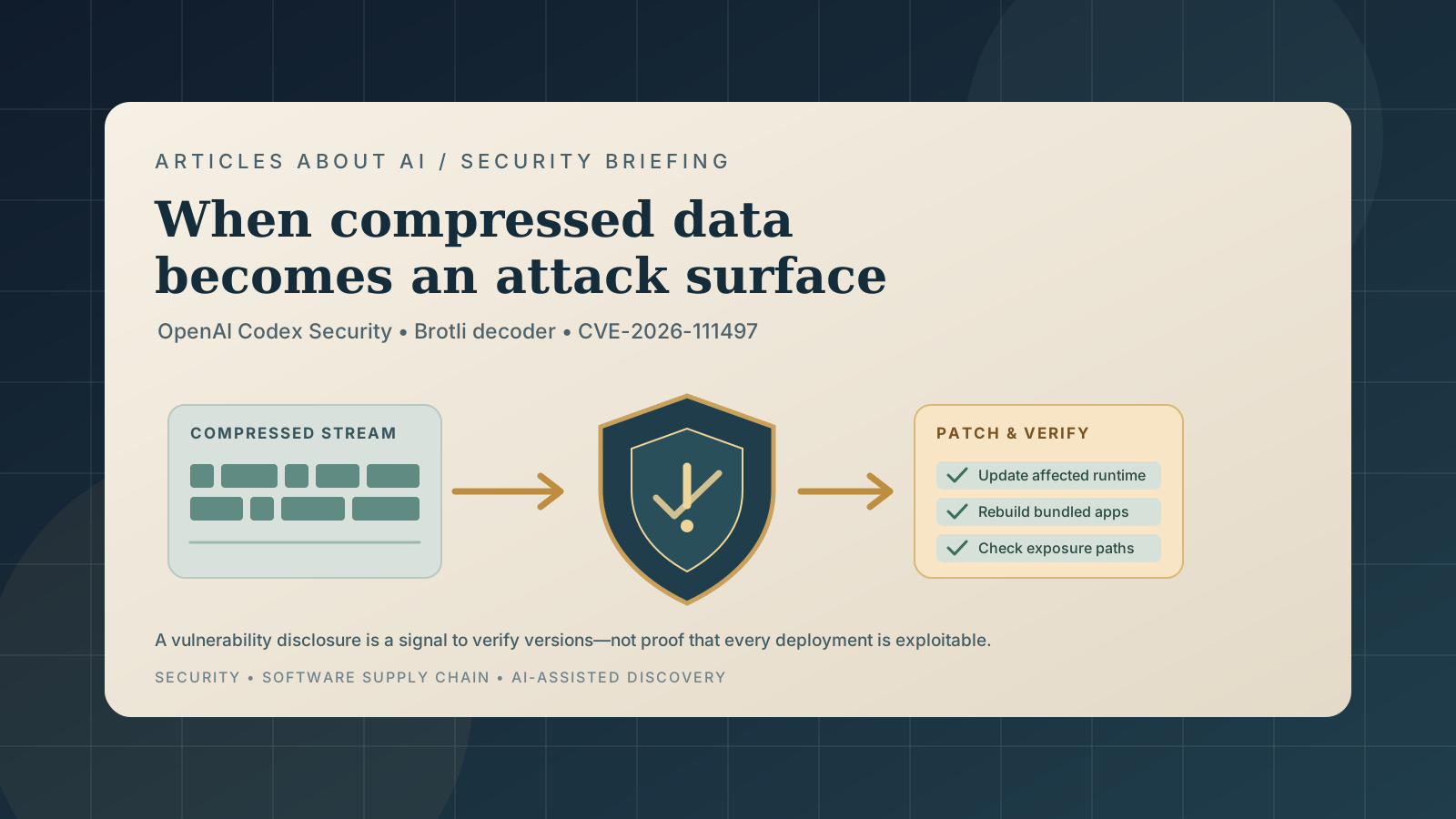
OpenAI disclosed on October 23, 2026, that its Codex Security red-teaming work had helped uncover a serious vulnerability in Brotli, a widely used data-compression library. The original announcement appeared at approximately 22:55 UTC on October 23. The disclosure matters beyond AI security: Brotli code is bundled into software used by web servers, applications, and developer tools, including Node.js, Bun, and Envoy.
The issue is tracked as CVE-2026-111497. A specially crafted Brotli-compressed stream can trigger an out-of-bounds write in the decoder. Depending on the vulnerable software and the way it processes untrusted compressed data, the impact may include a crash, memory corruption, disclosure of information, or potentially arbitrary code execution. The exact practical impact is not identical across every product that bundles Brotli, so administrators should follow each project’s advisory rather than assume that all deployments are equally exposed.
This is also a notable example of AI-assisted vulnerability discovery: OpenAI says the flaw surfaced during adversarial testing of its own research infrastructure. That does not mean an AI model independently proved exploitation in every affected product, nor that AI can replace security review. The practical priority for developers is straightforward: identify where vulnerable Brotli code is used, update affected runtimes and applications, and verify that the patched versions are actually deployed.
What is CVE-2026-111497?
Brotli is a lossless compression format commonly used to reduce the size of web content sent between clients and servers. Compression can improve transfer efficiency, but any component that decompresses data must safely handle malformed input. The flaw in this case concerns the Brotli decoder’s handling of an invalid block switch: the decoder could treat invalid data as a temporary need for more input instead of a permanent format error, allowing data to be written beyond an internal buffer.
The Node.js security advisory describes this as an out-of-bounds write that can corrupt process memory when an application decompresses attacker-controlled Brotli data. That can cause a denial of service and may create a path to more serious consequences, including code execution. The Brotli project and downstream vendors describe the issue as a serious decoder vulnerability, but the exploitability of a specific product depends on its build, runtime hardening, and whether an attacker can get crafted compressed data into the affected decoding path.
Some security trackers use the label “Node2Shell” for the issue. The underlying bug is in Brotli’s decoder rather than a flaw unique to the Node.js application framework. This distinction matters because other products that bundle affected Brotli versions may require their own updates even if Node.js is not installed.
Which software is affected?
The vulnerability affects Brotli versions 1.0.3 through 1.2.0, with fixes available in specific Brotli releases and downstream packages. Because software may bundle its own copy of a library, updating a system package does not necessarily fix every application that ships a separate copy.
| Product or component | Affected versions identified by its advisory | Fixed version or action |
|---|---|---|
| Node.js | 22.x, 24.x, and 26.x before the security releases | Update to 22.23.4, 24.22.1, or 26.12.1, respectively, or a newer supported security release |
| Bun | Versions from 1.0.21 up to, but not including, 1.4.4 | Update to Bun 1.4.4 or later; rebuild compiled executables |
| Envoy | 1.39.2, 1.38.5, 1.37.7, and 1.36.11 | Update to 1.40.0, 1.39.3, 1.38.6, 1.37.8, or 1.36.12, as applicable |
| Brotli library | Affected upstream versions 1.0.3–1.2.0, excluding fixed backport releases | Use a fixed release such as 1.0.10, 1.1.1, or 1.2.1, according to the project’s supported branch and packaging |
These versions are drawn from the respective project advisories. Always check the current vendor advisory before deployment: distributors may backport fixes without using the upstream version number shown above, and older end-of-life runtime branches may not receive a new patch.
Why the exposure path matters
A vulnerable library is not automatically proof that every application can be exploited remotely. The key question is whether untrusted Brotli data reaches the affected decoder.
Node.js applications
Node.js’s security notice says an application may be exposed when it decompresses attacker-controlled Brotli data through APIs such as node:zlib. Depending on the application’s architecture, relevant paths may include brotliDecompress, createBrotliDecompress, request-body decompression, or automatically decoded HTTP responses.
Teams should not assume that an application is safe merely because its own code never imports Brotli directly. A framework, dependency, HTTP client, or runtime feature may invoke decompression on its behalf. Review the Node.js advisory and the dependency chain, then confirm the actual runtime version used by production processes and containers.
Bun applications
Bun’s advisory explains that Bun bundles Google’s Brotli library. Its fetch implementation may automatically decode Brotli responses, while node:zlib and DecompressionStream can also expose decoding paths. Bun 1.4.4 updates the bundled Brotli version to a fixed release.
Applications built with bun build --compile need particular attention: an executable created with an affected Bun runtime continues to contain that runtime until it is rebuilt using a fixed version. Upgrading the developer’s globally installed Bun binary does not retroactively patch an executable that has already been distributed.
Envoy deployments
Envoy’s advisory identifies specific affected releases and patched versions. The listed risk applies to deployments where the Brotli decompressor is configured. Operators should inspect the deployed Envoy version and configuration, then apply the matching patched release through their normal rollout process.
The same general rule applies to any other program that embeds Brotli: identify the copy actually loaded or packaged, and follow the vendor’s instructions for updating it.
What should developers and administrators do now?
- Inventory versions first. Record the Node.js, Bun, and Envoy versions used in production, development containers, CI/CD workers, and compiled or packaged applications.
- Update to a fixed release. Use the version that corresponds to the product’s supported branch. If a vendor supplies a backported fix, verify that status in its own security notice.
- Rebuild and redeploy. Rebuild containers and compiled Bun executables where needed. Updating a workstation alone does not patch running services or already-distributed binaries.
- Find decompression of untrusted data. Review public endpoints, request-body parsing, HTTP clients, and application code that accepts compressed streams from external sources.
- Use temporary mitigations carefully. If patching must wait, consider disabling Brotli decoding or rejecting Brotli-encoded input on the relevant paths where the application can tolerate it. Test changes before production; a workaround may break legitimate clients and will not cover every decoding path.
- Verify the running build. After deployment, check the version reported by the live process or container and confirm that the service restarted onto the fixed binary.
- Follow the project advisories. Monitor updates from Node.js, Bun, Envoy, and the Brotli project for changes to affected ranges, mitigations, and technical details.
Do not run proof-of-concept exploit code against production systems simply to see whether they are vulnerable. Use a controlled test environment and your organization’s approved security process. Also remember that dependency scanners may not detect a vulnerability embedded inside a runtime or compiled executable, so a clean package scan is not sufficient proof that every deployment is fixed.
What OpenAI Codex Security contributed—and what is confirmed
OpenAI’s October 23 post says its frontier-model agents were used in a high-compute red-teaming campaign designed to find weaknesses that could allow unauthorized actions or escapes from restricted environments. The company says the campaign identified previously unknown software vulnerabilities and configuration weaknesses; it worked with maintainers to disclose and fix issues affecting open-source software.
The Brotli disclosure is an important real-world example of security testing producing a finding outside the immediate AI training environment. Reuters independently reported the disclosure and confirmed that the flaw affects widely used software including Node.js, Bun, and Envoy. The Node.js, Bun, and Envoy advisories provide the more actionable product-specific details about affected and patched versions.
There are important limits to what can be concluded. Articles About AI has not independently reproduced the vulnerability, tested exploitability against live products, or run a comparative benchmark of AI security tools for this report. OpenAI’s account explains how the issue was found; downstream advisories establish the affected versions and fixes. Neither should be interpreted as evidence that AI agents will find every serious bug or that every affected deployment can be taken over remotely under all conditions.
For readers interested in the wider tooling context, our guides to Claude vs ChatGPT for coding, Claude Opus 5.5 vs GPT-6 Astra for coding, and Claude Code vs Codex vs Gemini CLI discuss how to evaluate coding assistants and agents without treating vendor claims as equivalent to independent tests. Our article on evaluating AI agent reliability covers the broader question of how to test multi-step systems. For a separate view of model access and deployment trade-offs, see open-weight vs. closed AI models in 2026.
Frequently asked questions
Is CVE-2026-111497 a Node.js-only vulnerability?
No. The underlying defect is in the Brotli decoder. Node.js, Bun, Envoy, and other software that bundles an affected Brotli version may need an update. The exact affected releases and patch steps differ by product.
Which Node.js versions fix the Brotli issue?
The Node.js security release lists 22.23.4, 24.22.1, and 26.12.1 for the corresponding release lines. Use a newer supported security release if one is available, and consult the official Node.js notice for the full list of issues addressed in that update.
Does installing the latest Brotli package fix every application?
Not necessarily. An application may bundle its own Brotli copy or use a runtime that includes the library. Update the relevant runtime or application, rebuild packaged executables when necessary, and verify the running deployment.
Has exploitation in the wild been confirmed?
The advisories establish the vulnerability and describe its potential impact, but that is different from confirming widespread exploitation in the wild. Do not infer active exploitation solely from a high severity rating. Follow trusted incident-response and vendor updates for any new evidence.
Did OpenAI prove that AI can automatically secure software?
No. This case shows that AI-agent red-teaming helped uncover a serious vulnerability during a specific campaign. It does not prove that AI can discover every vulnerability, reliably prioritize every finding, or replace human review, reproducible testing, coordinated disclosure, and patch management.
Sources and further reading
- OpenAI: Securing our frontier model training environment — published October 23, 2026; describes the containment changes and red-teaming campaign.
- Node.js: October 21, 2026 security releases — official runtime advisory and patched Node.js versions.
- Bun security advisory: CVE-2026-111497 — affected Bun range, patch version, and decoding paths.
- Envoy security advisory: Brotli decoder out-of-bounds write — affected and fixed Envoy releases.
- GitHub Advisory Database: CVE-2026-111497 — vulnerability record and upstream references.
- Reuters: OpenAI resumes frontier AI training after security overhaul and discloses software flaw — independent reporting published October 23, 2026.
- Patch the Planet: Brotli vulnerability — coordinated disclosure and mitigation information.
Editorial note: This article summarizes public advisories and reporting. Articles About AI did not conduct exploit testing or independently verify the vendors’ remediation claims. Check the linked advisories for the latest affected-version information before taking action.