
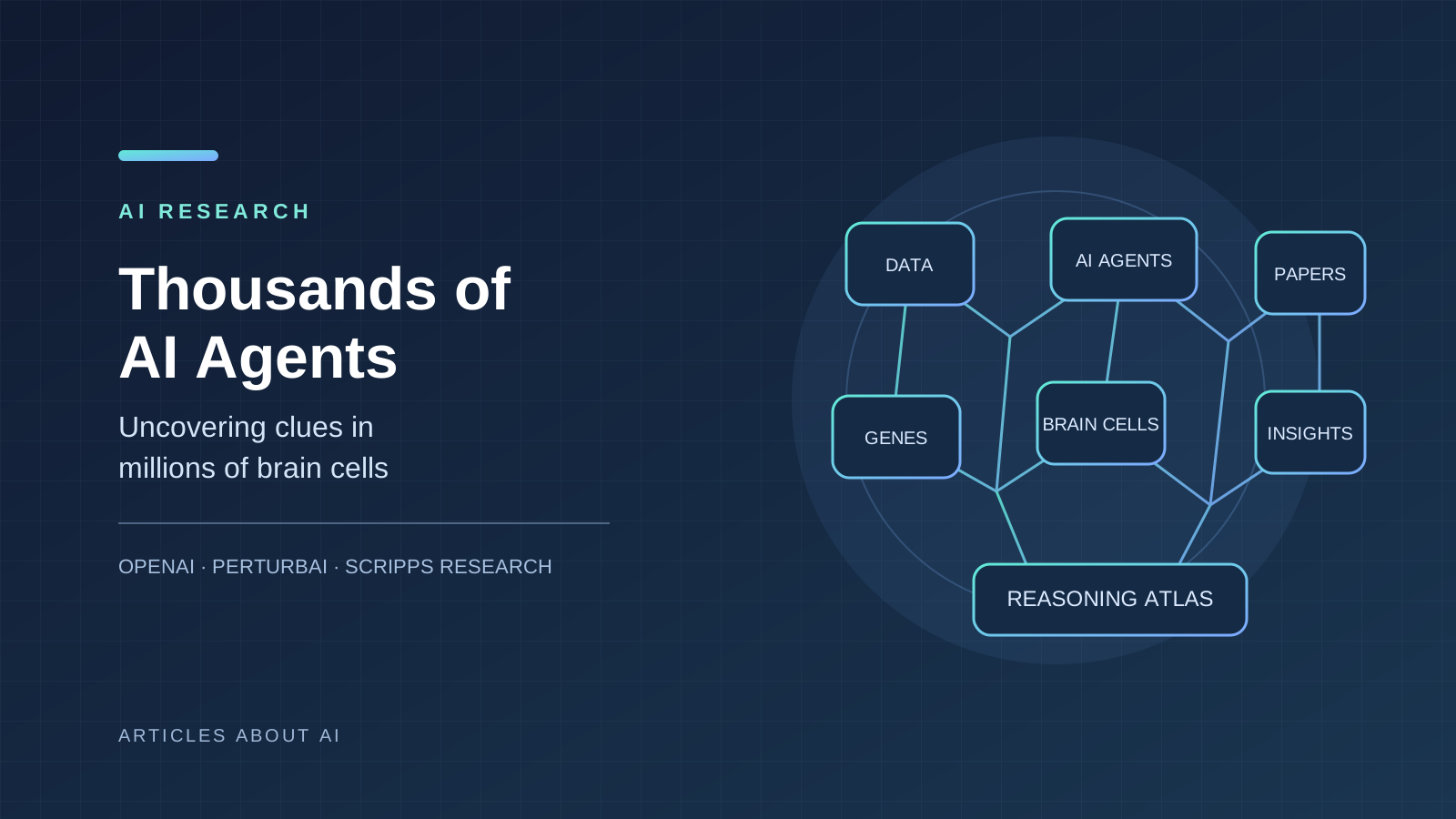
OpenAI, PerturbAI, and Scripps Research say they used thousands of AI agents powered by GPT-Rosalind to analyze experimental data from millions of mouse brain cells in 32 minutes. The system searched scientific literature, examined cellular responses to gene disruptions, and assembled potential biological explanations into a linked research resource the team calls a reasoning atlas.
The work, announced by OpenAI on October 21, 2026, illustrates how coordinated AI agents could help scientists explore large biological datasets and prioritize questions for follow-up experiments. It does not mean the system discovered a proven treatment for a brain disease. The biological connections described are research leads and hypotheses that need further experimental testing.
What did OpenAI and its research partners do?
The collaboration brought together OpenAI, PerturbAI, and Scripps Research. The team applied a distributed-reasoning workflow to a whole-brain CRISPR atlas containing data on how gene disruptions affect different cell types across the mouse brain.
Instead of asking one AI model to interpret the entire dataset sequentially, the researchers assigned many agents to individual parts of the analysis. Each agent examined a gene perturbation, interpreted cellular responses, searched relevant scientific literature, and proposed explanations for the observed effects. The results were then combined into a reasoning atlas linking genes, cell responses, publications, and possible biological mechanisms.
OpenAI reports that the distributed workflow completed the analysis in 32 minutes. The team estimated that a comparable process of human analysis and literature review, performed one perturbation at a time, could take months to a year. That is the researchers’ comparison estimate, not a controlled measurement showing that every scientific task can be completed this much faster.
Read the official OpenAI research announcement and the preprint on bioRxiv for the methodology and research context.
Why use thousands of AI agents instead of one model?
Large biological datasets contain many interacting signals. A gene disruption may affect different cell types in different ways, and a potentially useful explanation may depend on connecting an experimental result with findings scattered across multiple scientific papers.
A distributed multi-agent workflow divides a large task into smaller investigations that can run in parallel. The outputs can then be consolidated for researchers to review. In this project, the agents were used to scale analysis and literature coverage, not to replace experimental biology or scientific judgment.
OpenAI reports that the distributed system cited more than 700 references at the largest workload, compared with 11 references for a single-agent approach. The announcement also says blinded human experts preferred the distributed-agent reports over single-agent reports 75% of the time. These results are promising, but they should be interpreted within the study’s particular dataset, evaluation setup, and research team.
For more background on the operational challenges of multi-agent systems, see our guides to evaluating AI agents for reliability and monitoring AI agents in production.
A possible clue involving DCTN1 and cholesterol
One of the research leads involved DCTN1, a gene associated with Perry syndrome, a rare neurodegenerative disease that can include Parkinson-like symptoms.
According to OpenAI’s account, disrupting the mouse gene Dctn1 in the dataset increased expression of genes involved in cholesterol production. The agents connected that observation with existing research about cholesterol transport and neuronal function. They proposed a question for follow-up work: could disruption of intracellular cholesterol distribution contribute to neuronal dysfunction in this context?
That is a hypothesis, not a demonstrated disease mechanism or treatment. The data do not establish that changing cholesterol levels would treat Perry syndrome, nor do they show that an intervention identified by the agents is safe or effective in people. Researchers would need additional experiments to determine whether the proposed mechanism holds and whether it has therapeutic relevance.
The important point is how the AI workflow generated a testable research direction by connecting a signal in experimental data with relevant literature. Scientists must still establish whether that connection is biologically meaningful.
The agents also identified differences between Tsc1 and Tsc2
The OpenAI announcement describes another example involving Tsc1 and Tsc2, two genes involved in regulating the mTOR pathway, which influences cell growth and metabolism.
The analysis reportedly found that disrupting either gene had similar effects in several neuron groups, but their effects differed in the cerebellum. In that region, Tsc2 disruption altered the activity of many genes involved in neuronal communication, while Tsc1 disruption produced much smaller changes.
Such differences can be difficult to notice when a dataset contains thousands of perturbations and many cell types. A distributed workflow can help researchers compare more combinations and highlight observations that deserve closer investigation. The next step is not to accept the model’s explanation automatically, but to examine the underlying data and test the proposed biological interpretation.
What is GPT-Rosalind?
GPT-Rosalind is OpenAI’s model family for life-sciences research tasks. In this collaboration, it powered agents that interpreted biological data and connected experimental observations with scientific literature.
The work is an example of a broader shift from using AI only to summarize papers or answer isolated questions toward integrating models into multi-step research workflows. Such workflows can combine data analysis, literature retrieval, hypothesis generation, and synthesis of evidence.
That integration also introduces risks. An agent may misread a paper, overstate the strength of evidence, or combine two observations into a causal explanation that has not been demonstrated. A larger number of agents can expand coverage, but parallelism alone does not guarantee correctness. Traceable sources, reproducible analyses, expert review, and experimental validation remain essential.
For a broader look at how AI supports research workflows, read our guide to using Deep Research in ChatGPT. The methods are different, but both illustrate why source quality and human verification matter when AI synthesizes information.
What does this mean for drug discovery?
Drug discovery requires more than identifying a correlation or proposing a plausible mechanism. Researchers need to determine whether a target is causally involved in a disease, whether it can be safely modified, and whether an intervention produces a meaningful effect in appropriate experimental systems and eventually in clinical studies.
The potential value of distributed AI agents is earlier in that process: they may help scientists sift through large datasets, connect findings across disciplines, and rank hypotheses for further study. If this makes it easier to identify promising questions, researchers may be able to use limited experimental time and resources more effectively.
However, the 32-minute analysis should not be confused with 32 minutes to discover a drug. The underlying experiments and dataset already existed, and any proposed mechanism still requires follow-up work. The announcement demonstrates a method for analyzing existing evidence, not a completed drug-discovery pipeline or a validated treatment.
What are the limitations of this research?
Several qualifications matter when evaluating the announcement:
- The data came from mice. Findings in mouse brain cells do not automatically translate to human biology or clinical outcomes.
- Hypotheses are not proof. Proposed links, including the DCTN1-cholesterol connection, need experimental testing.
- Speed depends on the task. The 32-minute figure applies to this analysis workflow and should not be generalized to every research problem.
- The evaluation has a defined scope. Report preferences and citation counts are useful signals, but they do not alone establish scientific correctness.
- AI can make interpretation errors. Researchers need to inspect evidence, verify citations, and test important conclusions independently.
- The work is part of an active research process. New experiments may strengthen, refine, or reject the proposed explanations.
These limitations are normal for early-stage research leads. The proper question is whether the system helps scientists produce useful, verifiable hypotheses—not whether it can replace the scientific method.
What researchers should watch next
The most important follow-up will be whether scientists can reproduce and experimentally validate the leads generated by the agents. The reasoning atlas may help researchers inspect relationships among genes, cell responses, and relevant publications, while further studies can test which hypotheses survive closer scrutiny.
It will also be useful to see how the approach performs on other biological datasets and research questions. Generalizing from one atlas to other tissues, organisms, or disease areas requires evidence; it should not be assumed from the initial demonstration.
The bioRxiv preprint provides a research-paper view of the work, while the OpenAI announcement explains the collaboration and examples in more accessible language.
Bottom line
OpenAI, PerturbAI, and Scripps Research have demonstrated a way to deploy thousands of GPT-Rosalind agents in parallel to analyze a large mouse-brain dataset and generate research leads quickly. The reported DCTN1 and Tsc1/Tsc2 observations show how distributed AI reasoning may help surface questions that researchers can investigate further.
The achievement is best understood as AI-assisted evidence synthesis and hypothesis prioritization, not an AI-discovered cure. Its scientific value will ultimately depend on reproducibility, expert assessment, and experiments that establish which proposed biological mechanisms are real.