
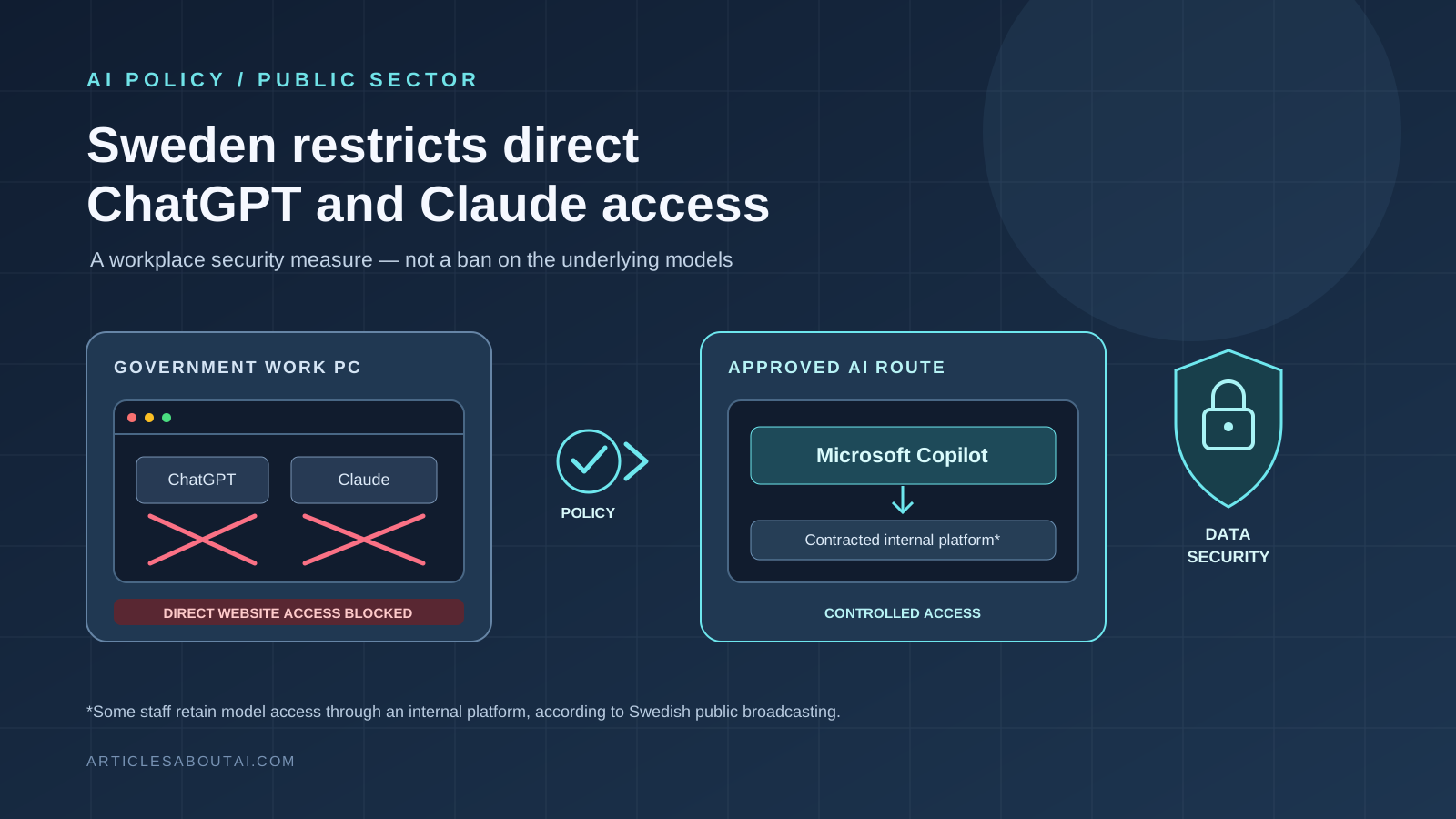
Sweden’s Government Offices are restricting direct access to the ChatGPT and Claude websites from employees’ work computers starting October 26, 2026. Staff are being directed to use approved AI services, including Microsoft Copilot, following a security review. The decision was reported by Swedish public broadcaster Sveriges Radio’s Ekot and separately covered by SVT Nyheter.
The measure is best understood as a workplace access restriction, not a nationwide ban on ChatGPT or Claude. Reports say some staff can still reach the underlying models through an internal AI platform, subject to the organisation’s arrangements.
What exactly is Sweden restricting?
According to Sveriges Radio Ekot and SVT Nyheter, the browser interfaces for ChatGPT and Claude will no longer be available from the Government Offices’ service computers from Monday, October 26.
The reported change concerns direct access to the public websites on work devices. It does not mean that every Swedish public employee or every resident is prohibited from using these services, and it does not mean that the models themselves have been shut down.
The reported arrangements are:
- ChatGPT website: direct access blocked on Government Offices work computers from October 26.
- Claude website: direct access blocked on those work computers from October 26.
- Microsoft Copilot: approved for staff following a review and additional security measures.
- Internal AI platform: some employees reportedly retain access to ChatGPT and Claude models through the Government Offices’ own platform.
- Other agencies: Ekot reports that the Swedish Tax Agency and the National Board of Institutional Care had also restricted AI services, while the Enforcement Authority was considering its position.
The public reports do not provide a complete technical specification of the website block or disclose every setting applied to the approved Copilot environment.
Why is the Swedish government taking this step?
The stated concern is information security. Sveriges Radio reported a comment from digitalisation director Mikael Wettercrantz, who warned that using AI services without an agreement could have consequences for the organisation’s information security.
The concern is not simply which AI model produces the best answer. When staff paste information into an external AI service, an organisation needs to understand what data is sent, how it is handled, what contractual protections apply, and whether employees are following approved procedures.
Unmanaged use of public AI tools can create several risks:
- Sensitive information exposure: staff may paste confidential, personal, or operational details into a service that has not been approved for that data.
- Unclear data-handling terms: consumer accounts and enterprise agreements may offer different contractual protections, administrative controls, and data-retention arrangements.
- Unverified AI-generated output: staff may rely on inaccurate answers or introduce generated material into official work without adequate checking.
- Fragmented oversight: when employees use multiple unapproved tools, an organisation can struggle to audit usage, enforce policy, and respond to incidents.
- Inconsistent access controls: personal accounts may not provide the central management, identity controls, and logging required in a government environment.
These are general information-security considerations, not claims that every one of these failures occurred in the Swedish Government Offices.
Why is Microsoft Copilot allowed?
SVT and Sveriges Radio report that the Government Offices reviewed Copilot and increased its security protections before approving it for staff use. The outlets did not publish the full technical details of that review or enumerate all the changes.
The distinction therefore appears to be based on organisational approval and security arrangements, rather than a public finding that one underlying AI model is universally safe and another is universally unsafe.
A properly managed enterprise AI service can provide an organisation with contractual terms, account administration, access policies, and other controls. The exact protections depend on the product configuration and contract. Approval should not be treated as a guarantee that every prompt or generated answer is safe to use.
Reports also say that some employees retain access to ChatGPT and Claude models through an internal platform developed or procured by the Government Offices. That detail is important: the restriction targets direct website access on work computers, not necessarily every route to the models.
Is Sweden banning ChatGPT and Claude completely?
No. Based on the reporting from Sveriges Radio and SVT, the change applies to direct access to the two websites from Government Offices work computers. Some employees are reportedly still able to use the models through an internal platform.
It is also not a nationwide ban on private citizens using ChatGPT or Claude. The decision described in these reports concerns how a government workplace manages AI services on its own devices.
Readers should avoid interpreting the headline as proof that Sweden has prohibited the products across the country or that all government access to the models has ended.
Other Swedish agencies are reviewing AI use
Sveriges Radio’s reporting says similar restrictions had already been introduced at the Swedish Tax Agency and the National Board of Institutional Care (Statens institutionsstyrelse, or SiS). The Enforcement Authority (Kronofogden) was reportedly preparing to take a position.
The broadcaster also discussed an internal audit at the Swedish Transport Administration (Trafikverket) that found widespread and risky use of multiple AI services. The reported concerns included the sensitivity of information entered into public AI tools and how generated responses were handled.
These reports suggest that the issue extends beyond one chatbot. Public organisations need policies for all external AI services, including tools employees may adopt without formal approval.
What businesses can learn from Sweden’s decision
The case offers practical lessons for any organisation deciding how employees should use generative AI.
1. Publish an approved-tools list
Employees need to know which AI services are approved for work, which data they may use with each service, and where to request access to alternatives.
2. Match tools to data sensitivity
A general-purpose assistant may be appropriate for public information but not for confidential records. Define which data categories may be entered into each tool, and prohibit sensitive inputs where the organisation has not approved the service for that purpose.
3. Review contracts and configurations
Security teams should examine data-processing terms, retention, training settings, identity controls, administrative features, and audit capabilities. Do not assume that two products offer equivalent protections simply because both use advanced AI models.
4. Provide a workable approved alternative
Blocking a website without offering a usable replacement can push employees toward personal devices or less visible workarounds. An approved service should meet legitimate work needs while applying the organisation’s controls.
5. Train employees and monitor policy compliance
Explain why restrictions exist and give staff examples of prohibited data. Where lawful and proportionate, use administrative controls and logging to identify risky usage and improve the policy.
For further reading, see our guides to Claude Duet safety and privacy, evaluating AI agent reliability, and AI agent observability and production tracing.
Does this mean Copilot is safer than ChatGPT or Claude?
The reported decision does not establish that Copilot is inherently safer than ChatGPT or Claude in every situation. It establishes that the Swedish Government Offices selected Copilot as an approved option after reviewing and tightening its security, while restricting direct access to the other two websites on work computers.
Security depends on the service edition, configuration, contract, data classification, user permissions, and the way a tool is used. A government-approved deployment can be more suitable for a particular organisation even when the underlying models are capable of similar tasks. Conversely, approval does not eliminate the need for careful use and oversight.
The Government Offices has not publicly detailed every control in the Copilot configuration in the reports cited here, so more specific comparisons would be speculative.
Key takeaways
- Sweden’s Government Offices began restricting direct ChatGPT and Claude website access from staff work computers on October 26, 2026.
- The stated reason is information security and the need to use approved services with suitable arrangements.
- Microsoft Copilot remains an approved option after a review and additional security measures, according to Swedish public broadcasters.
- Some staff reportedly retain access to ChatGPT and Claude models through an internal AI platform.
- This is a workplace access restriction, not a nationwide ban on the products or proof that one model is always safer than another.
- Organisations should define approved AI tools, classify data, review contracts, provide usable alternatives, and train employees.
The broader lesson is that responsible AI adoption requires more than choosing a capable model. Organisations also need clear rules for data, contracts, access, and accountability.