
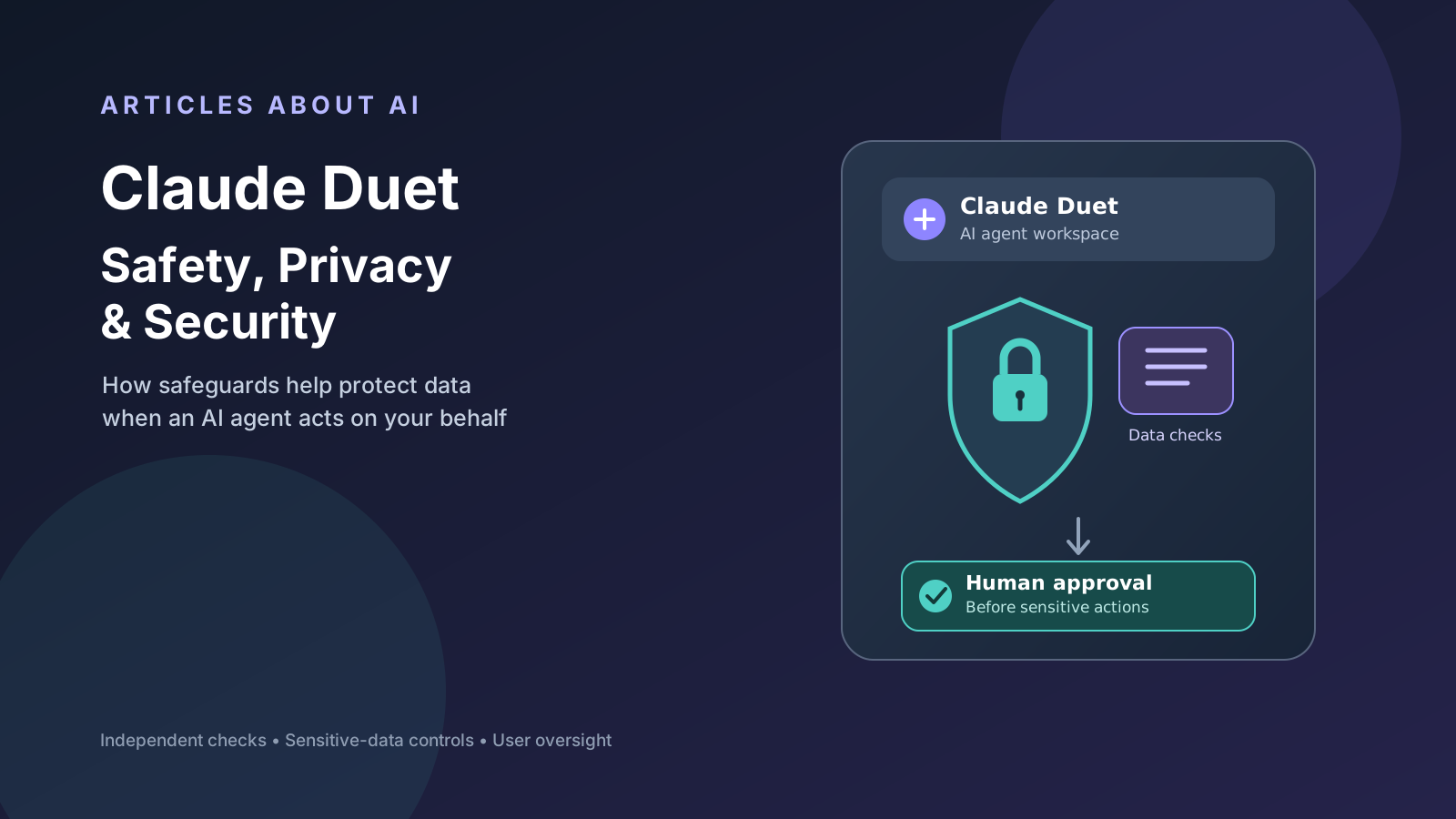
Anthropic published a dedicated explanation of Claude Duet’s safety, privacy, and security protections on October 23, 2026. The update matters because Duet is designed to work across connected apps, read information, prepare messages, and continue tasks while a user is away. That convenience also creates a clear security challenge: an AI agent must know what information it can use, where it can send that information, and when it must stop for approval.
Anthropic says Claude Duet combines safety training in the Claude model with product-level safeguards and additional checks for an agent acting across accounts. These controls reduce specific risks, but they do not make an early research-preview product risk-free.
What Anthropic announced
The October 23 update describes several layers of protection for Claude Duet:
- A separate check for sensitive information in messages the agent drafts.
- Approval steps before important actions, including sending messages, making payments, signing documents, or deleting content.
- An automated action check designed to assess whether a proposed action matches the user’s intent.
- Defenses against prompt injection and hidden instructions in webpages or other content the agent reads.
- Security testing that includes adversarial testing, an external penetration test, and coverage under Anthropic’s public bug bounty program.
These safeguards are intended to work together rather than rely on the model alone. Read Anthropic’s official Claude Duet safety, privacy, and security announcement for the company’s full explanation.
1. Sensitive information gets additional checks
An agent that reads email and drafts replies can encounter information that should not be shared with every recipient. Anthropic says Claude Duet uses a dedicated safety classifier and safety prompt to check messages before they are sent.
The company describes two broad categories:
- Never share: highly sensitive information such as sign-in credentials, full payment-card or bank-account numbers, and government identification numbers. The system is designed to refuse sharing these details, even when asked.
- Share only with consent: other private information, including health or financial details, may be shared when the user has explicitly instructed Duet to send it.
For example, a request to send a dentist a note about a health issue can provide consent for that specific disclosure. It does not mean the agent should include unrelated private information in a team-wide update.
The classifier is an additional safeguard, not a guarantee that every message will be classified correctly. Anthropic acknowledges that the system may sometimes miss sensitive content or flag harmless material.
2. Important actions require user approval
Claude Duet is designed to prepare work in the background, but Anthropic says it pauses for approval before actions such as sending a message, making a payment, signing a document, or deleting something. The approval request shows the action and the information needed for the user to make a decision.
A separate automated check evaluates the proposed action against the user’s intent. Anthropic says this check runs outside the model doing the task, helping prevent instructions hidden in a webpage from controlling the approval decision.
Some actions remain prohibited even if the user approves them. Anthropic gives examples including securities trading and moving money between bank accounts. The precise restrictions can vary by action and product rules, so users should review the approval details rather than assume every action is permitted.
Practical advice: Treat an approval card like a real authorization request. Check the recipient, destination, amount, content, and consequences before approving it.
3. Prompt injection is a specific risk
AI agents may read emails, documents, and webpages written by other people. Those sources can contain malicious instructions that try to persuade an agent to disclose information or perform an unrelated action. This is commonly called prompt injection.
Anthropic says Claude Duet uses defenses informed by its browser-use research, along with safeguards that check proposed actions. The browser environment also has boundaries: the agent operates it through a fixed set of commands, while webpage text and downloads may still need to be read for a task.
These measures can reduce exposure, but users should still be careful when connecting accounts and delegating tasks. Avoid asking an agent to handle more information or permissions than a task requires.
For broader context, see our guides to AI agent reliability and AI agent observability and production tracing.
4. Credentials and connected apps
Anthropic says Claude Duet follows a credential-handling design used by Claude Managed Agents, intended to keep passwords and sign-in tokens out of the model itself. The company also describes controls around the browser environment and connected apps.
Users can disconnect an app to stop future access. However, Anthropic notes that information already learned from an app may remain in Duet’s memory until that memory is reset. Disconnecting a connector should therefore not be treated as the same thing as erasing information already retained.
Before connecting a work account:
- Connect only the apps needed for the task.
- Review which data and actions each connection enables.
- Avoid placing passwords or authentication tokens in prompts.
- Disconnect integrations you no longer need.
- Review memory and history settings if you want previously retained context cleared.
If you’re comparing assistants, our ChatGPT vs. Claude vs. Gemini comparison explains how to assess tools against your own workflow rather than relying on a single headline feature.
5. How Anthropic says it tested Duet
Anthropic says its safeguards team developed evaluations based on routine-like tasks, including scenarios with malicious injected instructions and cases that tempt an agent to do more than requested. The company also reports red-team testing focused on data leaks, unauthorized actions, and malicious prompts, as well as an external penetration test with source-code access.
Claude Duet is included in Anthropic’s public bug bounty program, according to the announcement. The company says testing and tuning are ongoing as it learns from research-preview use.
These are company-reported testing measures; they should not be interpreted as proof that all vulnerabilities have been found or eliminated.
What this means for users
Claude Duet’s design reflects a central principle for agentic AI: access, information handling, and permission to act need separate controls. A system may be allowed to read a document without being allowed to send its contents to another person. It may prepare a payment without being allowed to complete it automatically.
For individuals and businesses, the sensible approach is to:
- Start with low-risk, narrowly defined tasks.
- Use explicit instructions about recipients and what information may be shared.
- Review approvals carefully, especially for external messages and financial actions.
- Keep connected-app permissions limited.
- Verify important outputs against the original email, file, or record.
- Remember that a research preview can change and may still make mistakes.
For related practical guidance, read How to Use Claude Duet: Setup, AI Agent Workflows, Safety, and Usage Limits and How to Fix Claude AI Not Responding.
Is Claude Duet completely private and secure?
No AI agent should be described as completely secure. Anthropic has outlined specific protections for sensitive information, approvals, credentials, and prompt injection, while also acknowledging that these safeguards will continue to evolve. The announcement is useful evidence of the protections the company says it has implemented, not an independent guarantee that every risk has been removed.
Claude Duet remains a research preview, so users should check the official product and safety documentation for current availability and limitations before relying on it for sensitive workflows.