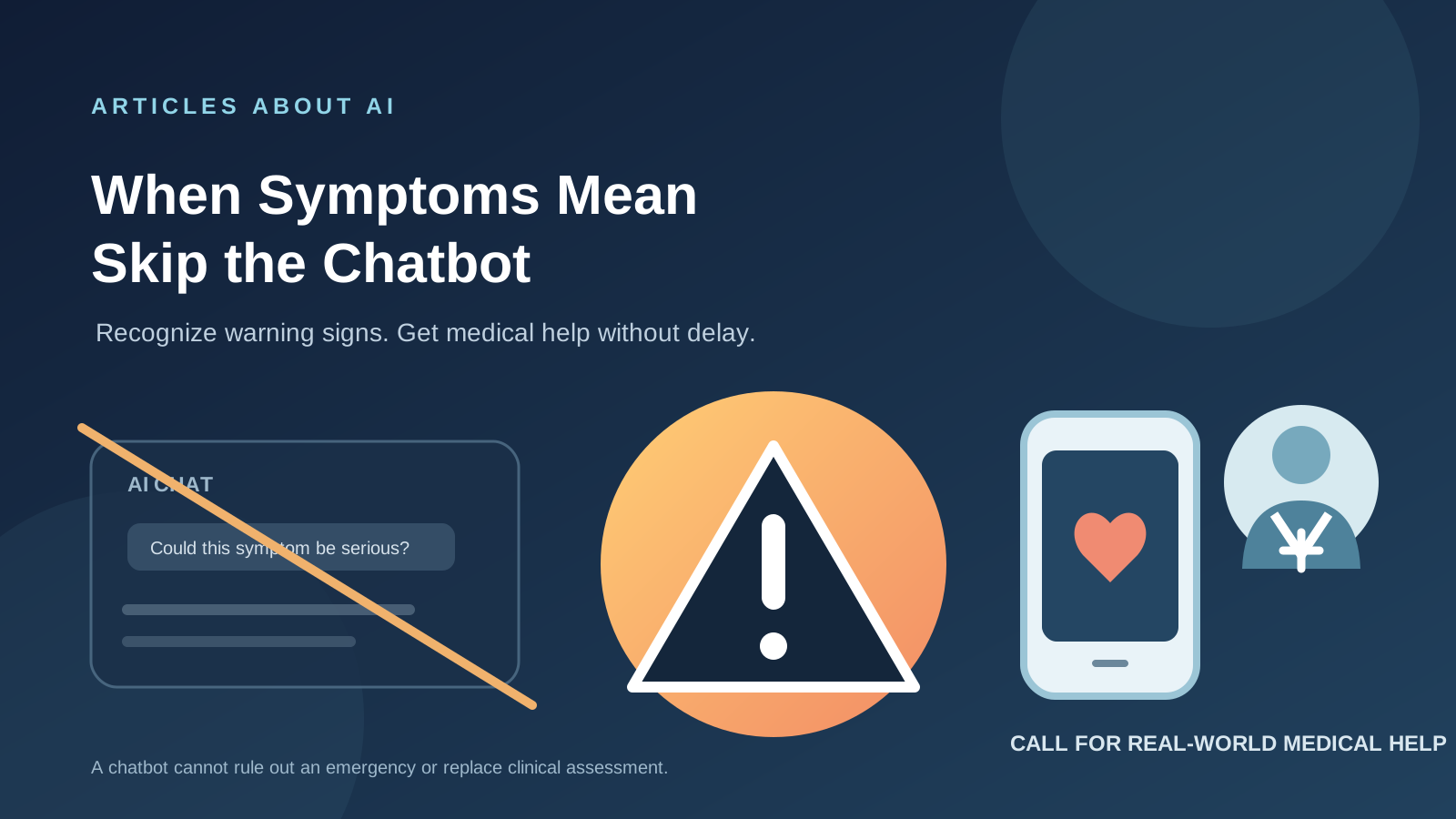
An AI chatbot can explain a medical term, summarize general health information, or help you prepare questions for an appointment. But there are moments when asking another question is the wrong next step. If symptoms could signal a medical emergency, the priority is to contact emergency services—not to wait for a chatbot to interpret them.
The difficult part is recognizing when a symptom needs immediate attention, prompt medical advice, or a routine appointment. A chatbot cannot reliably make that decision for you. It cannot examine you, measure vital signs, perform tests, or rule out a dangerous condition through a conversation.
This guide explains warning signs that should take you away from an AI chat and toward appropriate medical care. It is general safety information, not a diagnostic checklist. Symptoms and emergency procedures vary, and the examples below are not exhaustive.
Important: If you think you or someone else may be experiencing a life-threatening emergency, contact your local emergency number or emergency medical service now. Do not delay to ask an AI chatbot, search online, or finish reading this article.
1. Call emergency services instead of asking AI
Some symptoms can indicate conditions in which minutes matter. Do not use a chatbot to decide whether these symptoms are serious enough. Seek emergency help immediately if a person has any of the following warning signs.
Chest pain, pressure, or possible heart attack symptoms
New, sudden, severe, persistent, or unexplained chest discomfort needs urgent assessment. Heart attack symptoms may include:
- Pressure, squeezing, tightness, fullness, or pain in the center of the chest.
- Discomfort that spreads to one or both arms, the back, neck, jaw, or stomach.
- Shortness of breath, with or without chest discomfort.
- Cold sweating, nausea, vomiting, or light-headedness alongside chest discomfort.
Symptoms do not look exactly the same in every person. Do not wait for a chatbot to compare your symptoms with a list or reassure you that the pain is probably indigestion.
The American Heart Association’s heart attack and stroke warning signs and the NHS heart attack guidance explain symptoms that require emergency action.
Sudden signs of a stroke
A stroke is an emergency. Warning signs can appear suddenly and include:
- Face: one side of the face droops or feels numb.
- Arms: weakness or numbness, particularly on one side; one arm may drift down.
- Speech: slurred speech, difficulty speaking, or difficulty understanding others.
- Balance: sudden dizziness, loss of balance, or difficulty walking.
- Eyes: sudden trouble seeing in one or both eyes.
- Time: seek emergency help immediately if any of these signs appear.
A useful public-health reminder is B.E. F.A.S.T.: Balance, Eyes, Face, Arms, Speech, Time. Even if the symptoms disappear after a short time, do not dismiss them or wait for an AI response. A brief episode can still require urgent medical assessment.
See the U.S. Centers for Disease Control and Prevention’s stroke signs and symptoms.
Severe difficulty breathing
Do not ask a chatbot to assess severe breathing problems. Emergency warning signs include gasping, choking, being unable to speak normally because of breathlessness, or breathing difficulty accompanied by chest tightness, collapse, or a blue or unusually pale appearance.
Sudden severe breathlessness can have several causes, some of them life-threatening. The NHS guidance on shortness of breath explains when immediate emergency help is needed.
Unconsciousness, collapse, or a seizure that does not stop
Seek emergency help if someone is unresponsive, cannot be woken, is not breathing normally, has collapsed and does not recover promptly, or has a seizure that is prolonged or followed by failure to regain normal awareness.
A chatbot cannot assess consciousness, breathing, or the cause of a seizure remotely. Do not spend time describing the episode to an AI tool when emergency assistance is needed.
Severe bleeding or a serious injury
Emergency assessment is needed for bleeding that will not stop, major injuries, serious burns, suspected head or spinal injuries with concerning symptoms, or injuries accompanied by fainting, confusion, or difficulty breathing.
Do not rely on an AI-generated first-aid answer to determine whether a serious injury can be managed at home. Contact emergency services when the situation may be life-threatening.
Severe allergic reaction
A rapidly developing reaction involving breathing difficulty, swelling of the tongue or throat, collapse, or severe dizziness can be life-threatening. Do not wait for a chatbot to identify the allergen or confirm the diagnosis. Seek emergency help immediately.
Sudden confusion or other severe, unexplained symptoms
Sudden confusion, inability to speak, sudden loss of movement or vision, severe abdominal pain, coughing or vomiting blood, or a sudden unusually severe headache can also signal a serious problem. The MedlinePlus guide to recognizing medical emergencies lists a range of warning signs that require immediate attention.
These examples are not a complete list. If a person’s condition is rapidly worsening or you believe their life may be in danger, contact emergency services even if the symptom is not listed here.
2. Contact a healthcare professional promptly—even if it may not be an emergency
Not every concerning symptom requires an ambulance or emergency department. But some symptoms should not be left to repeated chatbot conversations or an indefinite wait.
Contact a doctor, nurse advice service, urgent care service, or another qualified healthcare professional promptly if:
- A symptom is new, persistent, worsening, or repeatedly returning.
- You have a fever or infection symptoms that are getting worse or are accompanied by significant weakness or dehydration.
- Pain is unexplained, increasing, or interfering with normal activities.
- You develop a new rash, swelling, or other reaction after starting a medicine.
- You are concerned about a medication side effect, interaction, or dosing error.
- You have a new symptom while living with a serious medical condition.
- You are pregnant or recently gave birth and develop a symptom that concerns you.
- A child, older adult, or person who cannot clearly describe their symptoms seems unusually unwell.
The right level of urgency depends on the person’s age, medical history, severity of symptoms, and other circumstances. If you are unsure whether a symptom is an emergency, use an official local medical advice line or contact an appropriate healthcare service for real-time guidance. If the person deteriorates or develops emergency warning signs, escalate to emergency services.
A chatbot can help you write down what changed and when it started. It should not be the service that decides whether you can safely wait.
3. When is a routine appointment more appropriate?
Some health questions are not emergencies but still deserve a professional conversation. A routine appointment may be suitable for issues such as:
- Symptoms that are mild and stable but have not resolved.
- Ongoing digestive, sleep, skin, or pain concerns.
- Questions about preventive screening or vaccinations.
- Follow-up on an existing diagnosis or treatment plan.
- Non-urgent questions about test results or medicines.
- A health concern that is affecting daily life or causing persistent worry.
A routine appointment is not the right choice if symptoms become severe, sudden, or rapidly worse. The key is to avoid letting an AI chatbot downgrade a symptom simply because it produces a reassuring explanation.
If you already have a clinician or care team, follow the advice they gave you about when to call and what changes should trigger earlier review.
4. Why an AI chatbot cannot safely rule out an emergency
AI chatbots can produce plausible explanations, but a conversation is not a clinical examination. There are several reasons not to rely on a general-purpose AI assistant for emergency triage.
It cannot examine you or measure vital signs
A chatbot cannot directly assess breathing effort, skin temperature, blood pressure, pulse, oxygen levels, consciousness, or neurological function. It may ask questions, but the answers are not a substitute for measurements and examination when those are needed.
It may not recognize the most important detail
People often describe symptoms in everyday language. They may leave out timing, severity, associated symptoms, or relevant medical history. An AI model can misunderstand a description or focus on a less important detail.
It can sound certain when the situation is uncertain
A fluent explanation can create false reassurance. A chatbot might list common, non-serious causes while failing to give enough weight to a dangerous possibility. A confident tone does not prove that an emergency has been excluded.
It may not know your complete medical context
Age, pregnancy, existing conditions, medicines, allergies, recent surgery, and other factors can change the urgency of a symptom. A general-purpose chatbot may not have reliable access to this information, and a user may not know which details matter.
Repeated prompts do not make the assessment clinical
Asking the same question in different ways, requesting a confidence score, or asking an AI to “be certain” does not turn the conversation into a medical assessment. If the symptoms warrant professional attention, stop prompting and contact the appropriate service.
For more background, read What AI Can and Cannot Tell You About Your Symptoms.
5. What to do while arranging medical help
When you have recognized a possible emergency, focus on getting appropriate help. Do not spend time trying to obtain a diagnosis from a chatbot.
- Contact your local emergency number or emergency medical service when emergency warning signs are present.
- Follow the instructions given by the emergency call handler or medical professional.
- Do not drive yourself if you may be experiencing a serious emergency; follow emergency-service advice about transport.
- If possible, note when the symptoms began or when the person was last known to be well. This can be important for clinical assessment, particularly with possible stroke symptoms.
- Share relevant information about medicines, allergies, medical conditions, and recent changes with the healthcare team when it is safe and practical to do so.
- If the person’s condition changes while waiting, tell the emergency service.
For non-emergency concerns, contact a qualified healthcare professional or an official medical advice service. Explain the main symptom, when it began, whether it is getting worse, and any relevant medical history.
6. Can AI still help after you have contacted a doctor?
Yes—provided it does not delay care or replace professional instructions. Once urgent concerns have been addressed, an AI tool may help with lower-risk tasks such as:
- Explaining unfamiliar medical terms in plain language.
- Turning a clinician’s written instructions into a list of questions to clarify.
- Organizing a symptom timeline for an appointment.
- Preparing questions about a diagnosis or treatment plan.
- Summarizing general information from reliable health organizations.
Do not use AI to overrule a clinician’s instructions, change prescribed medication, or decide that follow-up is unnecessary. If an AI explanation conflicts with medical advice, ask the healthcare professional who knows your situation to clarify the difference.
Our guide Five Questions to Ask Before Trusting an AI Health Answer explains how to check sources, evidence, uncertainty, relevance, and privacy before relying on health information generated by AI.
You can also read Why So Many Americans Ask AI Before They Ask Their Doctor to understand why people use chatbots for health information—and why access and convenience do not make AI a replacement for clinical care.
A simple decision rule: emergency, prompt advice, or routine care
| Situation | Appropriate next step |
|---|---|
| Possible life-threatening symptoms, severe breathing difficulty, stroke signs, severe chest pain, unconsciousness, or uncontrolled serious bleeding | Contact local emergency services immediately |
| New, worsening, persistent, or concerning symptoms without clear emergency signs | Contact a healthcare professional or official medical advice service promptly |
| Mild, stable, non-urgent concerns or planned follow-up | Arrange a routine appointment or ask your care team |
| General questions after urgent issues have been assessed | AI may help explain information and prepare questions, with verification |
This table is a broad guide, not a diagnostic tool. When in doubt about a potentially serious symptom, seek real medical advice rather than relying on a chatbot to decide.
Frequently asked questions
Should I ask ChatGPT about severe symptoms?
No. If symptoms are severe, sudden, rapidly worsening, or potentially life-threatening, contact emergency services or seek emergency medical care. Do not wait for ChatGPT or another AI chatbot to assess the situation.
What symptoms should never be checked by an AI chatbot first?
Do not use a chatbot as the first response to possible heart attack symptoms, stroke signs, severe difficulty breathing, unconsciousness, a prolonged seizure, severe bleeding, a severe allergic reaction, or another rapidly worsening condition. Seek emergency help.
Can an AI symptom checker tell me whether I need the emergency room?
A general-purpose chatbot cannot reliably rule out an emergency. It may provide general information, but it cannot perform an examination or assess all the clinical details needed for safe triage. Use emergency services or qualified medical advice when symptoms are concerning.
What if my symptoms go away after a few minutes?
The disappearance of a symptom does not always mean the danger has passed. For example, stroke-like symptoms that resolve can still require urgent medical assessment. Do not use an AI chatbot to decide that a serious episode can be ignored.
When should I call a doctor instead of going to the emergency department?
The appropriate service depends on the symptoms and their severity. For mild, stable concerns, a routine appointment may be suitable. For new or worsening symptoms, contact a healthcare professional or official medical advice service promptly. For life-threatening warning signs, contact emergency services immediately.
Is it safe to use AI after a medical appointment?
It can be useful for explaining general terminology or preparing follow-up questions. However, do not use an AI answer to change medication, ignore a clinician’s instructions, or replace recommended follow-up. Confirm important or conflicting information with your healthcare team.
The bottom line
AI chatbots can help explain health information, but they cannot reliably determine whether a dangerous condition is present. Severe chest pain, stroke symptoms, serious breathing difficulty, unconsciousness, severe bleeding, and other emergency warning signs call for real medical help—not another prompt.
Use AI for general education only when it is appropriate. When symptoms are urgent, skip the chatbot and contact emergency services or a qualified healthcare professional. Your safety should never depend on whether an AI system sounds confident.
Sources and further reading
- U.S. Centers for Disease Control and Prevention — Signs and Symptoms of Stroke. Official guidance on sudden stroke symptoms and the need for immediate emergency action.
- American Heart Association — Heart Attack and Stroke Symptoms. Warning signs of heart attack, stroke, and cardiac arrest.
- MedlinePlus, U.S. National Library of Medicine — Recognizing Medical Emergencies. Overview of emergency warning signs in adults.
- NHS — Heart Attack. Symptoms that can indicate a heart attack and when emergency help is required.
- NHS — Shortness of Breath. Guidance on severe breathing difficulty and immediate action.
- MedlinePlus, U.S. National Library of Medicine — When to Use the Emergency Room. Examples of symptoms and injuries that may require emergency assessment.
This article is for general educational purposes only. It is not medical advice, does not diagnose or triage an individual, and does not replace emergency services or care from a qualified healthcare professional.