
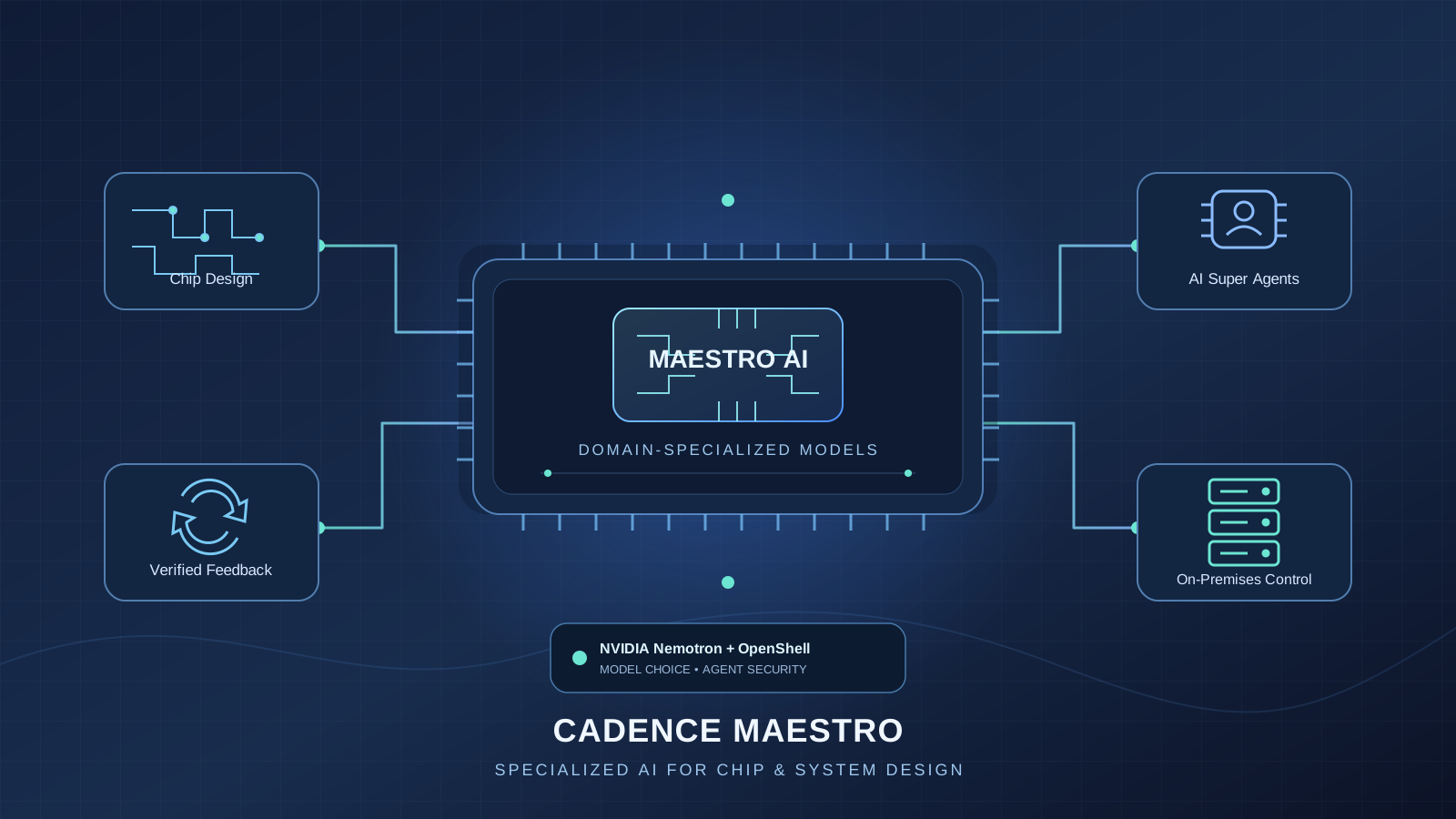
Cadence has introduced Maestro, a portfolio of domain-specialized AI models designed to power AI agents across semiconductor and system-design workflows. Announced on October 26, 2026, at 9:00 a.m. Eastern Daylight Time (13:00 UTC), the portfolio combines specialized models, trained decision models, and agent skills with Cadence’s electronic design automation (EDA) and system design automation (SDA) tools. The launch matters because it moves more engineering-specific knowledge into the models that operate design tools, while giving customers options for cloud or customer-controlled on-premises deployment.
This guide explains what Cadence Maestro is, how its NVIDIA integration works, what the company has—and has not—demonstrated, how deployment and data control are described, and how the approach compares with Synopsys’s announced work with OpenAI. The article is based on Cadence’s launch announcement and independent reporting; Articles About AI has not independently benchmarked Maestro.
What is Cadence Maestro?
Cadence Maestro is not presented as one general-purpose chatbot. It is a portfolio of domain-specialized AI models that works with Cadence’s AI Super Agents and established EDA and SDA tools. The portfolio includes post-trained large language models, trained decision models, and agent skills intended to support complex chip and system design tasks.
In the workflow described by Cadence, an agent interprets a high-level engineering objective, breaks it into tasks, selects and orchestrates appropriate models, calls design tools, evaluates outputs, and uses the results to guide subsequent decisions. The goal is to combine broad reasoning from frontier and open-weight models with domain-specific engineering knowledge and tool feedback.
That distinction is important. A general-purpose model can explain hardware concepts or draft code, but production design workflows must satisfy precise engineering constraints. The result must be evaluated against specifications and tool outputs, not judged only by whether its explanation sounds plausible. Cadence says Maestro is intended to bring specialized intelligence closer to the engineering tools and feedback loops that determine whether a design meets its objectives.
Key features in the Cadence Maestro AI model portfolio
1. Domain-specialized models for engineering
The Maestro portfolio is designed for semiconductor and system-design work rather than unrestricted everyday conversation. Cadence describes a combination of post-trained language models, decision models, and reusable agent skills. Different model sizes and architectures can be used for different stages of a workflow.
A specialized portfolio may help an agent route a task to a model that is better suited to the engineering subproblem. However, the public announcement does not identify every underlying model, disclose all training data, or publish a complete per-task evaluation suite. Readers should not infer that every model in the portfolio is available to all customers today.
2. Integration with Cadence AI Super Agents
Cadence says Maestro powers its AI Super Agents, including:
- AuraStack for relevant engineering and design workflows.
- ChipStack for chip-design and verification workflows.
- InnoStack for implementation and physical-design workflows.
- ViraStack for custom and analog design workflows.
The portfolio is intended to work with Cadence’s EDA and SDA tools rather than replace those tools. The agents interpret design intent, decompose work, invoke the appropriate models and tools, inspect results, and help engineers evaluate trade-offs. Exact capabilities depend on the agent, supported product, customer environment, and rollout.
For readers following AI agents more broadly, our guide to creating reusable Codex skills and plugins for AI workflows explains why specialized instructions and tool integrations are different from simply choosing a larger language model.
3. Reinforcement learning and engineering feedback
One of Cadence’s central claims is that Maestro sits inside a vertically integrated learning environment. The environment connects domain knowledge, curated engineering datasets, AI Super Agents, EDA/SDA tools, evaluation harnesses, and reinforcement-learning feedback loops.
Cadence says deterministic solvers and engineering tools can evaluate outputs against objectives, constraints, and ground truth. Those evaluations can then inform further model and agent improvement. In principle, grounding feedback in measurable engineering results is more meaningful than relying only on a language model’s self-assessment.
The announcement describes the architecture and its intended learning process, but it does not publish enough detail to independently reproduce every claimed improvement. It also does not establish that the system can autonomously complete every design task without engineering review. Designers still need to validate results against project requirements, verification flows, and sign-off criteria.
NVIDIA integration: Nemotron and OpenShell
Cadence’s launch announcement identifies NVIDIA Nemotron as part of the model portfolio and NVIDIA OpenShell as part of the agent-security collaboration. NVIDIA’s stated role includes contributing model technology and working with Cadence on grounding reinforcement learning in feedback from EDA tools and deterministic solvers.
The two names serve different purposes in the announcement:
- NVIDIA Nemotron is an open-weight model family used as part of the model approach. Open weights can give organizations more control over deployment and adaptation than a service that exposes only a hosted API, although the exact rights, hardware requirements, and terms depend on the specific model and license.
- NVIDIA OpenShell is associated with the security architecture for AI agents. Its presence should not be interpreted as proof that every possible agent action is automatically safe or that deployment requires no additional controls.
Cadence says the portfolio can combine domain-specialized models with leading frontier and open-weight models. This model choice is relevant to engineering teams that must balance task quality, cost, latency, security, and infrastructure constraints. The announcement does not identify all models that can be selected in every configuration, so customers should verify the supported combinations with Cadence.
For additional context on model deployment choices, see our guide to open-weight vs. closed AI models in 2026. The practical distinction is not simply “open is better” or “closed is safer”: model licenses, hosting, access controls, data handling, and operational responsibility all matter.
Can Cadence Maestro run on-premises?
Yes. Cadence says the complete agentic environment—including AI Super Agents, the Maestro model portfolio, and EDA tools—can run on Cadence’s secure cloud platform, supported public-cloud environments, or customer-controlled on-premises infrastructure. The stated aim is to give customers flexibility around data privacy, security, and deployment requirements.
On-premises deployment may be especially relevant to semiconductor companies because chip designs, verification artifacts, and engineering workflows can contain valuable intellectual property. Keeping a system inside a customer’s network can help meet internal data-residency or access-control requirements, but on-premises does not automatically mean risk-free.
Teams still need to establish who can access models and design files, how logs and telemetry are handled, how models and agents are updated, how tools are isolated, and what information can be sent to external services. They should also determine whether a workflow uses any hosted frontier model or other external component even when part of the system runs locally. The announcement describes deployment options, not a complete security audit or a guarantee that no data ever leaves a customer’s environment.
Cadence also says customers can post-train or fine-tune models using their proprietary data, designs, and workflows. This could help adapt the system to company-specific conventions and engineering processes. Before using that capability, customers should confirm the supported training setup, data retention terms, model ownership and access, rollback options, and the controls that apply to resulting model artifacts.
Cadence’s performance claims: up to 30% higher quality and 5X token efficiency
Cadence reports that initial design-workflow results show up to 30% improvement in quality of results and up to 5X greater token efficiency compared with a general-purpose foundation model. These are company-reported early results, not independent benchmark findings verified by Articles About AI.
The public announcement does not fully specify the tasks, baseline model, sample size, evaluation methodology, or the exact metric behind the 30% figure. “Quality of results” can mean different things across engineering tasks; a claim about one workflow should not be generalized to every chip design, verification run, or physical-design objective. Likewise, token efficiency does not necessarily translate into a fivefold reduction in total cost or elapsed project time, because tool execution, compute, licensing, and human review also contribute to the workflow.
Independent coverage from Reuters’ report on Cadence Maestro confirms the launch, the NVIDIA connection, deployment options, and the company’s performance claims. Tom’s Hardware’s analysis also highlights an important limitation: the public details do not fully define what the quality percentage measures or identify every baseline model.
A fair evaluation should compare equivalent tasks, the same constraints and tool versions, accepted design quality, verification outcomes, compute and token usage, and human intervention. Until reproducible independent results are available, the percentages should be presented as Cadence’s reported initial findings—not guaranteed outcomes for customers.
Cadence Maestro vs. GPT-Synopsys: what is different?
The most relevant comparison is with Synopsys’s September 30, 2026 announcement of its work with OpenAI on GPT-Synopsys. Both efforts aim to bring AI more deeply into semiconductor design tools, but the public announcements describe different approaches.
| Area | Cadence Maestro | GPT-Synopsys |
|---|---|---|
| Announcement | October 26, 2026 | September 30, 2026 |
| Approach | Portfolio of domain-specialized models, decision models, and agent skills | Specialized AI model effort announced with OpenAI |
| Model ecosystem | Includes NVIDIA Nemotron and can combine specialized, frontier, and open-weight models | Developed with OpenAI |
| Deployment described | Cadence cloud, public cloud, or customer-controlled on-premises environments | Reuters described OpenAI-hosted infrastructure |
| Customer data adaptation | Cadence says customers can post-train models on their own designs and workflows | Public announcements describe a different hosted approach; verify current terms before making data-handling assumptions |
| Performance claims | Cadence reports up to 30% higher quality and up to 5X token efficiency in initial results | No directly comparable figure was disclosed in the sources reviewed |
| Availability | First models for select early-access customers in Q4 2026 | Announced as a development effort; rollout and availability should be checked against current Synopsys updates |
This is a comparison of publicly announced strategies, not a head-to-head performance test. It would be premature to declare one system better without matched benchmarks, comparable tasks, and detailed information about deployment, costs, security, and availability.
For a broader look at how AI assistants perform across software-development workflows, see Claude vs. ChatGPT for coding. That article compares developer-facing products and should not be confused with this narrower comparison of AI systems integrated into electronic-design automation.
Availability and pricing
Cadence says the first Maestro models are expected to be available to select early-access customers in the fourth quarter of 2026. This is not the same as general availability to every Cadence customer. The announcement reviewed for this article does not provide a public standalone price for the Maestro model portfolio.
Organizations interested in adopting the portfolio should ask Cadence about eligibility for early access, supported EDA/SDA products, deployment prerequisites, GPU and infrastructure requirements, subscription or consumption pricing, model fine-tuning options, security documentation, and service-level commitments. They should also confirm which capabilities are currently shipped versus planned.
For official information, start with the Cadence Maestro announcement and Cadence’s official website. NVIDIA’s official website provides broader information about Nemotron and its AI infrastructure and security technologies. Product-specific availability and terms should be confirmed directly with the vendors.
What engineering teams should evaluate before adoption
A useful pilot should measure the system against real engineering requirements rather than relying on a headline percentage. Teams can begin with a bounded, non-critical workflow and define acceptance criteria before comparing results.
- Choose representative tasks. Use design, verification, debug, or implementation tasks with known requirements and an established baseline.
- Fix the evaluation conditions. Record tool versions, constraints, hardware, model configuration, and permitted external services.
- Measure engineering outcomes. Track correctness, quality-of-results metrics relevant to the task, verification failures, rework, and human review time.
- Measure total cost. Include model tokens, compute, EDA tool execution, infrastructure, and licensing rather than treating token efficiency as total-cost efficiency.
- Review data flows. Document where designs, logs, prompts, and generated artifacts are stored and whether any component calls a hosted model.
- Test security controls. Validate identity, access permissions, isolation, logging, model-update processes, and recovery procedures.
- Require reproducibility. Save the task specification, configuration, outputs, and evaluation results so the team can compare future releases fairly.
This evaluation approach is consistent with a broader principle in agentic AI: systems that can invoke engineering tools must be assessed on the actions they take and the results those tools verify, not on conversational fluency alone. Our article on AI agent security and engineering controls discusses why tool access, sandboxing, and least-privilege controls remain important in agent-based workflows.
Frequently asked questions
What is Cadence Maestro AI?
Cadence Maestro is a portfolio of domain-specialized AI models, decision models, and agent skills designed to power Cadence AI Super Agents across semiconductor and system-design workflows.
Does Cadence Maestro use NVIDIA technology?
Yes. Cadence’s announcement identifies NVIDIA Nemotron within the model portfolio and describes collaboration with NVIDIA on OpenShell-related agent security. The precise capabilities depend on the configuration and components deployed.
Can Cadence Maestro be deployed on-premises?
Cadence says the complete environment can run on its cloud platform, public clouds, or customer-controlled on-premises infrastructure. Customers should verify the exact deployment architecture and data flows for their chosen setup.
Is Maestro five times cheaper than a general-purpose AI model?
That has not been established. Cadence reports up to 5X greater token efficiency in initial results. Token efficiency is not the same as a fivefold reduction in total cost, and the public announcement does not establish that outcome.
Is Cadence Maestro generally available?
The announcement says the first models are available to select early-access customers in Q4 2026. It does not establish broad general availability.
How does Cadence Maestro compare with GPT-Synopsys?
Maestro is described as a portfolio that can combine domain-specialized, frontier, and open-weight models, with cloud or on-premises deployment. GPT-Synopsys was announced as a collaboration between Synopsys and OpenAI. There is not yet a comparable independent benchmark in the sources reviewed that establishes a universal winner.
Final verdict
Cadence Maestro is a significant development in domain-specialized AI for chip and system design because it connects specialized models to engineering agents, EDA/SDA tools, and feedback from measurable design outcomes. Its support for customer-controlled on-premises deployment and its work with NVIDIA Nemotron and OpenShell are particularly relevant to organizations that need to manage intellectual property and infrastructure choices carefully.
The main caveat is evidence. The launch is confirmed, but the up-to-30% quality improvement and up-to-5X token-efficiency figures remain Cadence’s initial claims. Early access is limited, public pricing was not disclosed in the announcement, and the available information is not enough to declare Maestro superior to competing systems. Engineering teams should evaluate it on representative tasks, independently measured outcomes, security requirements, and total workflow cost.
Sources and further reading