
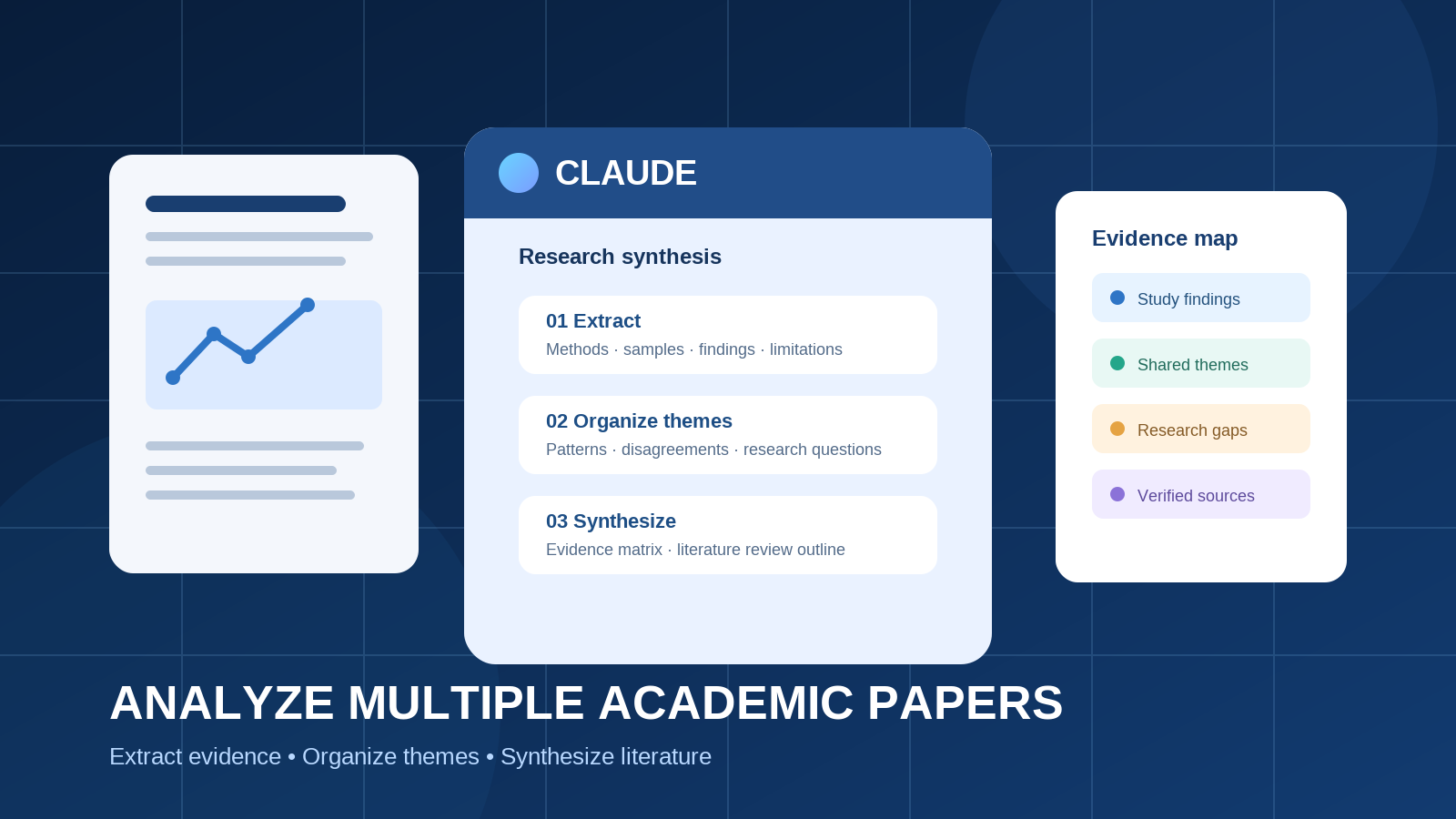
Analyzing a group of academic papers is not simply a matter of asking an AI assistant to summarize every PDF. A useful literature review requires consistent extraction, careful grouping, attention to differences in methods, and a synthesis that explains what the collection says as a whole.
Claude can help turn a folder of research papers into an organized analysis. You can upload PDFs in a chat or keep a continuing collection in a Claude Project, ask it to extract the same information from each study, organize findings by theme, and draft a synthesis that remains traceable to the original sources.
This guide focuses on a collection-wide workflow: moving from a pile of papers to a structured literature review. It is different from simply comparing two papers side by side. The objective is to identify patterns across a research corpus while preserving the evidence and limitations of individual studies.
What Claude can do with multiple academic papers
When you provide readable papers and a clear research question, Claude can help you:
- Create an inventory of the papers and their bibliographic details.
- Extract research questions, methods, samples, datasets, results, and limitations in a consistent format.
- Group studies into recurring themes or research approaches.
- Identify findings that converge, diverge, or appear to depend on different conditions.
- Highlight under-researched populations, methods, outcomes, or questions.
- Build a literature review matrix and a structured synthesis outline.
- Find passages that need human verification before they are cited.
Claude’s output is only as reliable as the files, instructions, and context it receives. Treat it as a research assistant for organizing and synthesizing evidence—not as a replacement for reading the papers or making scholarly judgments.
Step 1: Define the research question before uploading everything
Start with a specific question. A broad topic such as “artificial intelligence in education” may produce summaries that are too general to be useful. A more focused question might be:
- How do generative AI tutors affect students’ problem-solving performance?
- Which methods have researchers used to measure AI-assisted learning?
- What evidence exists about long-term retention after using AI study tools?
- What factors explain differences in results between classroom and laboratory studies?
Write down the scope before you begin. Include the topic, population, date range, outcomes, and any study types you want to include or exclude.
Prompt to establish the scope:
I am conducting a literature review about [research topic].

Research question:
[Write the specific question.]

Scope:
- Population or context: [define]
- Outcomes of interest: [define]
- Publication period: [define]
- Study types to include: [define]
- Exclusions: [define]

Before analyzing the uploaded papers, restate this scope as clear inclusion and exclusion criteria. Do not invent criteria that I have not provided. Ask me to confirm or revise them.
This prevents the analysis from drifting into papers that are related to the topic but do not answer your actual research question.
Step 2: Upload the papers in a manageable collection
For a one-time review, start a Claude chat and attach the papers using the file-upload control. For an ongoing literature review, a Claude Project can keep the documents and research instructions available across related conversations.
Anthropic’s documentation lists PDF and several text-based document formats among supported uploads. The exact file, page, size, and context limits can change, so check the current Claude file-upload guidance before preparing a large collection.
For PDFs, visual handling matters. Anthropic documents that supported models can interpret text and visual elements in PDFs of up to 100 pages, while longer PDFs may be processed as text only. If figures, charts, or scanned tables are central to your analysis, check that Claude can actually read them; OCR quality and document structure can affect extraction.
Use descriptive filenames when possible, such as:
2024-Smith-AI-tutoring-learning-outcomes.pdf2023-Jones-student-feedback-study.pdf2025-Lee-generative-AI-classroom-review.pdf
If you have a very large collection, do not assume that uploading every paper at once guarantees equal attention to every document. Work in batches, keep a source inventory, and ask Claude to state which files it used in each analysis.
Step 3: Ask Claude to create a paper inventory
Before requesting summaries, verify that Claude recognizes the files correctly. Ask it to create a source register containing each paper’s title, authors, year, journal or conference, DOI if present, and the filename.
Review the files attached to this conversation.

Create a source inventory with one row per paper:
1. File name
2. Full title
3. Authors
4. Publication year
5. Journal, conference, or publisher
6. DOI or stable URL, if stated in the file
7. Paper type (empirical study, review, theoretical paper, protocol, or other)
8. Relevance to my research question (high, medium, or low)
9. A short reason for the relevance rating

Use only information present in the files. Mark missing details as "not stated" rather than guessing.

At the end, list any files you could not read or identify reliably. Do not begin the synthesis yet.
Check this inventory against the papers’ title pages and DOI records. Correct any mistakes before using the collection for further analysis. This small verification step can prevent a wrong author, year, or title from propagating through your literature review.
Step 4: Extract the same fields from every paper
The most useful multi-paper analysis begins with a consistent extraction template. If Claude summarizes each paper in a different format, it becomes difficult to synthesize the collection.
Ask it to extract the following fields for each study:
| Field | What to record |
|---|---|
| Research objective | The question or hypothesis the paper investigates |
| Study design | Experimental, observational, qualitative, mixed methods, review, or other |
| Population or sample | Participants, setting, size, and selection criteria |
| Data or materials | Dataset, instruments, sources, or intervention |
| Method | Analysis technique, procedure, model, or framework |
| Main findings | Results directly relevant to your research question |
| Outcomes and measures | How outcomes were defined and measured |
| Limitations | Limitations stated by the authors |
| Future research | Recommendations or unanswered questions identified by the paper |
| Evidence location | Page, section, table, figure, or other locator |
Extraction prompt:
Analyze each paper separately using the same template.

For every paper, extract:
- Research objective or hypothesis
- Study design and methodology
- Population, sample size, and setting
- Data sources, instruments, or intervention
- Main findings relevant to my research question
- Outcome measures
- Limitations stated by the authors
- Future research recommendations
- Relevant page or section references

Use concise, factual notes. Distinguish the authors' statements from your interpretation. If a field is missing, write "not reported." Do not infer sample sizes, results, or limitations.

Return one structured record per paper. Do not combine the papers at this stage.
Review a few records in detail before continuing. If the extraction template is working, ask Claude to apply it to the remaining papers in the collection or the next batch.
Step 5: Organize the papers into research themes
Once the individual records are complete, ask Claude to group the papers by themes that emerge from the evidence. The themes should not be imposed merely because they sound convenient.
Possible grouping dimensions include:
- Research questions or objectives.
- Theoretical frameworks.
- Study populations or settings.
- Methods and research designs.
- Types of intervention or technology.
- Outcomes and measurement approaches.
- Findings that agree or conflict.
Use this prompt:
Using the paper-level extraction records—not general knowledge—organize the studies into a thematic map.

For each proposed theme:
1. Give the theme a descriptive name.
2. Explain why the papers belong together.
3. List the paper titles or source IDs included.
4. Identify the common question, method, population, or finding.
5. Note any paper that fits more than one theme.
6. Flag themes supported by only one paper.

Do not force every paper into a single theme. Explain overlaps and uncertain classifications.
A thematic map is a starting point, not a final academic taxonomy. You may need to merge themes, rename them, or separate a broad category into smaller groups after reading the papers.
Step 6: Synthesize findings across the entire collection
Now ask Claude to move beyond paper-by-paper summaries. A literature review synthesis should explain what the papers collectively show, how strong or consistent the evidence is, and why results may differ.
Ask for four types of synthesis:
Areas of convergence
Identify findings that multiple studies support. Record which papers support each pattern and whether their methods and populations are sufficiently similar to justify treating them as a common result.
Areas of disagreement
Identify conflicting or mixed results. Ask Claude to investigate whether differences could relate to study design, sample characteristics, intervention duration, outcome definitions, measurement tools, or context.
Methodological patterns
Summarize which methods dominate the collection, which populations or settings are underrepresented, and whether the field relies heavily on particular datasets, measures, or research designs.
Evidence strength and uncertainty
Separate repeated findings from preliminary observations. A result reported by several small studies is not necessarily strong evidence, and the number of papers alone does not establish quality.
Synthesis prompt:
Synthesize the extracted records across the full paper collection.

Organize the synthesis into:
1. Findings that converge across multiple studies
2. Findings that conflict or remain mixed
3. Methodological patterns and differences
4. Populations, settings, or outcomes that are underrepresented
5. Important limitations affecting the strength of the evidence
6. Questions that the current collection cannot answer

For every substantive statement, identify the paper IDs or titles that support it. Explain possible reasons for disagreement only when the source records provide evidence for those explanations. Clearly label hypotheses as hypotheses.

Do not write a generic overview. Make the synthesis specific to the uploaded papers and research question.
Step 7: Build a literature review matrix
A matrix makes the analysis easier to check and use when writing. Ask Claude to produce a table with one paper per row, then a separate thematic synthesis table.
A useful paper-level matrix might include:
| Paper | Method | Sample or context | Main finding | Limitations | Theme | |—|—|—|—|—|
A theme-level matrix can use:
| Theme | Supporting papers | Shared finding | Conflicting evidence | Confidence or caveat | |—|—|—|—|—|
If the table is large, ask Claude to create a downloadable spreadsheet or divide the matrix into manageable sections. Check the output for missing rows and ensure that every paper in the source inventory appears somewhere in the matrix.
For a deeper evidence-tracking process, see our guide to extracting evidence from a collection of documents with Claude.
Step 8: Ask Claude to identify potential research gaps
Research gaps should be derived from the analyzed papers, not generated from generic statements such as “more research is needed.”
Ask Claude to look for specific gaps, including:
- Populations that have not been studied or are represented by very small samples.
- Outcomes that are rarely measured.
- Short study durations where long-term effects remain unknown.
- Methods that dominate the field and alternative approaches that are missing.
- Contradictory findings that have not been adequately explained.
- Questions raised by authors but not addressed by the reviewed studies.
- Contexts in which evidence is not yet transferable.
Based only on the reviewed papers, identify candidate research gaps.

For each gap:
- Describe the missing evidence precisely.
- Explain which papers reveal the gap.
- Distinguish a gap explicitly stated by an author from one inferred from the collection.
- Explain why the gap matters to the research question.
- Suggest a research question that could address it.
- State what additional literature or evidence would be needed to confirm that the gap is genuine.

Do not claim that a topic has never been studied unless the reviewed collection and an additional search support that claim.
Claude can identify gaps within the collection you provide. It cannot establish that a gap exists across the entire literature unless the search itself is comprehensive and properly documented.
Step 9: Draft the literature review section by section
Do not ask Claude to write the entire literature review from the extraction table in one step. Draft by theme, with evidence and citations checked before moving to the next section.
A practical outline is:
- Introduction and scope of the literature.
- Theme one: major findings and approaches.
- Theme two: contrasting methods or results.
- Theme three: emerging evidence or underrepresented contexts.
- Cross-theme synthesis.
- Methodological limitations in the literature.
- Research gaps and implications for the current study.
Drafting prompt:
Draft the [section name] of my literature review using the verified synthesis table.

Requirements:
- Use an academic tone and coherent transitions.
- Synthesize papers by theme rather than listing one summary after another.
- Attribute findings to the relevant authors and year.
- Use only references present in the source inventory.
- Do not invent quotations, page numbers, DOI links, or bibliographic details.
- Preserve disagreements and methodological limitations.
- Mark any citation or claim that still requires verification.
- End with a transition explaining how this section connects to the next theme.
The draft is a writing aid. Verify each citation and ensure the wording accurately reflects the paper before using it in academic work.
Step 10: Verify the synthesis against the original papers
This is the most important quality-control step. AI-generated summaries can omit qualifications, misread tables, confuse correlation with causation, or attach a finding to the wrong study.
Use a verification pass:
- Select every important claim in the synthesis.
- Ask Claude to locate the supporting paper and passage.
- Open the cited paper yourself.
- Check the page, section, table, or figure.
- Confirm that the claim is not stronger than the authors’ conclusion.
- Record any correction in your matrix.
- Re-run the synthesis after correcting the source records.
You can prompt Claude to create a claim-check table:
Audit the draft synthesis against the uploaded papers.

For each substantive claim, return:
- Claim ID
- Exact claim from the draft
- Supporting paper(s)
- Relevant page, section, table, or figure
- Short source passage, if available
- Whether the source directly supports the claim
- Any qualification or correction needed

Mark claims as:
- Directly supported
- Partially supported
- Unsupported in the reviewed files
- Contradicted by the reviewed files

Do not repair unsupported claims by guessing. List them for human review.
Keep the final reference list separate and use a citation manager or verified publisher/DOI records to confirm bibliographic information.
Common mistakes when analyzing many papers with Claude
Asking for one giant summary
A single summary may hide important differences between papers. Use paper-level extraction first, then thematic synthesis.
Uploading papers without a defined research question
Without a scope, Claude may include tangential information or produce an overview that is too broad to support a literature review.
Treating a theme as a finding
A group of papers may share a topic without reaching the same conclusion. A theme should describe the shared analytical focus, while findings should remain tied to the individual evidence.
Accepting research gaps without checking the wider literature
A gap in your uploaded collection is not necessarily a gap in the field. Confirm potential gaps with a documented literature search.
Using citations that have not been checked
A paper title or author-year citation generated by Claude is not proof that the cited source supports the sentence. Verify the source and the passage.
Ignoring negative or null findings
Do not focus only on positive results. Null, mixed, and contradictory findings may be central to a balanced synthesis.
Failing to preserve source traceability
Keep paper IDs, filenames, page references, and evidence notes in the matrix. This makes the synthesis easier to audit and revise.
A reusable prompt for analyzing a full paper collection
Use this prompt after you have uploaded and inventoried the papers:
You are assisting with a scholarly literature review. Analyze the uploaded academic papers using a source-grounded workflow.

Research question:
[Insert question]

Scope and inclusion criteria:
[Insert criteria]

Phase 1 — Inventory:
List every file and identify its bibliographic details. Flag unreadable or incomplete files.

Phase 2 — Extraction:
For each paper, extract its objective, design, population, sample, data, methods, outcomes, main findings, limitations, future research suggestions, and source locations. Use the same fields for every paper. Do not guess missing details.

Phase 3 — Thematic organization:
Group papers into themes based on the extracted evidence. List the papers supporting each theme and explain overlaps.

Phase 4 — Synthesis:
Identify convergence, disagreement, methodological patterns, underrepresented areas, and evidence limitations. Cite paper IDs or titles for each substantive point.

Phase 5 — Research gaps:
Suggest candidate gaps, distinguishing those explicitly identified by authors from those inferred from the collection. Do not claim the gaps are definitive without a broader search.

Phase 6 — Review outline:
Create a literature review outline that follows the themes and evidence—not a paper-by-paper summary.

Phase 7 — Verification:
Create a table of important synthesis claims and their source papers, page or section references, and verification status.

Work in stages. Do not skip ahead, invent references, or treat your own interpretation as a source fact.
When should you use a Claude Project?
If your paper collection will grow or you plan to revisit it, a Project can make the workflow more manageable. Projects provide a workspace with a knowledge base and project instructions, allowing related chats to draw on the same research context. Anthropic’s Projects documentation explains how this works, while its RAG for Projects guide describes how larger knowledge bases can use retrieval.
For a focused task, a regular chat may be simpler. For an ongoing dissertation, thesis, or systematic review, a Project can help you keep the collection, scope, and analytical instructions together.
You may also find these related guides useful:
- How to Use Claude to Compare Multiple Research Papers — focused paper-to-paper comparison and study matrices.
- How to Use Claude Projects to Organize University Research — create a persistent workspace for academic documents.
- How to Use Claude to Extract Evidence from a Collection of Documents — create traceable records with source passages and locations.
- How to Use Claude to Analyze a Long Technical Report — structure the analysis of a single lengthy document.
- How to Use NotebookLM for Research — another AI-assisted research workflow.
Frequently asked questions
Can Claude read several academic PDFs at the same time?
Yes, Claude can analyze multiple uploaded documents in one conversation, subject to the current file, context, and account limits. For a large collection, use batches or a Project and verify which sources were included in each response.
Can Claude write a literature review from multiple papers?
Claude can help create an outline and draft thematic sections from extracted evidence. You should verify every claim, citation, and interpretation against the original papers and follow your institution’s AI-use policy.
Can Claude identify research gaps?
It can identify potential gaps within the papers you provide, such as underrepresented populations, missing outcomes, limited methods, or unresolved contradictions. Confirm any claim that a gap exists across the wider literature with an additional search.
Is Claude better at analyzing papers individually or together?
Use both stages. Individual extraction preserves each paper’s details and limitations. Collection-wide synthesis then reveals themes and patterns that are difficult to see when reading each paper separately.
Should I use a chat or Claude Project?
Use a chat for a small, one-time collection. Use a Project when you need a persistent research workspace, shared instructions, and access to the same papers across multiple conversations.
Final takeaway
The most reliable way to use Claude to analyze multiple academic papers is to separate the work into stages: define the research question, inventory the sources, extract consistent details from each paper, organize themes, synthesize the evidence, identify candidate gaps, draft by theme, and verify claims against the original sources.
This approach makes Claude useful for accelerating the organization and synthesis of academic research without surrendering the scholarly judgment that a literature review requires.