
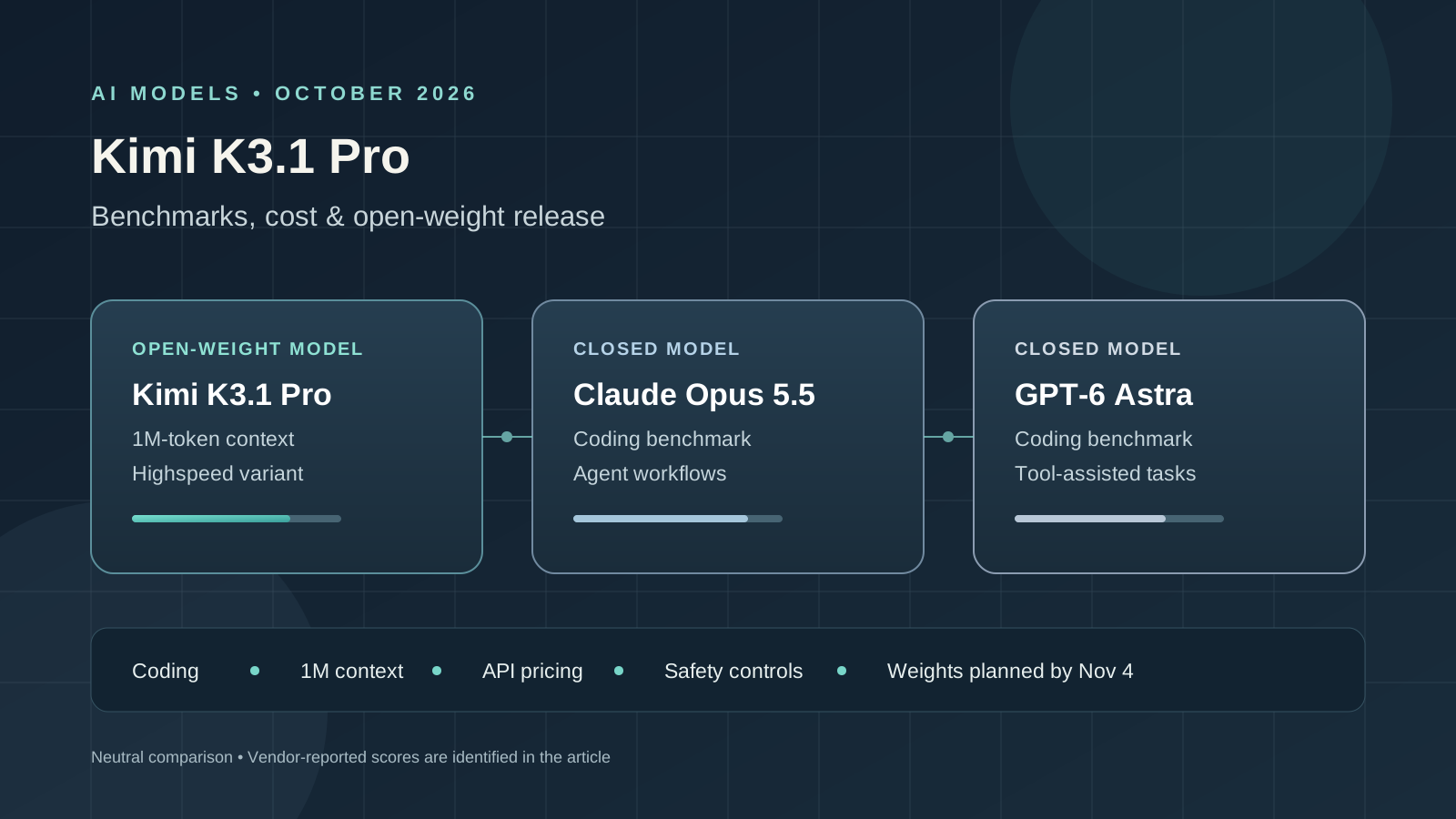
Moonshot AI introduced Kimi K3.1 Pro on October 24, 2026, alongside a faster variant called Kimi K3.1 Pro Highspeed. The company positions the model for coding, long-horizon agent tasks, 3D creation, and financial research. It advertises a one-million-token context window and says the full model weights are planned for release by November 4, 2026. Until those files and their licence are actually published, developers should treat the open-weight release as announced rather than already available. See the official Kimi K3.1 Pro technical announcement.
This guide compares the published information about Kimi K3.1 Pro with Claude Opus 5.5 and GPT-6 Astra, focusing on coding benchmarks, context length, API pricing, access, and safety claims. It does not present Articles About AI’s own benchmark results: the scores below are attributed to Moonshot or to the independent sources identified in the article.
Kimi K3.1 Pro at a glance
Kimi K3.1 Pro is a post-trained version of Kimi K3, according to Moonshot, with additional post-training compute and work on long-context inference and agent workflows. The company also released K3.1 Pro Highspeed, which it says delivers roughly two to three times the speed of the standard model. That speed figure is a vendor claim; real throughput depends on workload, service conditions, and how speed is measured.
The official announcement says the models are available through Kimi.com, Kimi Work, Kimi Code, and the Kimi API. Kimi Enterprise access is off by default at launch and must be enabled by an administrator. The model’s full weights are planned for release by November 4. The release announcement does not by itself establish the final licence, local hardware requirements, or whether every API feature will be available in the downloadable version.
Kimi K3.1 Pro vs Claude Opus 5.5 vs GPT-6 Astra
The most concrete headline comparison in Moonshot’s launch report is Terminal-Bench 4.0, a benchmark for coding agents working through terminal-based tasks with task-specific tests.
| Model | Terminal-Bench 4.0 score reported by Moonshot |
|---|---|
| Claude Opus 5.5 | 66.4% |
| Kimi K3.1 Pro | 65.7% |
| GPT-6 Astra | 58.2% |
On these published figures, Kimi K3.1 Pro is 0.7 percentage points behind Claude Opus 5.5 and 7.5 points ahead of GPT-6 Astra. This is not proof that Kimi is the second-best coding model in every setting. Moonshot says it tested Kimi with the Claude Code harness and took rival scores from the maximum values reported in model blogs or the official benchmark leaderboard. Differences in harnesses, tool access, prompts, model settings, and fallback behavior can affect comparisons.
Moonshot also reports 61.2% on its internal Kimi Code Bench 3.0 Long-horizon benchmark, up from 55.95% for Kimi K3. Because this is a company-developed benchmark, the result is useful as a reported comparison with its predecessor, but it is not an independent cross-vendor ranking.
For context on how coding tests can differ, read our related coverage: Claude vs ChatGPT for Coding and Claude Opus 5.5 vs GPT-6 Astra for Coding. For broader rankings and methodology, see Best AI Models in 2026: Benchmark Rankings Explained.
A one-million-token context window
Moonshot advertises a 1-million-token context window for Kimi K3.1 Pro. A long context can help an assistant work across large codebases, long technical documents, multi-file projects, or extended research materials without splitting everything into many separate prompts.
A large context limit is not the same as guaranteed perfect recall. Results still depend on retrieval quality, attention to relevant passages, prompt structure, tool use, and task complexity. It is also important to distinguish the model’s advertised context capacity from what a particular plan or API configuration actually permits. Verify the limits shown for the product or endpoint you intend to use.
If your main concern is whether an open model is more suitable for deployment than a hosted model, our guide to Open-Weight vs. Closed AI Models in 2026 explains the trade-offs around access, control, and responsibility.
Official API pricing: standard vs Highspeed
Moonshot’s official API platform lists the following prices for Kimi K3.1 Pro and Kimi K3.1 Pro Highspeed. The figures below are displayed in Chinese yuan (CNY) per million tokens on the official platform; check the live price page before budgeting because prices and billing terms can change.
| API model | Input, per 1M tokens | Output, per 1M tokens | Cached input hit, per 1M tokens |
|---|---|---|---|
| Kimi K3.1 Pro | ¥13.00 | ¥68.00 | ¥1.30 |
| Kimi K3.1 Pro Highspeed | ¥26.00 | ¥136.00 | ¥1.30 |
Source: official Kimi API platform. The page also lists cached-input writing separately; developers should check the current billing rules, cache duration, and any applicable usage conditions. Highspeed has higher listed input and output rates, so the advertised speed increase should be weighed against actual latency and token consumption in your own workload.
Do not compare API prices using input tokens alone. Agentic coding tasks can generate substantial output, tool calls, and repeated context. A meaningful cost comparison should use the same task set and count all billed input, output, cached tokens, retries, and any separate tool charges. We have not run a cost-per-completed-task test for this article.
Coding, 3D creation, and financial research
Moonshot highlights several capabilities beyond code completion:
- Long-horizon coding: multi-step work involving tools, debugging, and end-to-end engineering tasks.
- 3D modeling: the company reports 92.7% on BenchCAD with tools, compared with 96.2% for Claude Opus 5.5 and 95.9% for GPT-6 Astra in its reported table.
- Financial document analysis: Moonshot reports 64.4 on OfficeQA Pro v2 and improvements on its internal finance benchmarks.
- Factuality stress testing: Moonshot says Kimi K3.1 Pro’s claim-level hallucination rate fell to 8.3%, from 23.4% for Kimi K3, on its internal Kimi Hallu Bench Hard test.
These figures need context. BenchCAD results with tools depend on the tool environment and evaluation setup. OfficeQA Pro v2 is a specific benchmark, not a guarantee of financial accuracy. The hallucination figures come from an internal stress test designed to probe difficult cases; Moonshot explicitly says those rates do not represent the model’s overall factual error rate in everyday use.
For real-world selection, test the model on representative tasks and measure completion rate, review time, error severity, latency, and total cost. For additional context, see our AI model benchmark rankings guide.
Cybersecurity safeguards and the open-weight decision
The most consequential part of this release may be Moonshot’s explanation of how it reduced cyber-offensive capability before the planned weights release. The company says it removed cyber-related material from training data and reinforcement-learning environments while preserving general coding usefulness.
On Moonshot’s internal xdev-bench-hard evaluation, a checkpoint without those risk-reduction measures scored 90.5% pass@3, while the final Kimi K3.1 Pro scored 81.0%. Moonshot says the test includes source-code-based vulnerability discovery and exploitation tasks. These results have not been independently verified, as Reuters reported on October 24.
The distinction matters because downloadable model weights are different from access through a hosted API. Once weights are widely distributed, the original developer has less ability to revoke access, monitor use, or apply new safeguards centrally. At the same time, open weights can help security teams inspect software and run analysis on infrastructure they control. The benefits and risks depend on the model, its licence, the deployment environment, and the controls implemented by the operator.
Read the independent reporting from Reuters on Moonshot’s cybersecurity controls and planned release. For this story, distinguish Moonshot’s own benchmark claims from independent verification; do not treat the score reduction as proof that all misuse risks have been removed.
When should developers choose Kimi K3.1 Pro?
Kimi K3.1 Pro is worth evaluating if you need long-context coding, multi-step tool use, or a model that may become downloadable for self-managed deployment. Its listed API pricing may also make it attractive for workloads that benefit from a large context window, but the actual economics depend on output volume, caching, and task success.
Claude Opus 5.5 remains a relevant comparison for coding-agent workflows: on Moonshot’s reported Terminal-Bench 4.0 figures, Claude is slightly ahead. GPT-6 Astra is another useful reference point, but its relative performance changes by benchmark and task. No single score settles the choice.
Before adopting any model, run a small controlled evaluation:
- Select real tasks from your codebase or workflow.
- Use comparable prompts, tool permissions, context, and time limits.
- Record successful completion, correctness, retries, review time, latency, and total API cost.
- Repeat tasks when outputs vary and document the exact model version.
- For a local deployment, wait for the actual weight files and licence, then verify hardware needs, quantization options, security posture, and operational cost.
We have not independently benchmarked these models for this article. The comparisons above summarize published figures and explain their limitations.
Open-weight release date: what is confirmed?
As of October 24, 2026, Moonshot says the full Kimi K3.1 Pro weights will be released by November 4, 2026. That is a planned release window, not confirmation that the weights can already be downloaded. The final repository, licence terms, file formats, and system requirements should be checked when the company publishes them.
The service and API availability announced by Moonshot should not be confused with local self-hosting. Until the weights are publicly available under a clear licence, developers should not assume they can run K3.1 Pro on their own hardware or redistribute a modified version.
Verdict
Kimi K3.1 Pro is a significant model release to watch, especially for coding agents, long-context workflows, 3D modeling, and developers interested in future open-weight deployment. Moonshot’s published Terminal-Bench result places it close to Claude Opus 5.5 in that particular evaluation, while the official API page provides concrete prices for the standard and Highspeed variants.
The right conclusion is measured rather than absolute: benchmark results depend on setup, vendor-reported figures need independent replication, and the promised weights and licence are not yet available as of October 24. Evaluate the model against your own tasks and revisit the open-weight option after the release.
Sources and further reading
- Moonshot AI: Kimi K3.1 Pro technical announcement
- Kimi API platform and current model pricing
- Reuters: Moonshot curbs hacking ability in new Kimi model
- Claude vs ChatGPT for Coding
- Claude Opus 5.5 vs GPT-6 Astra for Coding
- Open-Weight vs. Closed AI Models in 2026
- Best AI Models in 2026: Benchmark Rankings Explained